

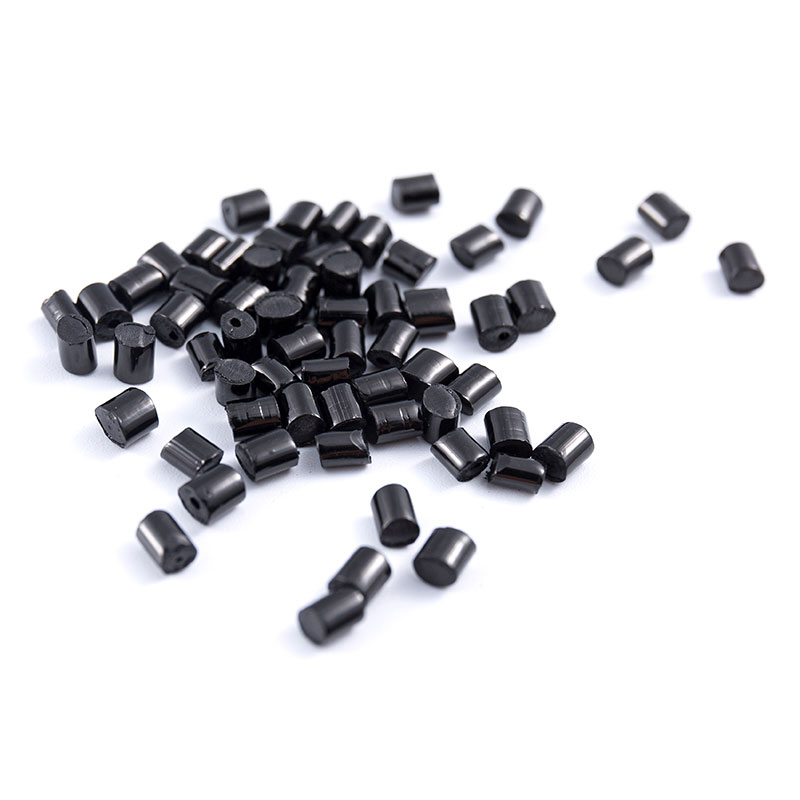

Uniformly Dispersed High Gloss Black Masterbatch Wholesale

Home / Products / Automotive Black Masterbatch / Automotive Exterior Parts Black Masterbatch / Uniformly Dispersed High Gloss Black Masterbatch

Uniformly Dispersed High Gloss Black Masterbatch

Uniformly Dispersed High Gloss Black Masterbatch

This black masterbatch is suitable for toughening and modifying engineering plastics such as ABS, PS, and PC, providing uniform and stable coloring during high-gloss injection molding and modification processes. The product utilizes highly dispersible carbon black as a colorant, ensuring uniform color distribution during material mixing and injection molding, avoiding localized color inconsistencies or precipitation, while maintaining a bluish-black color and meeting the aesthetic requirements of high-gloss plastic products.
The masterbatch's formulation combines UV and high-temperature resistance, enhancing the material's weatherability and structural stability over long-term use. Its excellent compatibility with the carrier material ensures that the toughening agent's performance is not affected during processing, while also improving the overall product's performance stability and achieving a more balanced balance between impact resistance and heat resistance.

Parameter

Nature Value/Unit Test Method
Carrier PC 600°C Oxygen Barrier Test
Carbon black 36% GB/T 13021-1991
Ash content 0 GB/T 9345.1-2008
Compatibility PC Simulated Production Process
Density 1.28 (g/cm³) GB/T 1033.1-2008
Melt flow index 56 g/10 min (300°C, 1.2 kg) GB/T 3682-2000
Moisture content 0.18% GB/T 6284-2006
Particle appearance Uniform cylindrical particles (water-drawn strands) Visual Inspection Method
Colour difference value L: 27.6±0.1
A: -0.05±0.05
B: -1.16±0.1
PC Grade L-1225Y
2% Masterbatch Added for Injection Moulding
Environmental protection RoHS Bromine = ND Lead = ND Cadmium = ND Chromium = ND Mercury = ND RoHS (6 Substances)
PAHs Benzo[a]pyrene < 20
Total < 200
EN 16143:2013
Exterior Parts · PC Carrier · 36% Carbon Black

Piano-Black Exterior Trim Lives or Dies on Dispersion

A high-gloss grille surround or mirror cap has nowhere to hide a flaw. Unlike a textured or matte panel, a Class-A gloss surface reflects light straight back at the viewer, so even a single fisheye or a faint speck from poorly dispersed carbon black becomes visible from arm's length. This grade uses a PC carrier loaded with 36% carbon black, built specifically to disperse cleanly through ABS, PS and PC without leaving the specking or localized dullness that undermines a mirror-like finish.

Gloss is only useful if it survives the vehicle's service life. Exterior trim sits directly under UV exposure, temperature swings and years of weathering, so the formulation also carries UV and high-temperature resistance intended to slow gloss loss and color drift compared with a masterbatch built only for indoor, short-life applications.

Relative gloss retention — illustrative comparison
Standard black masterbatchBaseline
This high-gloss gradeHigher & more even
For directional comparison only; actual gloss units depend on host resin, mold surface finish and processing parameters.

Where This Grade Is Actually Used

01

Radiator Grille & Front Fascia Trim

Large visible surfaces where any batch-to-batch color shift would be obvious under showroom lighting.

02

Side Mirror Caps & Window Trim

Compact, high-visibility parts that demand a defect-free, mirror-like surface at close inspection distance.

03

Roof Rails & Body Cladding

Long exterior runs exposed to continuous UV and weathering across the vehicle's full service life.

04

Spoilers & Exterior Badging

Sculpted geometries where flow marks or fisheyes are especially easy to spot along curved surfaces.

Certified Performance Data

Property Value / Unit Test Method
Carrier resin PC 600°C Oxygen Barrier Test
Carbon black content 36% GB/T 13021-1991
Ash content 0% GB/T 9345.1-2008
Density 1.28 g/cm³ GB/T 1033.1-2008
Melt flow index 56 g/10 min (300°C, 1.2 kg) GB/T 3682-2000
Moisture content 0.18% GB/T 6284-2006
Environmental compliance RoHS 6 substances — all non-detect RoHS (6 Substances)
PAHs Benzo[a]pyrene < 20 · Total < 200 EN 16143:2013

How Gloss and Color Are Kept Repeatable

Weathering Simulation

Formulated with UV and high-temperature resistance to slow gloss loss under long-term outdoor exposure.

Colorimetric Verification

Batches checked against L, A, B color targets (e.g. L 27.6±0.1) to keep tone consistent across production runs.

RoHS & PAH Screening

Every formulation is screened for the 6 RoHS substances and PAH limits before release for exterior use.

Melt Flow Matching

Melt index matched to Class-A injection tooling to avoid flow marks on large, visible panel surfaces.

The Engineering Behind the Reflection

Gloss is essentially a measurement of how much incoming light reflects back at a fixed angle instead of scattering. Every micro-agglomerate of poorly dispersed carbon black scatters a small amount of that light, which is what turns a true piano-black surface into something that looks slightly cloudy or speckled under direct light. At 36% carbon black in a PC carrier, this grade is compounded to keep particle dispersion fine and even through the full injection cycle, so the reflected image off the molded surface stays sharp rather than diffused.

Carbon black content
36%
Balanced for deep black coverage without overloading the PC carrier
Density
1.28 g/cm³
Consistent with GB/T 1033.1-2008, supporting predictable dosing by weight
Ash content
0%
Minimizes residual particulate that could otherwise dull surface reflection

Recommended Processing Parameters

Class-A gloss surfaces are especially sensitive to process drift, so these starting points are meant to protect surface finish rather than just throughput. Fine-tune against the specific tool, gate design and host resin grade in production.

Process Parameter Guideline Why It Matters
Pre-drying PC-based systems typically need 2–4 hours at 100–120°C Residual moisture causes splay marks that are highly visible on a glossy surface
Melt temperature Matched to host resin's standard high-gloss window Keeps carbon black dispersion stable without degrading gloss-critical surface layers
Mold temperature Run toward the higher end of the tool's rated range A hotter mold surface improves melt replication of the polished cavity finish
Injection speed Fast fill with controlled packing pressure Reduces flow marks and weld lines that break up a continuous gloss surface
Dosage Tuned to part geometry and target gloss level Under-dosing leaves a slightly warm or uneven black; over-dosing wastes material without gain

Dosage & Host Resin Compatibility

Host Resin Typical Dosage Notes
PC 1.5–2.5% Native match to the carrier resin; typically the most straightforward letdown
ABS 2–3% Common for grille surrounds and cladding; verify gloss target with a trial shot
PS 1.5–2.5% Suitable for lower-stress exterior trim with moderate weathering exposure
PC/ABS blends 2–3% Widely used for mirror caps and badging where impact resistance and gloss both matter

Manufacturing Capability & Traceability

Batch-Level Testing

Carbon black content, density, melt flow and moisture verified on every production lot before release.

Colorimetric Records

L, A, B values logged per batch against a defined injection procedure to support cross-batch matching.

RoHS & PAH Screening

Each formulation is screened against RoHS's 6 substances and PAH limits before release for exterior use.

Trial Batch Support

Small trial quantities are available to validate gloss and color on the customer's own tooling first.

Packaging, Storage & Shelf Life

Standard Packaging

25kg per bag in kraft paper or PE bags; palletized packaging available on request for large orders.

Storage Conditions

Keep in a dry, cool warehouse away from direct sunlight and rain to protect pellet flow and gloss consistency.

Shelf Life

Best used within 12 months of production when stored under the recommended conditions.

Handling

Reseal opened bags promptly; moisture pickup before molding can show up as surface defects on gloss parts.

Common Questions From Exterior Parts Buyers

Why does carbon black dispersion matter more on gloss parts than textured ones?
A glossy surface reflects light directly instead of scattering it, so any poorly dispersed particle, fisheye or micro-agglomerate becomes visible to the eye. Fine, even dispersion is what keeps a piano-black surface looking like a single continuous reflection rather than a speckled one.
How is color consistency controlled between production batches?
Each batch is checked against target L, A, B colorimetric values under a defined molding procedure, so parts produced weeks or months apart can still match on the same vehicle without a visible tone shift.
Can this masterbatch handle long-term outdoor UV exposure?
The formulation combines UV and high-temperature resistance to support gloss and color stability across the kind of prolonged outdoor exposure exterior trim experiences over a vehicle's service life.
Is this product compliant with RoHS and PAH restrictions?
Yes. It has been screened against the 6 restricted substances under RoHS and tested for PAH content per EN 16143:2013, with results within reportable limits.
What dosage range works best for high-gloss injection molding?
Dosage should be tuned to the target opacity and gloss level for the specific part geometry; our technical team can recommend a starting point once the host resin and wall thickness are known, and refine it against a molding trial.
Can gloss level or carbon black content be customized outside the standard 36% grade?
Yes. Carbon black loading and carrier resin can be adjusted for a specific gloss target, host polymer, or part geometry, typically validated through a small trial batch before scaling to full production.
Will parts molded from different production batches still match on the same vehicle?
Batches are checked against target L, A, B colorimetric values under a consistent injection procedure specifically so that grille surrounds, mirror caps and trim strips molded months apart can still be assembled onto the same vehicle without a visible mismatch.
How long can this masterbatch be stored before use?
When kept in a dry, cool warehouse away from direct sunlight and moisture, the material is best used within 12 months of production to preserve gloss and dispersion performance.
Is a small trial quantity available before committing to a full production order?
Yes. A trial batch can be supplied so gloss level, color and dispersion can be validated on the customer's own tooling before moving to larger production volumes.

Building a Class-A exterior part where gloss and color stability can't drift between batches? Send us your host resin, part geometry and gloss target and our team can recommend a dosage range or prepare a molding trial before you scale to full production.

About Us
E-LUCK .
E-LUCK .

As China Uniformly Dispersed High Gloss Black Masterbatch Factory and China Uniformly Dispersed High Gloss Black Masterbatch Suppliers, E-LUCK is a professional manufacturer and solution provider specializing in black masterbatch for industrial applications. Since our founding, we have remained committed to the core values of precision, consistency, and material intelligence, integrating advanced dispersion technology with rigorous quality systems to meet the increasingly complex demands of modern polymer processing. From pipes and fittings to automotive parts, from consumer electronics to packaging films, our black masterbatches play a quiet yet critical role in enhancing product appearance, performance, and lifecycle for a wide range of downstream industries.

News

