

Low Volatile Environmentally Friendly Interior Black Masterbatch Wholesale

Home / Products / Automotive Black Masterbatch / Automotive Interior Parts Black Masterbatch / Low Volatile Environmentally Friendly Interior Black Masterbatch

Low Volatile Environmentally Friendly Interior Black Masterbatch

Low Volatile Environmentally Friendly Interior Black Masterbatch

This product is designed specifically for automotive and home interiors, emphasizing low VOC (volatile organic compound) emissions and low migration, effectively reducing potential contamination to skin and fabrics during use. The masterbatch utilizes highly dispersible carbon black to ensure uniform coloration in high-gloss or matte plastics such as ABS and PC, achieving a stable blue-black color while maintaining a consistent surface finish. Its excellent compatibility with various interior materials allows it to be processed to achieve matte, high-gloss, or suede finishes, meeting diverse design requirements.
During processing, the masterbatch can be directly mixed with the raw materials at low or high speeds. The recommended addition level is between 0.5% and 4%, which can be flexibly adjusted based on the desired performance and color of the final product. Its excellent processing stability at high temperatures makes it suitable for injection molding modification and high-gloss injection molding, ensuring surface gloss while maintaining heat resistance and structural stability.

Parameter

Nature Value/Unit Test Method
Carrier AS(SAN) 600°C Oxygen Barrier Test
Carbon black 40% GB/T 13021-1991
Ash content 0 GB/T 9345.1-2008
Compatibility ABS/PC Simulated Production Process
Density 1.25 (g/cm³) GB/T 1033.1-2008
Melt flow index 89.5g/10min (200℃,21.6KG) GB/T 3682-2000
Moisture content 0.19% GB/T 6284-2006
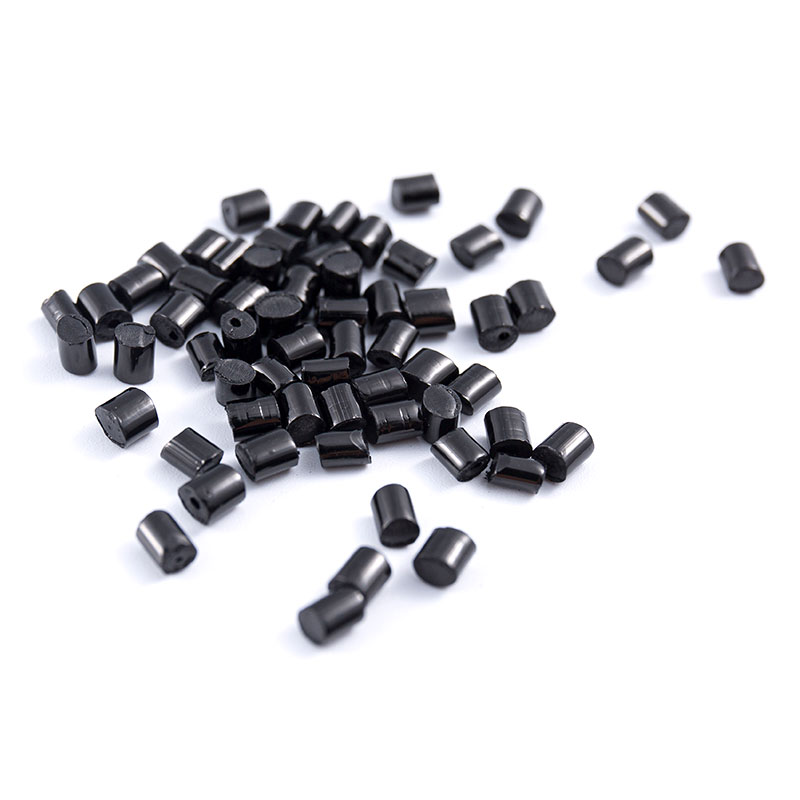
Particle appearance Uniform black round pellets Visual inspection method
Colour difference value L: 27.45±0.1
A: 0.04±0.05
B: -0.97±0.1
ABS Grade HI-121H
Add 2% masterbatch
Environmental protection RoHS Bromine = ND Lead = ND Cadmium = ND Chromium = ND Mercury = ND RoHS (6 Substances)
PAHs Benzo[a]pyrene < 20
Total < 200
EN 16143:2013
Automotive Interior Parts — Low VOC Series

Low Volatile Environmentally Friendly Interior Black Masterbatch — AS(SAN) Carrier

Compliance & Key Values
Carrier AS (SAN) ABS/PC-compatible engineering resin carrier
Carbon Black 40% GB/T 13021-1991
Ash Content 0 GB/T 9345.1-2008 — no mineral filler
MFI 89.5 g/10min · 200°C · 21.6kg
Moisture 0.19% GB/T 6284-2006
RoHS All 6 ND Br, Pb, Cd, Cr, Hg = Not Detected
PAHs EN 16143:2013 BaP <20 · Total <200 mg/kg

The automotive interior environment is unique in material specification: parts must pass both optical quality inspection (consistent gloss, uniform color, no surface defects) and chemical safety assessment (VOC emissions, heavy metal content, PAH contamination) simultaneously. Most black masterbatches address one or the other. This grade was formulated from the outset to satisfy both, with the compliance documentation — RoHS six-substance testing, PAH testing per EN 16143:2013 — built into the product specification rather than available as optional add-on testing.

The AS (SAN) carrier is the foundational specification choice for ABS and PC compatibility. SAN is the acrylonitrile-styrene copolymer component of ABS itself — using it as a carrier means the masterbatch carrier is chemically identical to the acrylonitrile-styrene matrix phase of the ABS base resin. The masterbatch integrates into ABS without creating a foreign polymer phase, preserving the precise balance of properties that interior-grade ABS compounds are formulated to deliver.

The MFI of 89.5 g/10min at 200°C/21.6kg reflects the SAN carrier's inherent flow behavior — significantly higher than PE-carrier equivalents — producing the uniform CB distribution across complex interior part geometries (instrument panels, door trims, pillar covers) that eliminates the weld-line color inconsistencies that are a common rejection cause in automotive interior QC.


Colorimetric Specification

Measured CIE L*A*B* Values — Automotive Interior Color Standard Reference

The following values are measured from injection-molded specimens using ABS grade HI-121H at 2% masterbatch addition. These define the precise color coordinates of this grade — allowing specification-to-specification color matching between production lots and between supply locations.

CIE L*A*B* Measured Values Base: ABS HI-121H · Dosage: 2% · Method: Injection Moulding
L* — Lightness
27.45
Tolerance: ±0.1
Deep black — L=0 absolute black, L=100 white
A* — Red/Green Axis
0.04
Tolerance: ±0.05
Neutral — no red or green bias. True achromatic black.
B* — Yellow/Blue Axis
−0.97
Tolerance: ±0.1
Cool blue-shifted — premium automotive interior tone

Technical Data Sheet

AS(SAN) Carrier Interior Grade — Complete Parameters

Parameter Value / Specification Test Method
Carrier AS (SAN) resin 600°C Oxygen Barrier — confirmed carrier identification
Carbon Black 40% GB/T 13021-1991
Ash Content 0 GB/T 9345.1-2008 — no mineral filler
Compatibility ABS / PC Simulated Production Process
Density 1.25 g/cm³ GB/T 1033.1-2008
Melt Flow Index 89.5 g/10min 200°C / 21.6kg · GB/T 3682-2000
Moisture Content 0.19% GB/T 6284-2006
Particle Appearance Uniform black round pellets Visual inspection
CIE L* 27.45 ± 0.1 ABS HI-121H + 2% MB injection
CIE A* 0.04 ± 0.05 ABS HI-121H + 2% MB injection
CIE B* −0.97 ± 0.1 ABS HI-121H + 2% MB injection
RoHS Bromine ND RoHS 6 Substances
RoHS Lead / Cd / Cr / Hg All ND RoHS 6 Substances
PAHs — Benzo[a]pyrene <20 mg/kg EN 16143:2013
PAHs — Total <200 mg/kg EN 16143:2013
Dosage 0.5%–4% Mixed directly at low or high speed

VOC Control

Why VOC and PAH Control Matters in Automotive Interior Material Specification

VOC
Volatile Organic Compounds

Automotive interior air quality is regulated by OEM specifications (BMW GS 97014, VW PV 3900, Toyota TSM 0505G) and national standards (China GB/T 27630, Germany VDA 278) that set emission limits for individual VOC species and total VOC from interior plastic parts. A masterbatch that introduces processing residues, low-molecular-weight oligomers, or solvent contamination into the ABS or PP compound can cause the finished interior part to fail headspace emissions testing — triggering rejection and rework at the part supplier level before parts even reach the OEM assembly line.

This masterbatch controls VOC at source through two mechanisms: the AS (SAN) carrier is a high-molecular-weight engineering resin with low inherent volatile content, and the manufacturing process uses controlled temperature profiles that minimize the formation of low-MW decomposition products during compounding. The 0.19% moisture content — the lowest in E-LUCK's automotive range — eliminates the main route by which moisture converts to formaldehyde and acetaldehyde at processing temperatures.

PAH (polycyclic aromatic hydrocarbon) contamination in carbon black is the second primary environmental concern for automotive interior masterbatch. Carbon black is produced by combustion processes that inherently generate PAH compounds; the PAH content of the finished masterbatch depends directly on the quality of the CB source and the purification steps applied during CB manufacturing.

EN 16143:2013 sets limits of <1 mg/kg for benzo[a]pyrene (the most potent carcinogenic PAH) and <10 mg/kg total PAH in articles in contact with the skin — limits adopted by multiple OEM specifications for interior parts. This masterbatch is tested to EN 16143:2013 at BaP <20 mg/kg and Total <200 mg/kg, which represents conformance at the article level when the masterbatch is used at 2% letdown (dilution factor of 50) in the finished part.

For interior parts requiring direct OEM PAH compliance documentation, provide your specific OEM PAH specification limit and finished part geometry — E-LUCK can provide a dilution calculation confirming the part-level PAH compliance based on masterbatch test data and your intended dosage rate.


Surface Finish

Three Automotive Interior Surface Finishes — One Masterbatch

Matte

Instrument Panels, Door Trims

At 1–2% dosage in matte-grade ABS (mold texture SPI C or D), the AS carrier's high MFI produces uniform CB distribution without over-concentration at the surface that would counteract the matte tooling effect. The <0.2% moisture prevents micro-surface roughness that can appear as inconsistent sheen in matte finishes under raking light.

High Gloss

Piano Black Trim, Bezels

At 1.5–2% in high-gloss ABS or ABS/PC blend (polished tool SPI A1/A2), the MFI 89.5 masterbatch phase wets the mold surface ahead of the base resin, establishing the uniform CB-rich skin layer that produces the deep, reflection-clear piano black surface required for premium interior trim. CIE L* of 27.45 defines this surface level quantitatively.

Suede / Soft-Touch

Soft-Feel Coated Panels

For ABS substrates receiving post-mold soft-touch coating, the masterbatch must not leave surface contamination that interferes with coating adhesion. The zero ash content (no CaCO₃ filler) and 0.19% moisture mean no inorganic residue or moisture outgassing at the substrate surface that would create delamination sites in soft-touch or PU coating systems.


FAQ

Automotive Interior Specification Questions

Why use an AS (SAN) carrier rather than ABS directly as the carrier for ABS-compatible masterbatch?+

SAN (AS) is the acrylonitrile-styrene copolymer component of ABS without the polybutadiene rubber phase. Using SAN rather than full ABS as a carrier provides two advantages in masterbatch production. First, SAN has a significantly lower melt viscosity than ABS at equivalent temperatures, which enables the high CB loading (40%) and the very high MFI (89.5) without requiring extreme shear that could degrade the carrier during masterbatch manufacture. ABS at 40% CB loading would be significantly harder to process to equivalent dispersion quality due to the rubber phase's effect on compound viscosity. Second, SAN is more thermally stable than ABS at the temperatures required to fully disperse 40% CB in the carrier — the absence of the polybutadiene rubber phase removes the main site of thermal oxidation that can generate volatile degradation products during masterbatch processing. The finished masterbatch, when added to ABS at 1–4%, introduces SAN carrier into an ABS matrix — a chemically compatible addition since SAN is one component of ABS itself.

How does this masterbatch perform in PC/ABS blend versus pure ABS?+

The masterbatch is validated for both ABS and PC (listed in the compatibility specification). In ABS/PC blends — the most common engineering material for automotive interior visible parts — the SAN carrier is compatible with both the ABS phase and the PC phase of the blend. SAN is partially miscible with PC at the elevated temperatures of injection processing (230–260°C), which facilitates rapid integration of the masterbatch into the blend melt. The CIE L*A*B* values provided (L=27.45, A=0.04, B=-0.97) are measured in ABS; values in ABS/PC blends will be similar but may show minor variation depending on PC content (typically ±0.3 L, ±0.1 A/B). For ABS/PC blend applications requiring tight color specification, request a color chip from E-LUCK produced in your specific blend ratio and PC grade.


OEM Interior Compliance — Full Documentation Available
Specify your OEM, interior part application, target finish, and relevant standards (RoHS, PAH, VOC, fogging). E-LUCK will provide compliance documentation applicable to your specific supply context.
About Us
E-LUCK .
E-LUCK .

As China Low Volatile Environmentally Friendly Interior Black Masterbatch Factory and China Low Volatile Environmentally Friendly Interior Black Masterbatch Suppliers, E-LUCK is a professional manufacturer and solution provider specializing in black masterbatch for industrial applications. Since our founding, we have remained committed to the core values of precision, consistency, and material intelligence, integrating advanced dispersion technology with rigorous quality systems to meet the increasingly complex demands of modern polymer processing. From pipes and fittings to automotive parts, from consumer electronics to packaging films, our black masterbatches play a quiet yet critical role in enhancing product appearance, performance, and lifecycle for a wide range of downstream industries.

News

