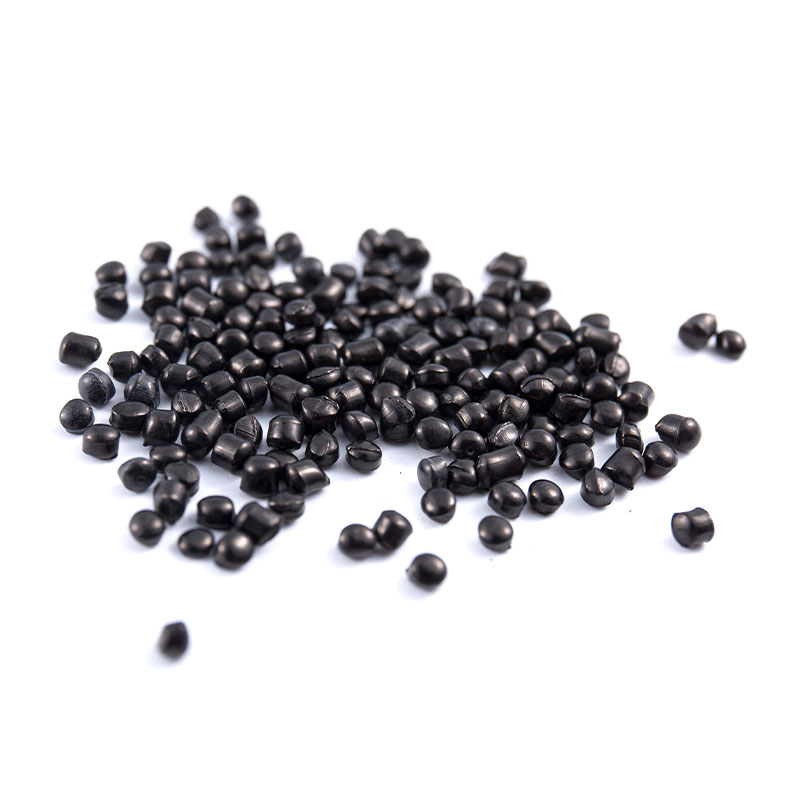
AM4018 is made of PE, carbon black with calcium carbonate filler. Carbon black concentration is around 40%. Applicable for FDA Food grade, film blowing, etc.
Technical Insight
Inside AM4018: Performance Data & Application Guide
A closer look at how this food-contact-oriented black masterbatch is formulated, tested and applied across light-sensitive food packaging film.
AM4018 is a PE-based black masterbatch built around a 40%±2 carbon black loading combined with a calcium carbonate filler. It is engineered to block visible light transmission through packaging film, helping preserve flavor, color and nutritional value in light-sensitive foods while keeping a stable, non-migrating black tone from batch to batch.
40%±2Carbon black loading for consistent opacity
1–3%Recommended letdown ratio
<19%Ash content for cleaner dispersion
<0.50%Moisture, limiting bubbles & streaking
What Goes Into AM4018
A light-shielding food masterbatch is more than "black pigment plus plastic" — the ratio and quality of each raw material directly decides whether the finished film looks fully opaque or shows faint pinholes of light under a bright shelf light. AM4018 is built from three functional components, each carrying its own role in the final film:
Carbon Black (≈40%±2)Primary pigment responsible for jetness and light absorption; particle fineness controls how completely visible light is blocked.
Calcium Carbonate FillerExtends the formulation cost-efficiently while helping maintain a smooth, even surface finish on thin film.
PE Carrier ResinCarries the pigment through the pellet and controls how well AM4018 melts and blends into the host film resin.
Dispersing AdditiveBreaks up carbon black agglomerates during compounding so pigment is spread evenly rather than clumped, which is what actually prevents pinhole light leaks.
In practice, it is this combination — not carbon black loading alone — that determines whether a film converter gets full, even opacity at low dosage or has to over-dose the masterbatch to compensate for uneven dispersion.
Performance Reference
| Property |
Common Test Reference |
Why It Matters for Packaging |
| Light Transmission |
Haze/transmittance style testing (ASTM D1003 category) |
Higher light blockage at 2%+ letdown reduces oxidation and nutrient loss in fat- or vitamin-sensitive foods |
| Melt Flow Rate |
ASTM D1238, 21.6kg/190°C |
Readings above 10g/10min support smooth, bubble-free blown-film processing |
| Density |
Density testing (ASTM D1505 category) |
Below 2.0g/cm³, in line with standard PE letdown calculations |
| Moisture |
Internal QC sampling |
Below 0.50%, reducing surface streak marks during extrusion |
Figures above describe typical formulation characteristics and commonly referenced industry test categories; actual film performance depends on base resin, film gauge and processing conditions, and should be confirmed through trial on the converter's own line.
Processing & Dosage Guide
AM4018 is compatible with LDPE, LLDPE and HDPE blown-film lines without special screw modification. The table below is a starting-point guide — actual dosage should be fine-tuned against the target film gauge and opacity requirement on the converter's own line.
| Film Gauge |
Suggested Dosage |
Expected Result |
| 0.02–0.03mm (ultra-thin) |
2–3% |
Full opacity achievable, but dispersion quality becomes more critical at this gauge |
| 0.03–0.05mm (standard packaging) |
1–2% |
Typical range for most snack, frozen and pouch film applications |
| 0.05mm and above (heavier gauge) |
0.8–1.5% |
Lower dosage often sufficient due to greater film thickness |
Recommended melt temperature range for blown-film processing is generally 170–210°C depending on base resin; excessive temperature or shear can affect pigment dispersion and should be avoided.
Where AM4018 Sits in the Product Line
| Grade |
Carbon Black Level |
Best Fit |
| AM4018 (this product) |
40%±2 |
Light-shielding food packaging film, lunch box liners |
| Standard Packaging Grade |
25–30% |
General non-food courier & shopping bag film |
| High-Opacity Barrier Grade |
45–50% |
Multi-layer barrier pouches requiring maximum light block |
Typical Applications
Foods with high fat, oil or vitamin content are particularly prone to light-driven quality loss — rancidity, discoloration and flavor drift can all accelerate under prolonged light exposure. Film built with AM4018 is commonly selected wherever a fully opaque, food-safe black layer is needed to slow this degradation without adding extra film thickness.
Frozen Food Bags Snack & Confectionery Pouches Pet Food Packaging Film Bakery & Bread Bags Dairy Pouch Film Industrial Liner Film
Customization Options
AM4018 is offered as a standard grade, but the formulation can be adjusted for specific converting requirements. Common customization requests include:
Higher Carbon Black Loading Custom Carrier Resin (LDPE / LLDPE / HDPE) Adjusted Pellet Size Custom Bag / Bulk Packaging Weight Slip & Anti-Block Additive Package
Storage & Shelf Life
Store AM4018 in its original sealed packaging in a dry, well-ventilated warehouse, away from direct sunlight, rain and sources of heat above 40°C. Under these conditions, pellets typically remain stable for 12 months from production date. Opened bags should be resealed promptly to limit moisture pickup, which can otherwise lead to surface bubbling during film extrusion.
Frequently Asked Questions
Does AM4018 meet the requirements for direct food-contact packaging?
AM4018 is formulated with food-contact-oriented raw material selection and controlled ash and residual-metal levels, making it suitable for use in food packaging film. Final compliance always depends on the complete film construction — resin, additives and processing — being validated against the food contact regulations of the destination market.
What actually determines how much light a black masterbatch can block?
Two factors drive it most: carbon black concentration and how evenly it is dispersed through the carrier resin. A high loading with fine, uniform dispersion produces continuous opacity even on thin film gauges below 0.05mm, while poor dispersion leaves microscopic light-leak points.
Can the dosage be reduced below 1% to save cost?
On thicker film above roughly 0.08mm this is sometimes possible, but for standard 0.03–0.05mm packaging film, dropping below a 1% letdown noticeably reduces both opacity and visual black consistency, so it is not generally recommended.
How is batch-to-batch color consistency controlled?
Through fixed raw material sourcing, locked twin-screw extrusion parameters, and spectrophotometer-based color comparison of every batch against a retained master sample before release.
Will AM4018 affect the recyclability of PE film?
AM4018 is formulated on a PE carrier without heavy-metal pigments, so film made with it stays within a single-polymer PE stream and does not inherently block mechanical recycling. As with any additive, the base film's overall recyclability still depends on the full film structure and any other layers or coatings used.
What is the minimum order quantity and lead time?
Order quantity and lead time depend on pellet packaging format and current production scheduling; please contact our team with your target film gauge and monthly volume for an exact quote.
Manufacturing & Batch Consistency
Each production run of AM4018 passes through twin-screw compounding with fixed temperature and screw-speed profiles, followed by microscope-based dispersion checks to confirm the carbon black is evenly distributed rather than clumped. Incoming carbon black and carrier resin are checked on arrival, formulation weighing is controlled by automated dosing rather than manual measurement, and a sample from every batch is retained on file — allowing new production to be measured directly against prior shipments so customers receive the same opacity and processing behavior order after order.


 Español