

High Gloss Weather-Resistant Black Masterbatch Wholesale

Home / Products / Injection & Extrusion Black Masterbatch / High-Gloss Injection Black Masterbatch / High Gloss Weather-Resistant Black Masterbatch

High Gloss Weather-Resistant Black Masterbatch

High Gloss Weather-Resistant Black Masterbatch

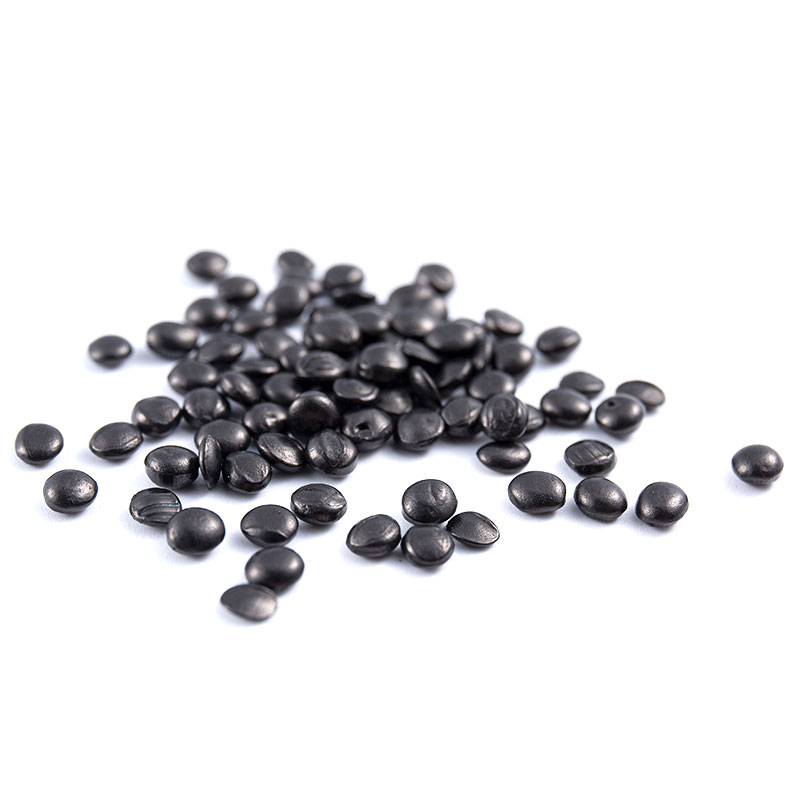
High gloss weather-resistant black masterbatch is a functional masterbatch based on polyethylene (PE) with carbon black and calcium carbonate fillers, manufactured through a rationally designed and processed process. Its carbon black content is approximately 43% ± 2%, maintaining high coloring performance while imparting excellent weather resistance and structural strength to finished products, meeting the dual demands of appearance and performance in various applications. This masterbatch exhibits stable dispersion during the compounding and injection molding of engineering plastics, ensuring uniform distribution of carbon black throughout the matrix, effectively ensuring high gloss and smoothness in finished products. It is suitable for injection molded parts requiring high aesthetic standards.
During use, this high-gloss weather-resistant black masterbatch can be directly added to raw materials for production. The recommended addition level is 1-3%, ensuring both aesthetic quality and enhanced durability. Its excellent dispersion properties not only reduce surface defects caused by pigment agglomeration but also improve the product's weathering stability under conditions of light, humidity, and temperature fluctuations, thereby extending the product's service life. It also enhances the mechanical properties of molded parts, making it suitable for applications requiring both structural strength and aesthetic appeal.
Parameter

# BLACK MASTERBATCH A104E

A104E is made of PE, carbon black with calcium carbonate filler. Carbon black concentration is around 43%. Applicable for Engineering Plastic compounding Injection, Blue tone, High glos, High tint Strength, High temperature resistance.

Ingredients Carbon Black: 43%±2
ASH: <15%
Usage Mixed with materials.
Dosage suggested 1-3%.
Technical Index Density: <2.0g/cm3
Melting Speed:>1g/10min(21.6kg/190℃)
Moisture:<0.50%
Package 25kg per bag, KP bag or PE bag
Storage Place in dry and cool warehouse, avoid sun shine and raining.
Note The above index is based on the testing result for reference only, not as the specific index.
High-Gloss Injection Series

High Gloss Weather-Resistant Black Masterbatch — Grade A104E


Technical Data Sheet

A104E — Full Parameter Reference

Parameter Specification Method / Notes
Grade Code A104E High-Gloss Weather-Resistant Injection Series
Carrier Resin Polyethylene (PE) Engineering plastic compounding compatible
Carbon Black Content 43% ± 2% Blue-tone, high tint strength, high-structure grade
Filler Calcium Carbonate (CaCO₃) Contributes weathering resistance and structural rigidity
Ash Content < 15% ISO 3451 — controlled mineral loading
Density < 2.0 g/cm³ ISO 1183
Melt Flow Rate > 1 g/10 min 190°C / 21.6 kg; ISO 1133 — low-flow profile for gloss retention
Moisture Content < 0.50% Controlled to prevent sink marks and surface dimpling
Surface Tone Blue undertone (cool black) Preferred tone for electronics and appliance casings
Key Properties High gloss, high tint strength, UV/weather resistance Validated in engineering plastic compounding and injection
Recommended Dosage 1% – 3% Blend directly into engineering plastic base resin
Compatible Processes Engineering plastic compounding, injection molding Not the primary recommendation for blown film or pipe
Packaging 25 kg / bag (KP or PE bag) Dry warehouse storage; avoid UV and moisture

Formulation Attributes

Three Properties That Define A104E Performance

43%

High-Tint-Strength CB Loading

The 43% carbon black concentration in A104E uses a fine-particle, high-structure furnace grade selected for its exceptionally high tinting strength — the optical property that determines how deeply black a part appears at low letdown rates. At 1% dosage, A104E introduces roughly 0.43% actual carbon black into the finished part, sufficient for the deep, saturated appearance expected in consumer electronics and home appliance casings without overloading the polymer matrix.

Gloss

Surface Gloss through Controlled Flow

The low MFR specification (>1 g/10min) is the primary mechanism behind A104E's gloss performance. At low shear rates, carbon black particles maintain their dispersed state with minimal mechanical breakup during the injection shot, which produces the smooth, light-reflective surface layer that characterizes genuinely high-gloss parts. Masterbatches with very high MFR thin the melt excessively and accelerate particle migration to weld lines, reducing surface uniformity.

UV+

Outdoor Weathering Stability

Carbon black is the most effective UV absorber available in polymer colorants. At 43% concentration, A104E introduces a carbon black volume fraction into finished parts that provides long-term UV protection comparable to dedicated UV stabilizer packages — without requiring a separate additive masterbatch for most outdoor applications. The CaCO₃ filler further contributes by acting as a thermal buffer, moderating surface temperature fluctuations that accelerate photo-oxidative degradation in cyclically heated outdoor plastics.


Color Science

What "Blue Undertone" Means in Practice — and Why It Matters for Your Product

Not all black is the same black. Industrial carbon blacks produce finished parts across a spectrum from warm brownish-black (low structure, thermal grades) to neutral black (standard furnace grade) to cool blue-black (high structure, fine particle grades). A104E uses a high-structure CB specifically selected to produce a blue undertone — described in colorimetry as a negative B value — that is the visual characteristic associated with premium, high-specification products.

In consumer electronics — televisions, audio equipment, personal devices — a warm or neutral black reads as lower-end against a cool blue-black. The same is true for home appliances where the front panel or casing is the primary design surface: a refrigerator door bezel, washing machine control panel, or air conditioner housing in genuine cool-black consistently tests higher in perceived quality assessments than the same part in warm-toned black from a different masterbatch grade.

For injection molders supplying branded consumer goods manufacturers, the ability to deliver a consistent, specified blue-tone black across multiple production runs — without variability in undertone that causes rejection at goods-in inspection — is a procurement differentiator. A104E addresses this with its tight CB concentration tolerance of ±2%, which constrains the main variable responsible for undertone drift between batches.

Color Characteristic Reference
Tone DirectionCool Blue-Black
CB TypeHigh-Structure Furnace
Target B ValueNegative (blue-shifted)
Visual CategoryPremium / High-Spec
Competing ToneWarm black (brownish) — avoid for high-end parts
Batch-to-Batch ToleranceCB ±2% — undertone stable

Weathering Performance

How Weather Resistance Translates to End-Product Lifecycle

The "weather-resistant" designation in A104E refers to the combined effect of high carbon black loading and CaCO₃ filler on the photo-oxidative, thermal, and hydrolytic degradation pathways that degrade outdoor and semi-outdoor plastic parts over time.

UV Absorption

Carbon black absorbs across the full UV-A and UV-B spectrum, dissipating photon energy as heat before it can initiate polymer chain scission in the base resin. At the carbon black fraction introduced by 1–3% A104E letdown, the UV dose reaching the bulk polymer is reduced by more than 99% at surface depths below 200 microns — the critical zone for surface chalking and gloss loss.

Thermal Cycling Stability

Outdoor plastic surfaces experience repeated thermal expansion and contraction. CaCO₃ filler reduces the CTE (coefficient of thermal expansion) of the polymer matrix, dampening dimensional change per cycle. This reduces fatigue stress accumulation at surface features — snap clips, screw bosses, thin ribs — that initiate stress-whitening or micro-cracking in unfilled resins under prolonged weathering.

Gloss Retention Under Humidity

The moisture ceiling of <0.5% in A104E, combined with the low ash content relative to the CB loading, results in a formulation that does not introduce significant hygroscopic sites into the finished part surface. Outdoor parts with high-filler content absorb moisture at the filler-polymer interface, which gradually disrupts the smooth surface topology responsible for specular gloss. A104E's controlled filler level limits this degradation pathway.

Color Shift Over Time

Black plastics in outdoor service occasionally exhibit a reddish-brown shift over years of exposure — this is photo-oxidation of residual organic processing aids or low-structure carbon black particles in the surface layer. The high-structure, high-loading CB in A104E is far more chemically inert than low-structure alternatives, and its volume fraction in the part provides a photon-absorption layer dense enough to shield underlying stabilizers from rapid depletion.


Applications

Where A104E Is Specified by Injection Molders

Consumer Electronics Casings

TV bezels, speaker enclosures, audio equipment panels requiring jet black with blue tone and scratch-level gloss retention across the product lifetime.

Home Appliance Panels

Washing machine, dishwasher, and refrigerator control panels and door frames. Parts visible to consumers at close range where surface uniformity is a product-quality signal.

Outdoor Electrical Enclosures

Junction boxes, meter housings, electrical panel covers in PP or ABS that are permanently sun-exposed. A104E's UV load eliminates the need for separate UV-stabilizer masterbatch in most PP grades.

Automotive Interior Trim

Interior panels and trim parts manufactured from engineering PP compounds where OEM specifications require cool-black and multi-year color stability without fading or surface chalking.

Engineering Plastic Compounding

Pre-compounding into PP, ABS, or PE engineering plastic pellets before further injection processing. A104E disperses cleanly in twin-screw compounding at 180–240°C barrel temperatures.

Outdoor Furniture & Hardware

Garden furniture components, outdoor storage boxes, and architectural hardware molded in PP or HDPE. Weathering stability at 1.5% dosage for 5+ years outdoor service in temperate climates.

Power Tool Housings

Tool casing and grip components in nylon-reinforced PP or ABS where appearance quality and resistance to UV-induced chalking from workshop outdoor storage are both required.

Display & Retail Fixtures

Point-of-sale display components and premium retail product trays where the cool-tone black reads as luxury and where gloss must remain consistent under retail lighting.


Technical FAQ

Questions Injection Molders Ask About A104E

Why does A104E have a lower MFR than other black masterbatches in the E-LUCK range?+

The MFR of a masterbatch affects how it behaves inside the injection barrel and mold cavity. A high-MFR masterbatch reduces the blend viscosity, which can cause preferential migration of the masterbatch toward the mold surface and flow-front — producing tiger-striping or weld-line darkening on complex geometries. A104E's lower MFR (>1 g/10min versus the >10 g/10min of standard grades) keeps the masterbatch more uniformly distributed in the melt shot, reducing the carbon black concentration gradient between the surface layer and the core. This is the primary mechanism by which A104E achieves consistent gloss across the full part surface rather than only in low-shear zones.

Does the CaCO₃ filler in A104E affect impact strength in the finished part?+

At the filler loading levels implied by an ash content of <15%, and at the 1–3% letdown rate of the masterbatch into the base resin, the total CaCO₃ contribution to the finished part is typically 0.05–0.45% by weight. At these concentrations, the filler has a negligible negative effect on impact strength — the absolute quantity of mineral is far below the threshold (typically 5–10% direct CaCO₃ addition) where impact property reduction becomes measurable. For parts with demanding impact requirements (thin-wall snap-fit closures, structural clips), we recommend confirming at trial; for standard panel and housing applications, no impact penalty has been observed at normal dosage rates.

Can A104E be used with ABS as well as PP?+

Yes. The PE carrier in A104E is compatible with both PP and ABS at the letdown concentrations used in injection molding. In ABS, the PE carrier introduces a minor incompatible phase — which is typical of PE-carrier masterbatches in ABS — but at 1–3% letdown the volume fraction of PE in the finished part is 0.65–2%, which is generally below the threshold for visible phase separation or mechanical property loss in standard ABS grades. For high-impact ABS or ABS/PC blends requiring Class-A surface finish, we recommend running a short trial run at your specific barrel temperatures before full production commitment.

What are the storage requirements for A104E versus standard masterbatches?+

A104E has the same basic storage requirements as other pellet-form masterbatches: sealed original packaging, dry warehouse away from direct sunlight, ambient temperature below 40°C. However, because A104E contains CaCO₃ filler which is mildly hygroscopic, moisture pickup on extended storage in humid environments is slightly faster than for filler-free grades. We recommend a pre-use moisture test if bags have been stored unsealed for more than 30 days in high-humidity conditions (above 70% RH). Any material measuring above 0.5% moisture should be dried at 70°C for 2 hours before blending to prevent surface pitting on the injected part.


Request an A104E Trial Sample or Technical Consultation
Specify your base resin, barrel temperature profile, and target gloss level — our technical team will confirm compatibility and recommend a starting dosage.
About Us
E-LUCK .
E-LUCK .

As China High Gloss Weather-Resistant Black Masterbatch Factory and China High Gloss Weather-Resistant Black Masterbatch Suppliers, E-LUCK is a professional manufacturer and solution provider specializing in black masterbatch for industrial applications. Since our founding, we have remained committed to the core values of precision, consistency, and material intelligence, integrating advanced dispersion technology with rigorous quality systems to meet the increasingly complex demands of modern polymer processing. From pipes and fittings to automotive parts, from consumer electronics to packaging films, our black masterbatches play a quiet yet critical role in enhancing product appearance, performance, and lifecycle for a wide range of downstream industries.

News

