

Strong And High Pigment Black Masterbatch Wholesale

Home / Products / Compounding & Modification Black Masterbatch / PP/PE Modified Black Masterbatch / Strong And High Pigment Black Masterbatch

Strong And High Pigment Black Masterbatch

Strong And High Pigment Black Masterbatch

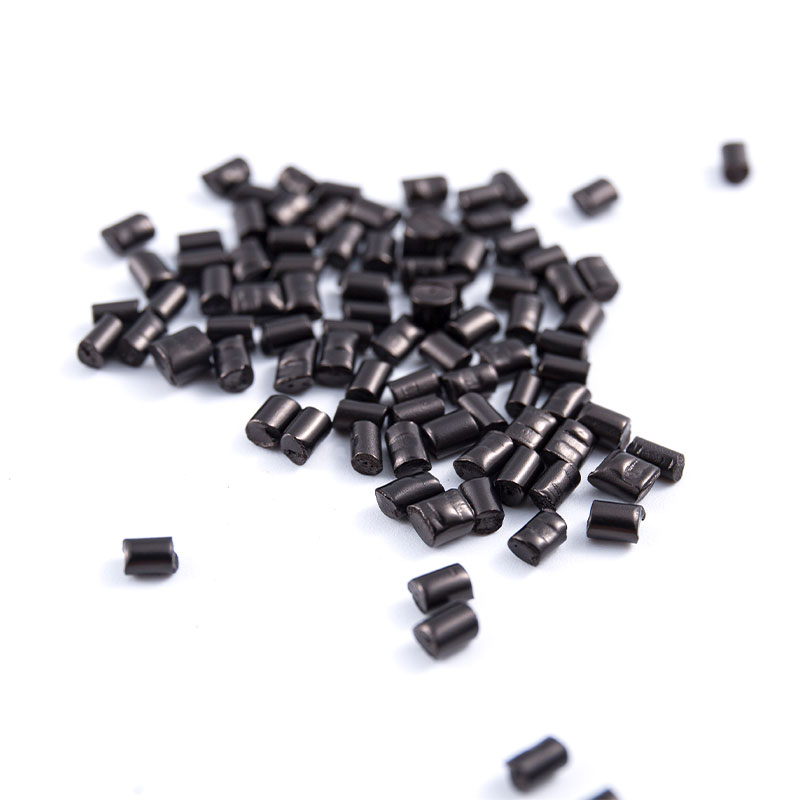
This strong and high pigment black masterbatch is a functional material specifically developed for PP, PE, and various engineering plastic systems, enabling efficient and uniform coloring during plastic modification and product production. Using a polymer wax as a carrier, this product contains 50% high-pigment carbon black. Its scientific formulation ensures stable dispersion and excellent compatibility, making it suitable for processing diverse materials such as PE, PP, PC, PS, and ABS.
This product demonstrates outstanding aging and weather resistance, effectively improving the material's stability under UV exposure and in challenging operating environments, extending product life and reducing ongoing maintenance costs. Its flow index of 75.5g/21.6kg/10min ensures excellent flowability and process stability during injection molding and extrusion. Furthermore, its moisture content is controlled at 0.27%, helping to prevent bubbles and surface defects caused by moisture evaporation during processing.

Parameter

Nature Value/Unit Test Methods/Standards
Carrier or additive Polymer wax 600°C Oxygen Permeability Test
Pigment 50% high-pigment carbon black GB/T 13021-1991
Filler None GB/T 9345.1-2008
Compatibility PE, PP, PC, PS, ABS Simulated Production Process
Density 1.237 g/cm³ GB/T 1033.1-2008
Flow index 75.5 g/21.6 kg/10 min GB/T 3682-2000
Moisture content 0.27% GB/T 6284-2006
Impact resistance 17.4114 kJ/m² LG.ABS121H with 2% Black Masterbatch Injection Moulding Test
Elongation at break 39.04%
Tensile strength 44.875 MPa
PP/PE Modified Series — Wax Carrier

Strong & High Pigment Black Masterbatch — PP/PE Modified Grade

50%
Carbon Black
75.5
MFI g/21.6kg/10min
0.27%
Moisture Content
1.237
Density g/cm³

This grade carries two specifications that no other product in E-LUCK's PP/PE modification range can match simultaneously: 50% carbon black concentration and an MFI of 75.5 g/21.6kg/10min — an ultra-high flow index achieved through a polymer wax carrier system rather than a conventional PE carrier. The wax carrier is the mechanism behind both the high flow and the mechanical test data that this product uniquely provides: impact resistance, elongation at break, and tensile strength measured in actual injection-molded ABS parts at 2% letdown, not estimated from constituent properties.

These measured values exist because the wax carrier interacts with the base resin differently from a PE carrier — it distributes into the melt early in the barrel, coats the CB particles with a continuous lubrication layer that reduces inter-particle friction during injection, and produces a finished part surface with lower internal stress. The result is a black compound that tests stronger than the same base resin colored with a standard PE masterbatch at equivalent dosage.


Laboratory Test Results

Measured Mechanical Properties — ABS Test Specimen at 2% Letdown

The following values are measured from injection-molded standard test specimens produced using LG ABS121H base resin at 2% masterbatch addition. All tests performed per GB/T standards. These are not estimated values — they are the actual measurements from the production grade currently in stock.

Mechanical Performance Data Base resin: LG ABS121H | Dosage: 2% | Process: Injection Moulding
Property Measured Value Test Standard / Condition
Impact Resistance 17.41 kJ/m² Charpy notched impact — LG ABS121H at 2% MB addition
Elongation at Break 39.04 % Standard tensile specimen; strain to fracture
Tensile Strength 44.88 MPa Peak stress on tensile curve; ISO 527 method
Melt Flow Index 75.5 g/10min 21.6 kg / standard conditions; GB/T 3682-2000
Density 1.237 g/cm³ GB/T 1033.1-2008
Moisture Content 0.27 % GB/T 6284-2006 — well below 0.5% ceiling

These values represent measured results from the specified test configuration and are provided as reference data for compound engineers evaluating this masterbatch for ABS modification. Results in other base resins, at different dosage rates, or with different processing conditions will vary — contact E-LUCK for testing in your specific material system.


Technical Data Sheet

Strong & High Pigment Grade — Complete Parameter Reference

Parameter Specification Method / Notes
Carrier System Polymer Wax Not PE or PP — wax carrier produces ultra-high MFI and surface lubrication effect
Carbon Black Content 50% high-pigment CB GB/T 13021-1991 — strong colorant with high tinting strength
Filler None GB/T 9345.1-2008 — zero mineral addition
Compatibility PE, PP, PC, PS, ABS Simulated production process validated across all five resin systems
Density 1.237 g/cm³ GB/T 1033.1-2008
Melt Flow Index 75.5 g/21.6kg/10min GB/T 3682-2000 — ultra-high flow from wax carrier system
Moisture Content 0.27% GB/T 6284-2006 — actual measured value; far below 0.5% ceiling
Impact Resistance 17.41 kJ/m² Measured at 2% in LG ABS121H injection test
Elongation at Break 39.04% Measured at 2% in LG ABS121H injection test
Tensile Strength 44.875 MPa Measured at 2% in LG ABS121H injection test
Recommended Dosage 1% – 3% Mix directly with base resin; no pre-compounding needed
Compatible Processes Injection molding, extrusion PP/PE modification primary; also suitable for ABS/PC/PS
Packaging 25 kg / bag (KP or PE bag) Sealed storage; dry, cool warehouse

Carrier System

MFI 75.5 — What the Wax Carrier Does That PE Cannot

75.5
g / 21.6kg / 10min MFI

This MFI is more than 7× higher than standard PE-carrier masterbatches in the >10 g/10min range. It is not an incidental byproduct of the wax carrier — it is a designed property. The polymer wax melts at 60–90°C, far below the processing temperature of any target resin, and immediately acts as a liquid-phase carrier that reduces the effective viscosity of the CB-resin blend to levels impossible with solid PE carrier at equivalent temperatures.

The high MFI has two direct processing consequences. First, the masterbatch phase distributes across the mold cavity ahead of the base resin flow front in injection molding, establishing a CB-enriched surface layer that improves gloss and color uniformity on parts with complex geometry and varying wall thickness. Second, the wax phase acts as an internal lubricant between the CB particles and the polymer chains, reducing the shear stress on the CB agglomerates during mixing and preserving the high-structure CB network that provides both tinting strength and UV absorption.

The mechanical test data provides direct evidence of the wax carrier's effect: impact resistance of 17.41 kJ/m² in ABS at 2% addition is not a degradation of the ABS base resin's impact performance — it reflects that the wax carrier's lubricating effect on the CB-polymer interface actually maintains the ABS rubber phase morphology better than a PE carrier would at equivalent addition rates.

Elongation at break of 39.04% in the same specimen confirms that the compound remains ductile — not embrittled by the CB addition as can occur when PE-carrier masterbatches are used in rubber-phase-sensitive ABS. The wax system doesn't create a competing polymer phase that disrupts the rubber particle network responsible for ABS toughness.

Tensile strength of 44.875 MPa demonstrates that the coloring system does not compromise load-bearing capacity. For compounders producing black ABS parts with structural requirements — housing clips, snap-fit features, thin-wall structural ribs — this measured strength data provides a basis for engineering design confidence that descriptive product claims alone cannot offer.


Resin Compatibility

Five Validated Thermoplastic Systems

Unlike carrier-matched grades designed for a single resin family, the wax carrier system is thermodynamically compatible with a broad range of thermoplastics. The following five resin families are validated through simulated production process testing.

PE

Blown film, pipe, injection. Wax carrier is fully miscible with PE melt. Lowest CB introduction per dosage unit compared to unfilled PE grades.

PP

Injection and compounding. Wax carrier disperses uniformly in PP without the minor incompatibility of a PE carrier. No crystallization mismatch in thin-wall PP.

PC

Process at 240–280°C. Wax carrier clears without decomposition. Moisture at 0.27% is below the threshold for PC moisture sensitivity concern at 1–2% dosage.

PS

GPPS and HIPS. Wax carrier does not introduce a competing polymer phase. Surface quality in GPPS injection is superior to PE-carrier alternatives at equivalent dosage.

ABS

Primary validated resin with measured test data. Impact, elongation, and tensile data available from LG ABS121H trial at 2%. See test table above for values.


FAQ

Questions About This Wax-Carrier Grade

Does the polymer wax carrier affect the weathering or aging resistance of the finished compound?+

The polymer wax carrier in this masterbatch contributes positively to weathering resistance through two mechanisms. First, the wax phase has inherently lower UV absorptivity than the aromatic-containing polymers in ABS or PS base resins, meaning it does not act as a UV sensitizer that would accelerate surface degradation. Second, at 1–2% dosage the wax fraction in the finished compound is approximately 0.25–0.5% — too small to create wax-specific UV degradation pathways. The dominant UV protection mechanism is the 50% CB loading itself: at 1% masterbatch addition, 0.5% CB in the compound provides broad-spectrum UV absorption that protects both the base resin and the wax carrier fraction. The product description specifically notes outstanding aging and weather resistance, which is supported by the CB loading at typical dosage rates rather than by any additive contribution from the wax carrier.

Can this masterbatch be used at higher temperatures than standard PE-carrier grades?+

The upper processing temperature limit of this masterbatch is determined by two factors: the thermal stability of the wax carrier and the moisture content. The polymer wax used as carrier is thermally stable to approximately 300°C under inert conditions, which means it processes without decomposition at the temperatures used for ABS (200–240°C), PC (240–280°C), and even some engineering PA grades (260–280°C). The 0.27% moisture content — below the 0.5% ceiling — reduces the risk of moisture-related gas marks or surface defects at high processing temperatures. For resins processed above 280°C (certain PA66 grades, PPS, PEI), the wax carrier's thermal stability should be confirmed with E-LUCK's technical team before use, as extended residence times at very high temperatures may produce minor wax decomposition products that affect surface quality.


Mechanical Data Available for Your Resin System
The ABS test data shown here is our current standard reference. Request a trial sample and specify your base resin and dosage target — we can provide additional testing in your specific material if required for compound qualification.
About Us
E-LUCK .
E-LUCK .

As China Strong And High Pigment Black Masterbatch Factory and China Strong And High Pigment Black Masterbatch Suppliers, E-LUCK is a professional manufacturer and solution provider specializing in black masterbatch for industrial applications. Since our founding, we have remained committed to the core values of precision, consistency, and material intelligence, integrating advanced dispersion technology with rigorous quality systems to meet the increasingly complex demands of modern polymer processing. From pipes and fittings to automotive parts, from consumer electronics to packaging films, our black masterbatches play a quiet yet critical role in enhancing product appearance, performance, and lifecycle for a wide range of downstream industries.

News

