

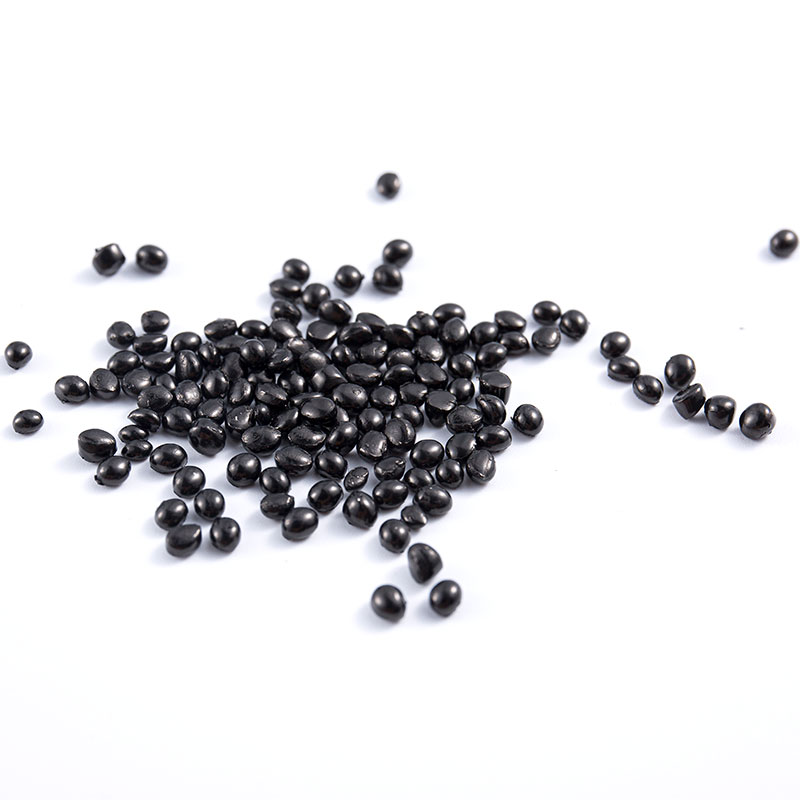

High Stability Plastic Black Masterbatch Wholesale

Home / Products / Sheet, Profile, & Wire Black Masterbatch / Profile Black Masterbatch / High Stability Plastic Black Masterbatch

High Stability Plastic Black Masterbatch

High Stability Plastic Black Masterbatch

This high-stability plastic black masterbatch is refined from polyethylene (PE), carbon black, and calcium carbonate filler. With a carbon black content of approximately 27%, it exhibits excellent compatibility and stability in a variety of plastic processing applications. Its uniform dispersion ensures consistent coloration across plastic products, preventing localized color variations. It also enhances the overall appearance of profiles, creating a clean, smooth, and long-lasting visual effect.
This masterbatch enhances the UV and weather resistance of plastic products, ensuring that materials such as ground films, blown films, filaments, pipes, sheets, and wire maintain structural stability and mechanical properties over long-term use, preventing deformation or performance degradation. Furthermore, its excellent compatibility with substrates prevents interference with processing techniques such as extrusion, injection molding, and thermoforming, facilitating ease of use and maintaining production efficiency.

Parameter

# BLACK MASTERBATCH 2003

2003 is made of PE, carbon black with calcium carbonate filler. Carbon black concentration is around 27%. Applicable for Mulch film, Blown film, Filament, Pipe, sheet, wire, extrusion, injection, thermoforming.

Ingredients Carbon Black: 27%±2
ASH: <47%
Usage Mixed with materials.
Dosage suggested 1-3%.
Technical Index Density: <2.0g/cm3
Melting Speed:>10g/10min(21.6kg/190℃)
Moisture:<0.50%
Package 25kg per bag, KP bag or PE bag
Storage Place in dry and cool warehouse, avoid sun shine and raining.
Note The above index is based on the testing result for reference only, not as the specific index.
Profile / Sheet / Wire / Pipe — Multi-Process Series

High Stability Plastic Black Masterbatch — Grade 2003

27%
Carbon Black ±2%
<47%
Ash (CaCO₃)
>10
MFR g/10min
8
Validated Processes

Grade 2003 is defined by one number that no other product in this range matches: eight validated plastic processing methods in a single masterbatch formulation. Most masterbatches are engineered for a primary process — blown film, pipe extrusion, injection molding — and tolerate adjacent processes with acceptable but not optimized results. 2003 is explicitly qualified for mulch film, blown film, filament, pipe, sheet, wire, extrusion, and injection and thermoforming — a breadth that makes it the single-inventory solution for converters and processors running multiple product lines on the same site.

At 27% carbon black with a calcium carbonate filler loading below 47% ash, 2003 occupies a deliberate middle position in the concentration spectrum: high enough for effective coloring and UV protection at 1–3% dosage across all eight processes, moderate enough to maintain melt flow compatibility (>10 g/10min) across the temperature and shear ranges that span from blown film (low-shear, continuous) to injection molding (high-shear, cyclic). The CaCO₃ filler contributes structural stability — particularly relevant in profile extrusion and sheet thermoforming where dimensional stability under heat is a production quality factor — without overloading the formulation with inorganic content that would restrict its film applications.


Technical Data Sheet

2003 — Complete Parameter Reference

Parameter Specification Method / Notes
Grade Code 2003 High Stability — Profile / Multi-Process Series
Carrier Resin Polyethylene (PE) Compatible across polyolefin-based processing methods
Carbon Black Content 27% ± 2% Balanced CB level for multi-process use across thin film to thick-wall injection
Filler (CaCO₃) Present — ash <47% Contributes dimensional stability in profile and sheet; improves hiding in film
Ash Content <47% ISO 3451 — moderate mineral loading; below threshold for film property restriction
Density <2.0 g/cm³ ISO 1183
Melt Flow Rate >10 g/10 min 190°C / 21.6 kg — wide processing window across all eight target applications
Moisture Content <0.50% CaCO₃ filler: pre-dry if stored unsealed in high humidity before use in film applications
Recommended Dosage 1%–3% 2% standard for most applications; 3% for thin film (<20 µm) or full light-block requirement
Validated Processes Mulch film, Blown film, Filament, Pipe, Sheet, Wire, Extrusion, Injection & Thermoforming 8 explicitly validated manufacturing processes
Packaging 25 kg / bag (KP or PE bag) Sealed; dry, cool warehouse storage

Process Compatibility

Grade 2003 — Eight Processes, One Masterbatch

The following eight manufacturing contexts are explicitly validated for 2003. Each requires slightly different considerations for dosage and processing conditions — the details below address the most relevant aspects of each application.

Single-Grade Solution
2003
27% CB · CaCO₃ Filler · PE Carrier · >10 g/10min MFR
Mulch Film

LLDPE or LDPE agricultural mulch at 15–30 µm gauge. At 2–3% dosage, full black opacity for soil heating. CaCO₃ filler modestly increases soil contact stiffness. No special screw settings needed for mulch line speeds.

Blown Film

General-purpose LDPE and LLDPE blown film for industrial and agricultural use. At 2%, full opacity at gauge above 20 µm. The <47% ash does not restrict blow ratio in standard die configurations.

Filament

PE monofilament for outdoor mesh, agricultural netting, and industrial strapping. 2003 at 1.5–2% provides black coloring and UV protection for multi-season outdoor filament service. CB concentration sufficient for color at high draw ratios.

Pipe Extrusion

HDPE drainage and irrigation pipe. CaCO₃ contributes minor nucleating benefit to the pipe wall structure. Not recommended for pressure-rated water supply pipe — for that application, use E-LUCK's H6045 (ash <1%).

Sheet

PE or PP sheet extrusion for trays, liners, and industrial flat sheet. The CaCO₃ filler in 2003 provides modest stiffness and dimensional stability benefits to extruded sheet, particularly relevant for thermoforming applications where pre-heat sag resistance matters.

Wire & Cable

PE jacket extrusion for electrical wire and conduit. At 2%, full hiding of the insulation layer color beneath the jacket. For high-speed wire lines (>200 m/min), confirm moisture at <0.3% to prevent pinhole surface defects at extreme line speed.

General Extrusion

Profiles, seals, gaskets, and tubing in PE or PP. CaCO₃ filler helps maintain profile dimensional stability during the post-die cooling phase — relevant for hollow-section profiles where wall collapse can occur with unfilled compounds at similar dosage rates.

Injection & Thermoforming

PE and PP injection molding and thermoformed sheet. At 2%, full black coloring at wall thickness above 1.5 mm. CaCO₃ provides minor crystallization nucleation benefit in PP injection, slightly improving cycle time at equivalent mold temperature.


Stability Analysis

What "High Stability" Means Across Different Dimensions

Dimension 01
Color Stability

The ±2% CB concentration tolerance ensures consistent color depth from batch to batch. For a converter running multiple product types from the same masterbatch inventory, this consistency means no visible color difference between a pipe produced in January and a film produced in August from different 2003 bags. The CaCO₃ filler at controlled ash level does not introduce color variation — calcium carbonate itself is white and inert at the loadings present in 2003, contributing to opacity without shifting the black hue.

Dimension 02
Process Stability

The MFR of >10 g/10min at 21.6 kg is the primary process stability parameter. Across the eight validated process types — from low-shear blown film to high-shear injection — the masterbatch integrates without creating melt pressure spikes, die buildup, or color concentration variation within the shot or run. The PE carrier melts at 180°C and is fully incorporated into all target resins before the material reaches the die, regardless of whether the line is running at film speeds or injection cycle rates.

Dimension 03
Dimensional Stability

For profile extrusion and sheet thermoforming applications specifically, the CaCO₃ filler in 2003 contributes to the dimensional stability of the finished product under post-processing thermal conditions. CaCO₃ reduces the coefficient of thermal expansion of the PE matrix slightly, which in profile applications means less post-extrusion shrinkage and warpage during cooling. For thermoformed sheet, the slightly lower CTE helps maintain the thermoformed geometry during the cooling phase before the part is ejected from the tool.

Dimension 04
Long-Term UV Stability

At 2% dosage, 2003 introduces 0.54% actual CB into the finished product. Carbon black at this concentration provides UV absorption sufficient for 2–5 years outdoor service in most product categories — agricultural film, wire jacketing, drainage pipe, and general-purpose extrusion. For applications requiring >5 years outdoor UV resistance (permanent infrastructure, long-life agricultural netting), supplement 2003 with a UV stabilizer masterbatch at 0.5–1% to extend the photochemical protection beyond what the CB loading alone can provide at this concentration.


FAQ

Questions About Grade 2003

Why would a processor choose 2003 over a higher-concentration grade when 2003 requires higher dosage?+

The multi-process advantage of 2003 is most valuable when a single site runs diverse product lines on multiple pieces of equipment. A converter producing agricultural film, drainage pipe, and PE sheet from the same facility can stock one masterbatch SKU (2003) rather than three separate grades optimized for each process. The inventory simplification, reduced minimum order quantity risk, and elimination of cross-grade usage errors have economic value that can outweigh the slightly higher dosage rate versus a 40–45% CB grade. Additionally, for thermoforming and profile applications specifically, 2003's CaCO₃ filler content provides structural benefits that a clean high-CB grade cannot deliver — so the choice is not purely about CB concentration efficiency but about the combination of CB, filler, and multi-process compatibility.

Is 2003 suitable for PP as well as PE substrates?+

2003 uses a PE carrier, which is compatible with PP injection and extrusion at the dosage rates used in practice. At 2% addition, the PE carrier introduces approximately 1.46% PE into the PP compound — a minor incompatible phase that in most standard PP applications produces no measurable effect on mechanical properties or surface quality. For thin-wall PP injection where surface inspection standards are very tight, or for reinforced PP compounds where the PE carrier might interact with fiber reinforcement interfaces, the PP-carrier grade PP30F (reviewed separately) is the preferred specification. For general PP extrusion, profile, and standard injection, 2003 performs adequately and its multi-process compatibility maintains the single-inventory advantage for mixed PP/PE production sites.


Running Multiple Plastic Processes? One Grade, Eight Applications.
Tell us your process mix, equipment types, and base resins. We'll confirm 2003 dosage recommendations for each application and can provide trial quantities per process for parallel qualification.
About Us
E-LUCK .
E-LUCK .

As China High Stability Plastic Black Masterbatch Factory and China High Stability Plastic Black Masterbatch Suppliers, E-LUCK is a professional manufacturer and solution provider specializing in black masterbatch for industrial applications. Since our founding, we have remained committed to the core values of precision, consistency, and material intelligence, integrating advanced dispersion technology with rigorous quality systems to meet the increasingly complex demands of modern polymer processing. From pipes and fittings to automotive parts, from consumer electronics to packaging films, our black masterbatches play a quiet yet critical role in enhancing product appearance, performance, and lifecycle for a wide range of downstream industries.

News

