

Environmentally Friendly Black Masterbatch Wholesale

Home / Products / Blown Film Black Masterbatch / Shopping & Garbage Bag Black Masterbatch / Environmentally Friendly Black Masterbatch

Environmentally Friendly Black Masterbatch

Environmentally Friendly Black Masterbatch

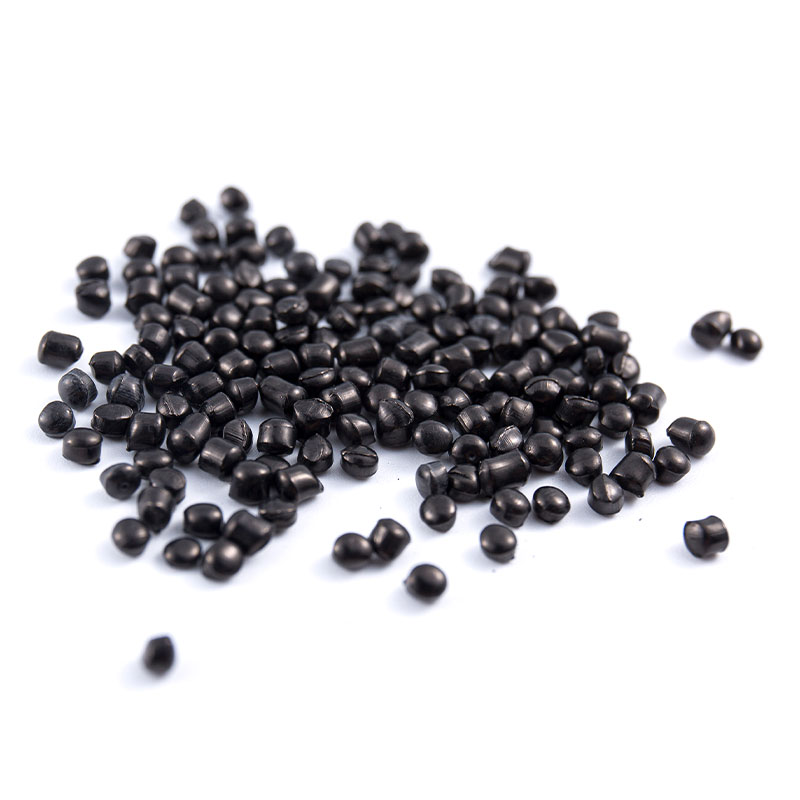
This environmentally friendly black masterbatch is a functional material made from recycled polyethylene (PE) with carbon black and calcium carbonate fillers. With a carbon black concentration of approximately 20%, the formula balances coloring, filling, and performance requirements, making it suitable for a variety of plastic processing techniques, including blown film, pipe, extrusion, and injection molding. Through its optimal ingredient ratio, this product meets processing requirements while reducing reliance on virgin polyethylene, helping to lower production costs and supporting resource reuse and sustainable development.
In terms of ingredients, this product contains 23% ± 1% carbon black, which imparts stable coloring and a certain degree of light resistance. The ash content is controlled to less than 50%, ensuring that the material maintains excellent physical properties during processing. Its technical specifications include a density of less than 2.0 g/cm³ and a melt rate greater than 10 g/10 min (21.6 kg/190°C), demonstrating excellent flowability and processability. The moisture content is less than 0.50%, effectively reducing bubbles and unevenness caused by moisture during processing.

Parameter

# BLACK MASTERBATCH E20

E20 is made of recycled PE, carbon black and calcium carbonate filler. Carbon black concentration is around 20%. Applicable for blowing film, pipe extrusion, and injection

Ingredients Carbon Black: 23%±2
ASH: <50%
Usage Mixed with materials.
Dosage suggested 1-3%.
Technical Index Density: <2.0g/cm3
Melting Speed: >10g/10min(21.6kg/190℃)
Moisture: <0.50%
Package 25kg per bag, KP bag or PE bag
Storage Place in dry and cool warehouse, avoid sun shine and raining.
Note The above index is based on the testing result for reference only, not as the specific index.
Product Overview

Environmentally Friendly Black Masterbatch — E20 Grade

Engineered for blown film lines that demand consistent jet-black output without relying on virgin polyethylene, the E-LUCK E20 grade is a recycled-PE carrier black masterbatch built around high-structure carbon black and calcium carbonate filler. The result is a pellet that delivers deep, uniform color at dosage rates as low as 1%, while simultaneously contributing weight, stiffness, and a measurable reduction in raw material spend per tonne of finished film.

~20%
Carbon Black Concentration
<2.0 g/cm³ Density
>10 g/10min Melt Flow Rate
<0.50% Moisture Content

Recycled-PE-based carriers are notoriously variable in flow behavior. E-LUCK addresses this by sourcing post-industrial PE streams with controlled melt index, then compounding under twin-screw conditions that achieve carbon black dispersion at the sub-micron level — a critical factor for surface gloss, film strength, and gel-free output on high-speed lines.

The ash-content ceiling of <50% reflects the calcium carbonate load and sets a hard upper bound on inorganic residue, so downstream mechanical properties — tear resistance, puncture strength, elongation at break — remain within the tolerances expected for shopping bags and garbage liner applications.


Technical Data Sheet

E20 — Full Specification at a Glance

All values measured under standard laboratory conditions. Contact our technical team for application-specific testing data.

Parameter Specification Testing Method / Remarks
Product Code E20 Shopping & Garbage Bag Grade
Carrier Resin Recycled Polyethylene (PE) Post-industrial PCR stream
Carbon Black Content 23% ± 2% High-structure furnace grade CB
Ash Content (Filler) < 50% Calcium carbonate based; ISO 3451
Density < 2.0 g/cm³ ISO 1183
Melt Flow Rate > 10 g/10 min 190°C / 21.6 kg; ISO 1133
Moisture Content < 0.50% Karl Fischer or gravimetric
Recommended Dosage 1% – 3% Mixed directly with base resin
Compatible Processes Blown Film, Pipe Extrusion, Injection Molding Confirm with E-LUCK for specific line conditions
Packaging 25 kg / bag (KP bag or PE bag) Custom pallet configurations available
Storage Conditions Dry, cool, shaded warehouse Avoid direct sunlight and moisture exposure
Shelf Life 12 months (sealed original packaging) Re-test if stored beyond 12 months

Why It Performs

Three Engineering Commitments Behind Every Pellet

01

Dispersion — Not Just Concentration

Color consistency across a 20-tonne blown film run depends far less on how much carbon black is present than on how uniformly it is distributed at the microscopic level. Our twin-screw compounding process achieves dispersion ratings that translate directly into gel-free film and streak-free surface finish — even at 1% letdown.

02

Recycled Carrier with Predictable Flow

Using recycled PE as a carrier is a sustainability gain, but only if the carrier's melt behavior is controlled. E-LUCK selects and conditions post-industrial PE streams to maintain a stable MFR window, so the masterbatch integrates cleanly into your existing process settings without die-pressure spikes or film gauge variation.

03

Moisture Management Below 0.5%

Moisture above 0.5% in a masterbatch introduces micro-voids, pinholes, and surface streaks in finished film. Our pellet drying and hermetic packaging protocol keeps moisture content consistently below specification, eliminating a common and often overlooked root cause of film defects on high-output lines.


Sustainability

The Circular Material Logic of E20

Conventional black masterbatch is formulated around virgin LDPE or LLDPE carriers — clean, predictable, but entirely dependent on freshly cracked petroleum. The E20 grade inverts that assumption by substituting post-industrial recycled PE as the primary carrier, directing plastic waste that would otherwise enter the general waste stream back into productive material use.

This is not a cosmetic sustainability claim. Recycled PE typically carries a lifecycle carbon footprint 30–60% lower than virgin PE of equivalent grade, depending on collection and processing efficiency. For a film converter running several thousand tonnes of masterbatch per year, the substitution represents a quantifiable reduction in Scope 3 emissions that can be incorporated into supply chain reporting.

The calcium carbonate filler serves a dual role: it partially displaces polymer content per unit weight — reducing the absolute quantity of plastic in each bag — while contributing stiffness and dimensional stability at gauge reductions that a pure-polymer formulation could not maintain. Thinner bags, same strength, lower resin content per bag is the outcome.

Recycled Carrier

Post-industrial PE diverted from waste streams, reducing virgin resin dependency at source.

CaCO₃ Filling Efficiency

Inorganic filler partially replaces polymer content, lowering resin consumption per finished bag.

Lower Dosage = Less Additive

Effective at 1–3%, meaning less masterbatch consumed per tonne of film versus lower-concentration alternatives.

PCR System Compatibility

Validated for use in post-consumer recycled PE film lines — supports closed-loop packaging systems.

No Heavy Metals

Formulation excludes cadmium, lead, and mercury compounds, meeting international restriction standards for plastic colorants.


Applications

Where E20 Fits in Real Production Workflows

The E20 grade is validated for the following end-product categories. For applications not listed, contact our technical team with your base resin spec and processing conditions.

Shopping Bags

T-shirt and flat shopping bags on LDPE/LLDPE blown film lines. Consistent opacity at 1.5–2% dosage. No gel contamination on standard die gaps.

Garbage Bag Liners

Household and commercial waste liners requiring full light-block and UV shielding. Maintains tear resistance at gauge down to 15–18 micron.

Agricultural Mulch Film

Black soil mulch requiring UV stability for seasonal field use. CaCO₃ filler contributes soil heat retention alongside the coloring function.

Courier & Mailer Bags

Co-extrusion compatible for multi-layer courier bags. Uniform outer-layer black against co-extruded inner film structures.

Construction Sheeting

Heavy-gauge PE sheeting for ground cover and moisture barriers. Higher dosage (2.5–3%) for maximum opacity in 80–200 micron gauge.

Stretch & Pallet Wrap

Opaque stretch wrapping for light-sensitive cargo. Confirmed compatible with linear LLDPE base resins on cast-film and blown lines.

Pipe Extrusion

Drainage and non-pressure pipe applications where black coloring provides UV protection in exposed installations. Excellent extrudate surface.

General Injection Parts

Non-structural injection molded components requiring black finish. Suitable for PP and PE-based compounds at standard processing temperatures.


Processing Guide

Integrating E20 into Your Blown Film Line

E20 requires no special equipment and introduces cleanly into standard PE film compounding workflows. The sequence below covers first-run integration for processors new to this grade.

01
Confirm Moisture

Open one bag and run a quick gravimetric or Karl Fischer test if your line is sensitive to micro-moisture. E20 ships at <0.50%, but storage conditions post-shipment can affect this. If stored >3 months in high-humidity environments, pre-dry at 70°C for 2 hours.

02
Set Dosage

Start at 2% letdown by weight for a standard shopping bag or liner specification. Adjust down to 1% if your target film gauge is above 30 micron and opacity is not critical. Increase to 3% for full UV block on agricultural mulch or construction sheeting.

03
Blend & Feed

Blend E20 pellets with your base resin in the hopper at the target dosage ratio. Gravimetric blending is preferred for large runs. No pre-compounding step required. The high MFR of E20 (>10 g/10min) ensures fast integration within the extruder barrel.

04
Monitor & Adjust

At steady state, visually inspect film for streak uniformity and gel presence. If streaks are visible, increase melt temperature by 5–10°C or reduce line speed 10%. Gel count above 3 per m² at 2% dosage indicates base resin contamination — isolate variables before adjusting E20 dosage further.


Material Comparison

E20 vs. Common Alternatives

Procurement decisions for black masterbatch typically involve three alternatives. The comparison below sets out the key technical and commercial trade-offs from a film converter's perspective.

Criterion E20 (E-LUCK) Virgin-PE Black MB Raw Carbon Black (direct)
Carbon Black Dispersion Sub-micron; twin-screw compound Typically good; virgin carrier Poor without specialist equipment
Cost per Unit Color Strength Lower — recycled carrier reduces base cost Higher virgin resin premium Low raw material, high processing cost
Moisture Risk <0.50% — hermetic pack Variable by supplier High — open handling hazard
Recycled Content Yes — PCR PE carrier No N/A
Line Downtime Risk Low — controlled MFR window Low High — dust, agglomeration, die buildup
Worker Safety Pellet form — minimal dust Pellet form — minimal dust Significant inhalation risk
Minimum Order Quantity Flexible — contact E-LUCK Typically 1–5t minimums Usually sold by full container

Frequently Asked Questions

Questions Buyers Ask Before Ordering Black Masterbatch

What is the difference between recycled-PE and virgin-PE carrier black masterbatch? +

The carrier resin in a masterbatch acts as the medium that distributes carbon black into your base polymer during processing. Virgin-PE carriers are produced from fresh petrochemical feedstock and offer highly predictable melt behavior, but come at a higher material cost and carry the full environmental burden of primary polymer production. Recycled-PE carriers derive from post-industrial waste streams — off-spec film, production trim, regrind — and are reprocessed to achieve controlled melt index ranges suitable for masterbatch compounding. The E-LUCK E20 uses a conditioned post-industrial PE stream selected for consistent MFR, which means the processing behavior is stable while the carbon footprint of the carrier material is significantly reduced versus a virgin alternative.

Can this black masterbatch be used in food contact packaging? +

The E20 grade is formulated for shopping bags, garbage liners, agricultural film, and general industrial blown film — categories where food contact compliance is not a primary requirement. It is not tested or certified for direct food contact applications under EU Regulation 10/2011, FDA 21 CFR, or equivalent frameworks. For film converters producing black packaging that will be in direct contact with food, E-LUCK offers a separate food-grade black masterbatch line with the corresponding documentation and compliance testing. Please enquire with our technical team and specify your target regulation.

What dosage rate gives full opacity for a standard 25-micron shopping bag? +

For a 25-micron single-layer LDPE or LLDPE shopping bag, full light block is typically achieved at 2–2.5% letdown of E20. At 1.5%, the film will appear uniformly black under normal handling but may show light transmission when held directly against a strong light source — acceptable for most applications, but below the threshold for light-sensitive content bags. Gauge thicker than 40 micron will achieve full opacity at 1.5% or lower. For co-extrusion structures, apply the masterbatch to the outer skin layer only at 3%, which achieves the same optical result using less total masterbatch per kg of film.

What does the calcium carbonate filler do in the formulation? +

Calcium carbonate (CaCO₃) is an inorganic mineral filler that partially replaces polymer in the masterbatch carrier. In the finished film, it contributes stiffness and dimensional stability, which is particularly useful in shopping bags that need to hold their shape during loading. The filler also allows gauge reduction — the film can be run thinner while retaining adequate mechanical performance — which reduces total resin consumption per bag and directly lowers material cost. Because mineral fillers are lower-cost than polymer resin on a per-kilogram basis, the CaCO₃ content in E20 also contributes to the overall cost-competitiveness of the masterbatch relative to all-polymer alternatives.

How should E20 masterbatch be stored after arrival? +

Store E20 in its original sealed bag inside a dry, temperature-controlled warehouse. Avoid areas with ambient humidity above 70% RH and keep bags away from direct sunlight, which can raise pellet surface temperature and encourage moisture condensation when the bag is subsequently opened. Do not stack pallets more than three-high to prevent bag rupture and pellet contamination. Once a bag is opened, reseal it or transfer the contents to a sealed hopper within 24 hours. Product stored correctly in unopened bags maintains specification for 12 months from production date; beyond that, we recommend running a quick moisture test before use.

Does E-LUCK offer custom formulations or private-label masterbatch production? +

Yes. E-LUCK operates a custom manufacturing service for buyers who require formulations outside the standard product range — this includes modified carbon black concentrations, alternative carrier resins (PP, EVA, metallocene PE), specific additive packages (anti-block, slip, UV stabilizer inclusion), and private-label pellet packaging. Custom orders typically require a minimum volume commitment and a technical consultation to validate the formulation against your specific base resin and process conditions. Lead times for custom grades range from 15 to 30 working days after formulation sign-off. Submit your specification through our Custom Manufacturing inquiry page.


Manufacturer Credentials

Direct from the Compounding Floor — Not a Trading Intermediary

Facility Huangxi Industrial Park, Shiwan Town, Boluo County, Huizhou City, China
Production Equipment Twin-screw compounding extruders with inline dispersion monitoring
QC Laboratory In-house batch testing for MFR, moisture, ash content, and color strength before each shipment
Certifications Available upon request — contact for current documentation package
Custom Development In-house R&D team; custom grades from formulation to trial sample in 15–30 working days
Export Experience Regular shipments to Southeast Asia, Middle East, South America, and Europe
Minimum Order Quantity Flexible — enquire with your volume and delivery port

Ready to trial E20 on your line?
Request a sample, a technical data sheet, or a quotation — our team responds within one business day.
About Us
E-LUCK .
E-LUCK .

As China Environmentally Friendly Black Masterbatch Factory and China Environmentally Friendly Black Masterbatch Suppliers, E-LUCK is a professional manufacturer and solution provider specializing in black masterbatch for industrial applications. Since our founding, we have remained committed to the core values of precision, consistency, and material intelligence, integrating advanced dispersion technology with rigorous quality systems to meet the increasingly complex demands of modern polymer processing. From pipes and fittings to automotive parts, from consumer electronics to packaging films, our black masterbatches play a quiet yet critical role in enhancing product appearance, performance, and lifecycle for a wide range of downstream industries.

News

