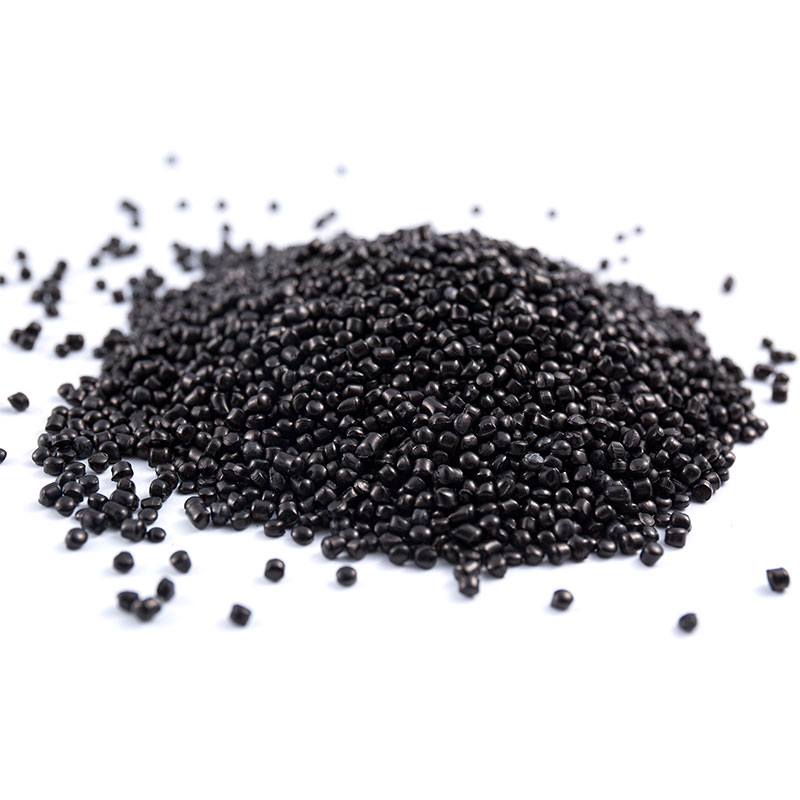
47% Carbon Black Concentration ±2% tolerance, batch-to-batch consistent
1–3% Recommended Addition Rate Full color coverage at minimal dosage
<2.0 g/cm³ Density Lightweight carrier, easy handling
>10 g/10min Melt Flow Index 190 °C / 10 kg, smooth extrusion flow
Evaluated across stretch film, food packaging film, and agricultural mulch applications
Carbon Black Dispersion Uniformity 96 / 100
Nano-scale wetting agents ensure carbon black particles are fully separated and evenly distributed throughout the PE matrix, eliminating streaking and color spots in finished film.
UV Barrier Effectiveness 94 / 100
High carbon black loading provides broadband UV absorption across the 280–400 nm range, protecting contents from photodegradation in outdoor storage and agricultural environments.
Compatibility with PE/LLDPE 98 / 100
PE carrier is fully miscible with LDPE, LLDPE, and HDPE resins. No interface separation, no bleed-out during extrusion or under long-term mechanical stress.
Mechanical Impact on Host Film 90 / 100
At 1–3% addition rate, tensile strength, elongation at break, and tear resistance of the final film remain within ±5% of uncolored baseline — no measurable mechanical trade-off.
Process Stability (Extrusion) 95 / 100
MFI above 10 g/10min at 190 °C keeps back-pressure stable across a wide screw-speed range. No head pressure spikes, no flow inconsistency during continuous production runs.
Ash Content Control 99 / 100
Ash content consistently below 1%, meaning inorganic impurities are minimized. This directly reduces the risk of die deposits, surface roughness, and equipment wear over extended production cycles.
Packaging
Stretch Film & Wrap Film
Designed specifically for LLDPE-based stretch film lines where consistent optical blackness, high cling retention, and dimensional stability are required across wide film widths.
Typical dosage: 2–3% | Line speed: Compatible with high-speed coextrusion
Agriculture
Mulch Film & Greenhouse Film
The high carbon black concentration delivers dependable soil warming, weed suppression, and UV degradation resistance for films exposed to full outdoor conditions across multiple growing seasons.
Typical dosage: 2–2.5% | UV longevity: Supports 12–24 month outdoor service
Food Packaging
Black Food Packaging Film
Clean-carrier PE base with controlled ash content supports production of black films for meat trays, prepared-food packaging, and premium retail packaging where appearance and regulatory compliance both matter.
Typical dosage: 1.5–2% | Compliance note: Contact your E-LUCK engineer for food-grade certification details
Logistics
Courier & Mailer Bags
Provides consistent jet black appearance and light-blocking performance for logistics packaging bags. Low dosage requirements keep raw material costs predictable at high-volume production scales.
Typical dosage: 1.5–2.5% | Finish: Uniform matte black surface
Silage & Storage
Silage Film & Bale Wrap
Effective UV block and sustained black opacity protect fermentation conditions in silage applications. The masterbatch's high MFI maintains consistent film gauge and tear uniformity during co-extrusion.
Typical dosage: 2–3% | Film structure: Suitable for 5–11 layer coex lines
Industrial Film
Geomembrane & Construction Film
High carbon black loading and tight dispersion quality translate directly to long-term UV stability and color fastness in heavy-duty geomembrane sheets and construction vapor barrier films.
Typical dosage: 2.5–3% | Density: <2.0 g/cm³ for consistent gauge control
01
Raw Material Selection
High-structure carbon black (N220/N330 grade) and food-safe PE resin are pre-qualified per batch
02
Wetting & Pre-dispersion
CB particles are surface-treated with dispersant before compounding to break agglomerates at the nanoscale
03
Twin-Screw Compounding
Co-rotating twin-screw extruder applies precise shear and temperature profiles to achieve uniform melt dispersion
04
Pelletizing & Screening
Water-ring or air-cooled pelletizing ensures uniform pellet size; metal detectors screen every batch output
05
QC Testing & Release
MFI, moisture, ash content, and dispersion grade are verified against spec sheet before packaging approval
Recommended starting points — final settings depend on your resin grade and line configuration
Recommended Dosage by Application
Stretch Wrap Film (LLDPE) 2.0 – 3.0%
Agricultural Mulch Film 2.0 – 2.5%
Food Packaging Film 1.5 – 2.0%
Courier / Mailer Bags 1.5 – 2.5%
Silage & Bale Wrap 2.0 – 3.0%
Geomembrane & Construction 2.5 – 3.0%
Processing Recommendations
Processing Temp 160–220 °C for PE-based lines. Avoid sustained temperatures above 230 °C to prevent carrier degradation.
Pre-drying Not required under normal storage conditions. If stored in humid environments, dry at 70 °C for 2 h before use.
Blending Method Tumble-blend with base resin for 3–5 min before feeding. Gravimetric dosing systems are recommended for precision above 1,000 kg/h throughput.
Screw Design High-dispersion screw configuration with barrier flights improves color homogeneity, particularly at 1–1.5% dosage levels.
Purging When switching from CM50 to natural/white grades, purge with HDPE-based purging compound for 10–15 min to clear residual black pigment.
What is the difference between CM50 and a 25–30% carbon black masterbatch?
CM50 contains approximately 47% carbon black versus the 25–30% found in many standard grades. The higher loading means you achieve equivalent opacity and UV protection at roughly half the dosage. This directly reduces the cost per kilogram of finished film, because you are adding less masterbatch per ton of base resin. It also reduces the risk of mechanical dilution effects — lower additive volumes have less impact on elongation, tear strength, and tensile properties of the host film.
Can CM50 be used in food-contact packaging films?
CM50 uses a clean PE carrier and tightly controlled additive package. However, food-contact compliance depends on specific regulations in your target market (e.g. FDA 21 CFR in the US, EU Regulation 10/2011, or GB 9685 in China). We recommend contacting our technical team directly with your product application and target market to confirm whether CM50's current formulation meets your regulatory requirements, or whether a dedicated food-grade variant should be specified.
What resins is CM50 compatible with?
CM50's PE carrier is fully compatible with LDPE, LLDPE, mLLDPE, and HDPE. It is routinely used in single-layer blown film, coextrusion lines, and cast stretch film applications. For PP-based or specialty engineering resin applications, E-LUCK offers dedicated masterbatch grades with matched carrier systems to ensure full miscibility.
How is dispersion quality measured and verified?
Each production batch is assessed using filter pressure value (FPV) testing and optical microscopy to confirm that carbon black agglomerates above a defined size threshold are absent in the melt. The dispersion grade is reported on the Certificate of Analysis provided with every shipment. Our QC process follows ISO 18553 dispersion grade standards as a reference framework.
What is the minimum order quantity and lead time?
Standard packaging is 25 kg bags. MOQ and lead time vary depending on order volume and current production scheduling. For spot orders of in-stock grades, lead time is typically 7–15 business days from order confirmation. Custom formulations or larger volumes follow a separate production schedule — contact our sales team for a current availability and lead time quote.
Does E-LUCK offer custom carbon black concentrations or carrier options?
Yes. Beyond the standard CM50 formulation, E-LUCK's in-house compounding facility is able to produce custom masterbatches with different CB grades (e.g. high-jetness N110, UV-stable N550), alternative carrier resins (LLDPE, mLLDPE, HDPE), adjusted MFI ranges, or proprietary additive packages such as antioxidants, UV stabilizers, or anti-block agents. Custom development typically requires a sample qualification stage before volume production.
How should CM50 be stored, and what is its shelf life?
CM50 should be stored in a cool, dry, well-ventilated warehouse away from direct sunlight and moisture. Recommended storage temperature is below 40 °C. Under proper conditions, the product maintains its specified performance for 24 months from the date of manufacture. The KP bag packaging option provides an additional moisture barrier layer for shipments to tropical or high-humidity destinations.
Temperature
Store below 40 °C. Avoid heat from direct sunlight, radiators, or enclosed containers during summer transport to tropical regions.
Humidity
Dry warehouse required. Moisture content must remain below 0.50% before feeding. KP bag packaging provides additional protection for humid-climate storage.
Packaging Integrity
Keep bags sealed until point of use. Opened partial bags should be resealed and consumed within 30 days to prevent surface oxidation of the carbon black.
Shelf Life
24 months from production date under recommended storage conditions. Batch date is printed on every bag. Use FIFO (first in, first out) stock rotation.
Handling Precautions
Carbon black dust is fine and pervasive. Use dust masks and gloves when cutting or handling bags in open environments. Avoid open flames near loose material.
Pre-drying
Not required under standard conditions. If ambient humidity exceeds 80% RH or bags have been exposed to moisture, pre-dry at 70 °C for 2 hours before processing.


 Español