

Environmentally Friendly Impact-Resistant Black Masterbatch Wholesale

Home / Products / Injection & Extrusion Black Masterbatch / Toy Grade Black Masterbatch / Environmentally Friendly Impact-Resistant Black Masterbatch

Environmentally Friendly Impact-Resistant Black Masterbatch

Environmentally Friendly Impact-Resistant Black Masterbatch

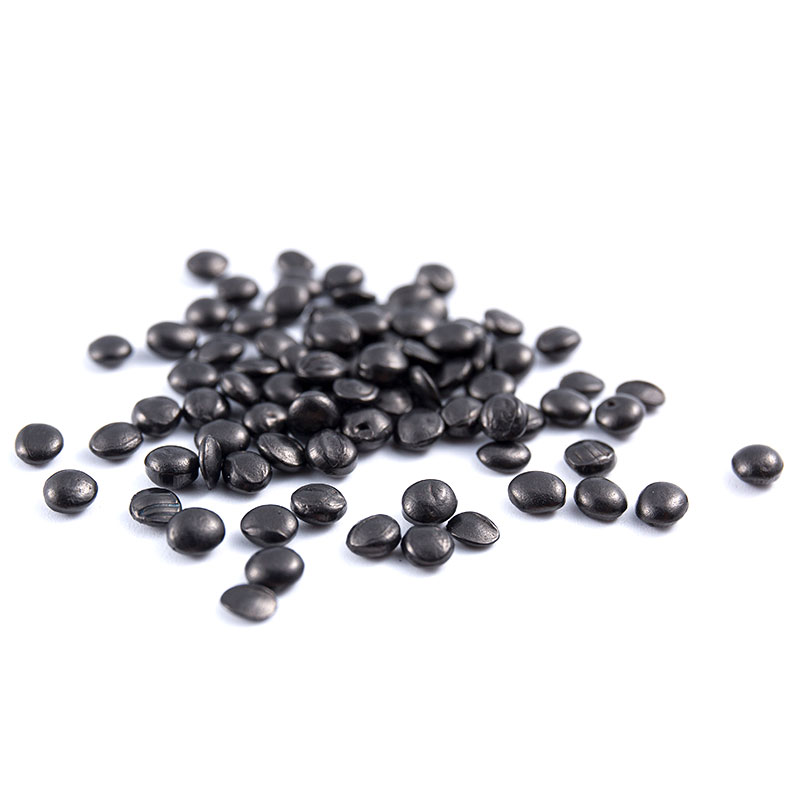
This environmentally friendly impact-resistant black masterbatch is a functional material specifically developed for the processing of a variety of plastic products, offering stable coloring properties and reliable mechanical reinforcement. Based on polyethylene (PE), this product incorporates 40% ± 2% carbon black and an appropriate amount of calcium carbonate filler, resulting in a balanced overall structure that facilitates uniform dispersion during processing. Its formulation not only ensures a deep, long-lasting color, but also enhances the impact resistance and structural strength of the finished product.
This black masterbatch is particularly suitable for modifying PP used in automotive interiors. Its low VOC emissions meet environmental requirements, enhancing the appearance and quality of finished products while reducing the release of potentially harmful substances, ensuring a healthy environment. Furthermore, this product exhibits excellent processing compatibility in the manufacture of toys and other everyday plastic products, improving durability and ensuring greater safety and reliability. By balancing color uniformity, weather resistance, and processing safety, it is suitable for a variety of applications, including automotive, toy, and engineering plastics, providing solid functional support and reliable appearance.

Parameter

# BLACK MASTERBATCH W40

W40 is made of PE. Carbon black concentration is around 40%. Applicable for automotive interior PP modified (low VOC).

Ingredients Carbon Black: 40%±2
ASH: <1%
Usage Mixed with materials.
Dosage suggested 1-3%.
Technical Index Density: <2.0g/cm3
Melting Speed:>10g/10min(21.6kg/190℃)
Moisture:<0.50%
Package 25kg per bag, KP bag or PE bag
Storage Place in dry and cool warehouse, avoid sun shine and raining.
Note The above index is based on the testing result for reference only, not as the specific index.
W40 — Key Specifications

Eco-Friendly, Impact-Resistant Black Masterbatch for PP Modification

Technical parameters verified from production batch records

40% Carbon Black Content ±2% batch tolerance
Low VOC VOC Emission Level Specifically designed for automotive interior PP
<0.50% Moisture Content Prevents splay and surface defects
1–3% Recommended Dosage For PP / impact-modified PP
The Core Differentiator

Why Low VOC Matters — and What W40 Does About It

Three environmental and regulatory dimensions addressed by this formulation

Automotive Interior
Cabin Air Quality Standards
Automotive OEMs in Europe, China, and North America apply increasingly strict total VOC and TVOC limits for interior plastic parts. W40's low-VOC formulation is designed to meet the PP interior component requirements where standard black masterbatches would exceed VOC headspace thresholds during hot-climate testing.
Toy Safety
Child Safety Compliance
Toys and children's products are subject to restricted substance regulations across key markets (EN 71 in Europe, ASTM F963 in the US, GB 6675 in China). W40's additive selection avoids restricted plasticisers, heavy metal-based pigment accelerators, and processing aids that could migrate in soft or painted plastic toy surfaces.
General Engineering
Odour-Sensitive Applications
Beyond regulated applications, many consumer product manufacturers require black plastic parts to pass odour panel testing. W40's carrier selection and compounding conditions minimise residual volatile by-products from the compounding process itself, reducing odour complaints in enclosed product applications.

Two Functions in One Masterbatch

Coloring Performance + Mechanical Reinforcement

W40 delivers both functions without requiring separate additive compounds

Coloring Performance
Jet Black Depth 40% CB concentration delivers consistent, deep black in PP and impact-PP compounds at 1–3% dosage. No mottling or color variation across moulded part surfaces, including textured and grained surfaces.
Dispersion in PP Matrix CB particles are dispersed in a PE carrier that is fully compatible with PP melt during processing. The dispersion quality avoids undispersed agglomerates that would show as surface defects on high-gloss or textured automotive parts.
Color Consistency Across Cavities In multi-cavity injection tools producing automotive trim, consistent MFI ensures equal color distribution across all cavities — eliminating the need for re-dosing adjustments between tool positions.
Mechanical Reinforcement
CaCO₃ Filler — Impact Modification The calcium carbonate filler integrated into W40's formulation acts as a nucleating and reinforcing agent in PP, improving notched Izod impact resistance and stiffness without requiring a separate talc or rubber toughener at equivalent addition rates.
Part Rigidity Retention Unlike POE or rubber-based impact modifiers that trade stiffness for toughness, the CaCO₃ system in W40 maintains flexural modulus while improving impact performance — suitable for structural trim parts that must not deform under clip or fastener loads.
Surface Hardness The filler system in W40 increases surface hardness (Shore D) compared to unfilled black masterbatch in equivalent PP systems, improving scratch resistance for interior parts subject to daily contact abrasion.

Verified End Uses

Where W40 Delivers Consistent Results

Application data from automotive, toy, and consumer product processing

Automotive Interior

Dashboard & Centre Console Parts

Black PP interior trim parts produced by injection moulding require both VOC compliance and uniform surface colour without weld-line visibility. W40 meets low-VOC PP modification requirements and produces consistent black across flow-length-to-wall-thickness ratios typical of thin-section dashboard components.

Dosage: 2.0–3.0%  |  Key req: Low VOC, no weld-line visible
Automotive Interior

Door Panel Inserts & Pillar Trim

Door panel components face repeated mechanical contact during normal use. The impact modification provided by W40's CaCO₃ system improves resistance to localised impact (door slam, object impact) without compromising the surface texture appearance required for A-surface trim parts.

Dosage: 2.0–2.5%  |  Key req: Impact resistance, surface quality
Toy Manufacturing

Black Plastic Toy Components

Toy parts produced from PP require compliance with restricted substance regulations covering heavy metals, phthalates, and migration of colourant components. W40's additive selection avoids regulated substances, making it suitable for injection-moulded toy parts where surface contact by children is expected.

Dosage: 1.5–2.5%  |  Key req: Restricted substance compliance
Consumer Products

Housewares & Storage Products

Black PP storage containers, toolboxes, and household equipment must pass odour testing in markets where consumers expect low-odour plastic goods. W40's low-VOC formulation reduces odour complaints while the CaCO₃ filler improves stiffness of thinner-wall container designs.

Dosage: 1.5–2.0%  |  Key req: Low odour, structural stiffness
Engineering Plastics

PP-Modified Structural Components

For structural applications in PP where impact modification is specified without separate toughener addition, W40 provides a cost-effective solution. The CaCO₃ filler reduces the need for POE or elastomeric impact modifier, simplifying the compound recipe while maintaining colour and impact targets.

Dosage: 2.0–3.0%  |  Key req: Impact mod + coloring in one
Appliance Components

Black PP Appliance Housings

Small appliance housings in PP require uniform black, scratch resistance, and low odour for indoor use environments. W40's combined filler and colour system produces housings that meet surface quality requirements while the low-VOC profile reduces VOC emissions during first use — reducing complaint rates in enclosed packaging scenarios.

Dosage: 1.5–2.5%  |  Key req: Low odour, surface quality

Regulatory Positioning

Key Standards W40 Is Designed to Support

Contact E-LUCK for compliance documentation — specific certification depends on your market and application

Europe — Automotive
VDA 270 / VDA 275
German automotive VOC and formaldehyde emission standards for interior components. W40's low-VOC formulation is developed with these headspace emission thresholds in mind for PP interior modification applications.
China — Automotive
GB/T 27630
China's mandatory vehicle interior air quality guideline. Automotive interior PP parts coloured with W40 are designed to support conformance with the GB/T 27630 TVOC and individual VOC substance limits applicable to interior trim.
Toy Safety — Europe
EN 71-3
European toy safety standard governing migration of chemical elements from toy materials. W40 avoids heavy metal compounds and restricted plasticisers in its additive system, supporting compliance qualification for plastic toy parts.
Toy Safety — USA
ASTM F963
US Consumer Product Safety Improvement Act standard for toy safety, including restrictions on harmful substances in plastic components. W40's clean additive package is compatible with ASTM F963 compliance for PP toy components.
Toy Safety — China
GB 6675
China national mandatory toy safety standard with restrictions on specific chemical substances. W40 is formulated to avoid restricted substance categories covered under GB 6675 for plastic toy materials.
General Chemical Safety
REACH / RoHS Reference
MSDS and substance declarations are available from E-LUCK for REACH SVHC screening and RoHS compliance verification. Contact our technical documentation team with your specific substance exclusion requirements.

Specification Comparison

W40 vs. Standard Black Masterbatch for PP Applications

Why application-specific formulation matters for regulatory and performance outcomes

Parameter E-LUCK W40 Standard PE-Carrier Black MB Impact on End Product
Carbon Black Content 40% (±2%) 25–40% (varies) W40 maintains consistent CB across batches
Carrier Resin PE (PP-compatible) PE or PP (varies) PP carrier reduces interface stress in PP parts
VOC Emission Control Low VOC formulation Not controlled Critical for automotive interior and toy applications
CaCO₃ Filler Included Not typically included Impact strength and stiffness improvement in one step
Moisture Content <0.50% 0.5–1.0% Prevents splay marks on polished mould surfaces
Toy Safety Additive Profile Clean additive selection ~ Not specified Reduces restricted substance risk in toy qualification
Automotive Interior Suitability Specifically designed ~ General use VOC and odour requirements not met by general grades

Processing Reference

Dosage & Processing Notes for W40

Starting parameters for PP injection moulding and extrusion — validate with a production trial

Dosage by Application
Automotive Interior Trim (PP)2.0–3.0%
Door Panel & A-Surface Components2.0–2.5%
Toy Parts (PP injection)1.5–2.5%
Consumer Housewares (PP)1.5–2.0%
Appliance Housings (PP)1.5–2.5%
Engineering PP Structural Parts2.0–3.0%
PP Processing Notes
Temp Range190–240 °C for PP injection. Barrel temperature profile should be set to PP base resin requirements — W40 is fully compatible across the standard PP processing window.
Back PressureThe CaCO₃ filler component in W40 can cause a marginal increase in back pressure versus unfilled grades. Set back pressure 5–10% lower than baseline during initial trial and adjust upward as needed.
Mould TemperatureStandard PP mould temperatures apply (20–80 °C). Higher mould temperatures improve surface gloss on textured A-surface parts coloured with W40.
VOC VerificationIf automotive or toy VOC testing is required, produce test plaques at your production dosage rate and submit to your testing laboratory under the relevant standard's conditioning protocol before supplier qualification sign-off.
PurgingWhen transitioning from W40 to natural PP grades, purge thoroughly as CaCO₃ filler can remain in screw channels. Use a commercial PP-compatible purging compound for 3–5 screw volumes before introducing natural resin.

Technical FAQ

Questions Asked About W40 Before Qualification

Answers from E-LUCK's formulation and application engineering team

How does W40's CaCO₃ content differ from adding talc separately to a PP compound?
Talc and CaCO₃ serve different reinforcement roles in PP. Talc primarily improves stiffness (flexural modulus) and heat deflection temperature. CaCO₃ in W40 provides a balanced impact-stiffness improvement and acts as a surface nucleating agent that improves mould replication on textured surfaces. By incorporating CaCO₃ within the masterbatch itself, W40 eliminates the need for a separate filler addition step in the compounding or moulding process, simplifying the recipe while delivering the mechanical benefit.
Is W40 suitable for PP-based materials that already contain impact modifiers such as POE or EPDM?
Yes. W40 is compatible with impact-modified PP compounds that contain POE, EPDM, or rubber-phase modifiers. The CaCO₃ filler in W40 does not adversely interact with elastomeric modifier phases. In such compounds, W40 primarily contributes the coloring function and a secondary filler stiffening effect — the dominant impact performance is provided by the existing elastomeric modifier in the base compound.
Can W40 be used in PP grades designated for food contact or medical applications?
W40 is not formulated as a food-contact or medical-grade masterbatch. Its CaCO₃ filler content and additive system are designed for automotive interior and toy applications. For food-contact PP parts, E-LUCK's dedicated food-contact black masterbatch series should be specified. Contact our technical team to discuss the correct grade for regulated food or medical applications.
What VOC testing has been conducted on W40, and can E-LUCK provide test reports?
E-LUCK conducts in-house VOC screening on W40 formulations as part of the product development process. Specific third-party test reports conducted to VDA 270, GB/T 27630, or other OEM-specified protocols can be discussed with E-LUCK's technical team. Note that VOC test results are compound-specific — the masterbatch VOC contribution depends on the PP base resin and process conditions used, so testing on the final compound at your production site is typically required for formal OEM qualification.
Does W40 affect the paint adhesion or secondary bonding of automotive trim parts?
At the 2–3% dosage range recommended for automotive interior parts, W40 does not introduce surface migration compounds that would reduce paint or adhesive bonding strength. However, for painted or bonded applications, a pre-production adhesion test (cross-hatch or pull-off) on parts produced with W40 at your dosage level is recommended, as paint adhesion in PP is sensitive to surface energy and any surface-active additive in the substrate.

Manufacturer Capability

What Factory-Direct Eco Grade Supply Provides

Six factors that matter when sourcing a regulated-application masterbatch

01
Application-Specific Formulation Control
W40's additive selection is not a commodity black masterbatch re-labelled for automotive use — it is formulated specifically for low-VOC PP modification, with each additive evaluated for its contribution to VOC headspace emissions.
02
Batch Documentation for Qualification
CoA with CB content, MFI, moisture, and ash per batch. MSDS and substance declaration available for REACH SVHC screening. Additional documentation for automotive PPAP submissions can be discussed with our technical team.
03
Consistent Filler Source
The CaCO₃ filler grade used in W40 is sourced under fixed supply arrangements. Filler particle size distribution and surface treatment are consistent across batches — a critical factor for impact performance repeatability in PP moulding.
04
Custom Low-VOC Formulation Support
If W40's standard formulation does not meet a specific OEM VOC headspace requirement, E-LUCK's formulation team can evaluate alternative carrier resin or additive combinations to develop a project-specific variant.
05
Sample Programme for Qualification
Qualification samples are produced under identical conditions to commercial batches. Samples include CoA and can be supplied alongside blank plaques moulded at standard PP conditions for VOC testing reference.
06
Cross-Industry Experience
E-LUCK produces masterbatches for automotive, toy, pipe, film, and engineering plastic applications from the same facility — enabling direct benchmarking of W40 against the performance requirements of each sector during development.
About Us
E-LUCK .
E-LUCK .

As China Environmentally Friendly Impact-Resistant Black Masterbatch Factory and China Environmentally Friendly Impact-Resistant Black Masterbatch Suppliers, E-LUCK is a professional manufacturer and solution provider specializing in black masterbatch for industrial applications. Since our founding, we have remained committed to the core values of precision, consistency, and material intelligence, integrating advanced dispersion technology with rigorous quality systems to meet the increasingly complex demands of modern polymer processing. From pipes and fittings to automotive parts, from consumer electronics to packaging films, our black masterbatches play a quiet yet critical role in enhancing product appearance, performance, and lifecycle for a wide range of downstream industries.

News

