

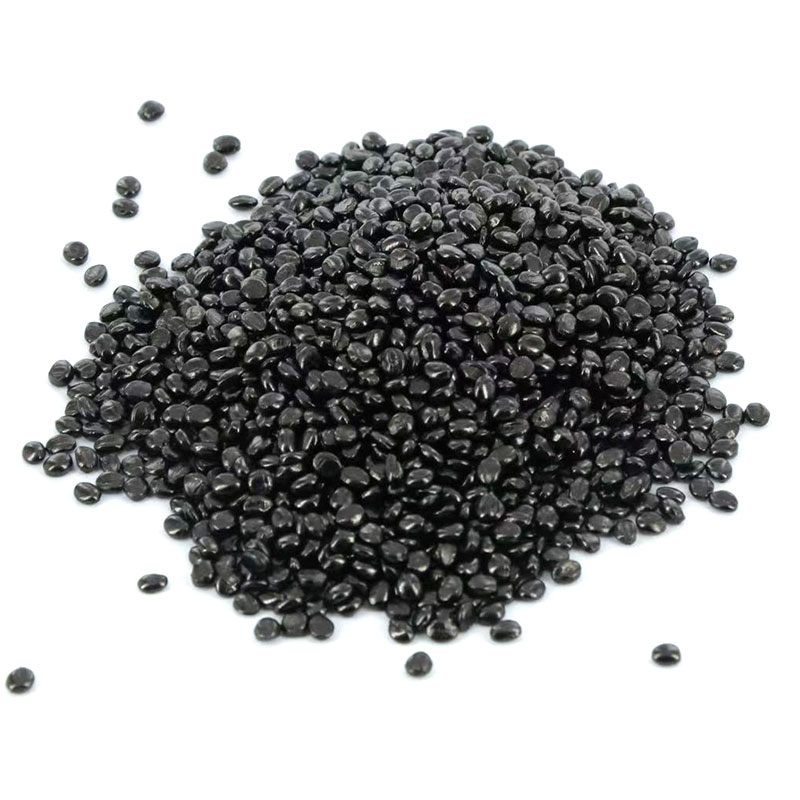

Injection Molding Grade Reinforced Black Masterbatch Wholesale

Home / Products / Injection & Extrusion Black Masterbatch / Appliance Casing Black Masterbatch / Injection Molding Grade Reinforced Black Masterbatch

Injection Molding Grade Reinforced Black Masterbatch

Injection Molding Grade Reinforced Black Masterbatch

This injection molding grade reinforced black masterbatch is a functional material based on polyethylene (PE) and infused with carbon black and calcium carbonate fillers. The carbon black concentration is approximately 40%. The product's formula offers a balanced balance of coloring and filling properties, enabling excellent dispersibility and processability in PP injection molding processes. The inclusion of an appropriate amount of calcium carbonate filler not only enhances the structural stability of the finished product but also provides more balanced performance during application.
This masterbatch is primarily used in the production of various injection-molded products, such as daily necessities, household items, and engineering plastic accessories. By mixing with raw materials, it effectively improves the color uniformity of finished products and enhances the appearance stability while maintaining mechanical properties. The recommended addition level is 1-3%, and users can adjust the amount based on specific process conditions and product requirements to achieve the desired processing effect.

Parameter

# BLACK MASTERBATCH PP103

PP103 is made of PE and carbon black with calcium carbonate filler., Carbon black concentration is 40%. Applicable for PP injection.

Ingredients Carbon Black: 40%±2
ASH: <12%
Usage Mixed with materials.
Dosage suggested 1-3%.
Technical Index Density: <2.0g/cm3
Melting Speed:>10g/10min(21.6kg/190℃)
Moisture:<0.50%
Package 25kg per bag, KP bag or PE bag
Storage Place in dry and cool warehouse, avoid sun shine and raining.
Note The above index is based on the testing result for reference only, not as the specific index.
Appliance Casing Series

Injection Molding Grade Reinforced Black Masterbatch — Grade PP103

PP103 is an injection molding masterbatch formulated specifically for polypropylene — a carrier-resin match that matters more than it might appear. When a PE-carrier masterbatch is used in PP injection without attention to the MFR relationship between carrier and base resin, the mismatch in flow behavior can produce localized carrier-rich zones that appear as color variation or surface texture breaks in the finished part. PP103 is compounded with a carrier and CaCO₃ filler loading (ash <12%) tuned to the MFR range of standard injection-grade PP, delivering predictable distribution across the mold shot without requiring processing adjustments on the line.

At 40% carbon black concentration, PP103 provides the color strength expected from a high-performance injection masterbatch while the controlled filler content adds structural contribution at the part level — particularly relevant for thin-walled daily use items and appliance components that must resist warpage and dimensional creep under sustained mechanical loading.

40%
Carbon Black
<12%
Ash Content
>10
MFR g/10min

Technical Data Sheet

PP103 — Full Parameter Reference

Parameter Specification Method / Notes
Grade Code PP103 PP Injection — Appliance Casing Series
Carrier Resin Polyethylene (PE) MFR-matched for PP injection processing window
Carbon Black Content 40% ± 2% Standard furnace grade for uniform black and adequate UV protection
Filler (CaCO₃) Present — ash <12% Structural reinforcement contribution at part level
Ash Content < 12% ISO 3451 — controlled for balance between filling effect and part properties
Density < 2.0 g/cm³ ISO 1183
Melt Flow Rate > 10 g/10 min 190°C / 21.6 kg — PP injection compatible flow range
Moisture Content < 0.50% Prevents surface sink marks and gloss-loss in PP injection molding
Primary Process PP Injection Molding Validated on standard single-stage injection lines
Recommended Dosage 1% – 3% Adjust based on target part color depth and wall thickness
Typical Applications Daily-use items, household articles, home appliance parts, engineering plastic accessories
Packaging 25 kg / bag (KP or PE bag) Store sealed in dry, cool warehouse

Formulation Rationale

What "Reinforced" Means in an Injection Molding Masterbatch Context

Dimension 01

Structural Stability from Controlled CaCO₃ Loading

The "reinforced" designation reflects the CaCO₃ filler content — controlled to an ash ceiling of <12% — which at typical letdown (1–3%) introduces roughly 0.12–0.36% inorganic content into the base resin. At this concentration, CaCO₃ acts as a nucleating agent for crystalline PP, accelerating spherulite formation during cooling and slightly increasing the stiffness and heat deflection temperature of the finished part. For household items and appliance components that must resist deformation under mechanical loading or elevated ambient temperature (near cooking surfaces, motor housings), this nucleating contribution is a meaningful functional advantage over an unfilled masterbatch of equivalent color strength.

Dimension 02

Color Uniformity Across Complex PP Injection Geometries

PP injection molds for appliance parts and household articles often feature complex gating, thin ribs, and variable wall sections — geometry that creates significant shear variation across the mold fill path. Masterbatches with poor dispersion exhibit color concentration gradients in these regions, appearing as shading differences across the part visible in uniform lighting. PP103 uses a twin-screw compounded carbon black dispersion at 40% loading that maintains color uniformity across the shot, including at gate points, weld lines, and thin-rib terminations where flow-induced segregation is most pronounced.

Dimension 03

Flow Compatibility with Standard Injection-Grade PP

The MFR of PP103 (>10 g/10min) is matched to the injection-grade PP range (typically 8–30 g/10min), ensuring that adding the masterbatch to the blend does not create a significant viscosity imbalance that would require barrel temperature or injection pressure changes. This is particularly important for production lines running multiple PP grades on the same machine: a masterbatch that requires process adjustments when switching base resin grades creates downtime and scrap. PP103 integrates cleanly into standard PP processing windows without line re-qualification.

Dimension 04

Appearance Stability for Mass-Production Household Products

Household items and daily-use articles are often produced in continuous multi-cavity tooling at high cycle rates. Under these conditions, small batch-to-batch variation in masterbatch CB concentration translates directly into visual color shift across production lots — a cause of customer returns and rework for consumer goods manufacturers. PP103's ±2% CB concentration tolerance, combined with in-house batch QC testing at E-LUCK, constrains the main variable responsible for lot-to-lot color drift and allows multi-lot production runs with visually consistent output.


Process Context

PP Injection Molding: The Process Environment PP103 Is Designed For

180–240°C
Typical PP barrel temperature range

PP103 is formulated for the processing temperatures standard in injection-grade PP: barrel temperatures of 180–240°C and mold temperatures of 20–60°C depending on part geometry and cooling system. The PE carrier in PP103 melts completely before 180°C, ensuring early and uniform incorporation into the PP melt before the injection shot is formed. This early melt integration is the mechanism that prevents unmixed pellets from reaching the cavity and causing color spots or surface defects.

1–3%
Dosage range by weight

Within the 1–3% dosage range, PP103 delivers full black saturation for most PP part thicknesses above 1.5 mm. At 1% for thick-section parts (>3 mm), full color depth is reached and cost per kilogram of finished product is minimized. For thin-wall parts or parts requiring a particularly deep, non-reflective black, 2–3% dosage compensates for the lower optical path length through the part wall. The <12% ash ceiling ensures that even at 3% letdown, the total CaCO₃ contribution to the PP matrix remains below practical property-loss thresholds.


Dosage Guide

Recommended PP103 Addition Rates by Application Category

Application Category
Color Demand
Dosage
Appliance casing — thick section (>3 mm)
1–1.5%
Household articles — standard wall
1.5–2%
Daily-use items — thin wall (<2 mm)
2–2.5%
Engineering plastic accessories
1.5–2.5%
Multi-cavity fast-cycle production
1.5–2%

Dosage ranges are indicative. Final rate depends on part wall thickness, base resin grade, and mold design. Contact E-LUCK technical team for part-specific dosage confirmation.


End-Product Applications

Three Manufacturing Categories Where PP103 Delivers

01
Home Appliance Components

Internal and external injection-molded PP components for washing machines, refrigerators, air conditioners, and small kitchen appliances. PP103's uniform color distribution across complex mold geometries ensures consistent appearance on parts viewed by the end consumer — control panel bezels, drawer guides, door hinges, and ventilation grilles.

The structural contribution from the CaCO₃ filler is particularly relevant for internal mechanical components (gear housings, bracket clips, motor covers) that must maintain dimensional stability under cyclic thermal and mechanical loading over the product service life.

02
Household Articles and Daily-Use Products

Storage containers, organizers, tool handles, closet accessories, and general household PP moldings produced in high-volume multi-cavity tools. For this category, the economic calculation favors PP103's 40% CB concentration: fewer kilograms of masterbatch per tonne of PP processed, consistent color across long production runs, and no requirement for line adjustment between production shifts.

At 2% letdown in standard injection-grade PP (MFR 12–20 g/10min), PP103 delivers a clean, dense black suitable for retail shelf display without gloss treatment, anti-static coating, or post-mold secondary operations.

03
Engineering Plastic Accessories

Structural brackets, cable management clips, connector housings, and mechanical accessories molded in engineering-grade PP or PP compounds with talc or glass fiber. In fiber-filled PP compounds, the masterbatch flow behavior must integrate with a base resin that is already highly reinforced and potentially at higher viscosity than unfilled grades.

PP103's MFR of >10 g/10min provides adequate flow to blend uniformly even in glass-filled PP compounds (typically processed at higher barrel temperatures) without requiring viscosity compensation. Confirm at trial for fiber content above 30% GF where compound MFR may be below 5 g/10min.


Technical FAQ

Common Technical Questions on PP103

Why is the ash ceiling for PP103 set at 12% rather than the <1% used in higher-purity grades?+

The ash content in PP103 reflects the functional role of the CaCO₃ filler in this particular grade. For household articles and appliance components molded in PP — which is inherently lower in stiffness than engineering resins like PC or PA — the CaCO₃ contribution at 12% ash provides a measurable increase in rigidity and heat deflection temperature that is useful in the finished part. This is a deliberate formulation choice rather than a purity limitation. Processors who require a filler-free black at similar CB concentration should look at E-LUCK's E148J or 6005 grades, which use clean PE carrier without mineral addition, at the cost of the filler's structural contribution to the part.

Can PP103 be used in glass-fiber reinforced PP (GFPP) compounds?+

PP103 is compatible with GFPP at fiber loadings up to approximately 20–25% by weight, confirmed at standard processing temperatures for GFPP (220–260°C barrel). At higher fiber contents (>30% GF), the base compound viscosity may require a masterbatch with lower MFR than PP103's >10 g/10min to maintain uniform dispersion — an excessively fluid masterbatch in a high-viscosity matrix can migrate to the fiber-rich zones and create color non-uniformity near fiber agglomerates. For GFPP compounds above 30%, contact E-LUCK's technical team for a customized grade recommendation.

What surface finish can be expected from PP103 at standard injection conditions?+

PP103 delivers a consistent semi-gloss to gloss surface finish on standard polished tool steel molds, depending on the PP base resin and processing conditions. For high-gloss surface requirements (Class A or SPI A1/A2 finish), E-LUCK's A104E grade (lower MFR, optimized for gloss) is more appropriate than PP103. PP103 is optimized for appearance quality in standard appliance and household article tooling — typically SPI B1 to A3 finish levels — where gloss consistency across the part is more important than peak gloss value. For matte-tool finishes, PP103 produces a uniform non-reflective surface without surface irregularities at 1–2% dosage.

How does PP103 compare to using a pre-compounded black PP pellet?+

Pre-compounded black PP offers fixed color in a single material — convenient but inflexible. Switching part color, shade, or filler level requires a new compound SKU and a new supply agreement. Using PP103 as a letdown masterbatch with your chosen base PP resin gives you the flexibility to adjust dosage to hit your target color depth, change base resin supplier without reformulating, maintain separate natural-resin inventory for other colors, and qualify color adjustments without a new compound approval cycle. For high-volume production of a single black part family, pre-compound can be cost-effective; for mixed-product lines or products where base resin sourcing may change, masterbatch approach provides significantly more procurement agility.


Ready to Run PP103 on Your Injection Line?
Request a trial sample with your PP base resin specifications, or ask our technical team for process parameter recommendations for your specific mold geometry.
About Us
E-LUCK .
E-LUCK .

As China Injection Molding Grade Reinforced Black Masterbatch Factory and China Injection Molding Grade Reinforced Black Masterbatch Suppliers, E-LUCK is a professional manufacturer and solution provider specializing in black masterbatch for industrial applications. Since our founding, we have remained committed to the core values of precision, consistency, and material intelligence, integrating advanced dispersion technology with rigorous quality systems to meet the increasingly complex demands of modern polymer processing. From pipes and fittings to automotive parts, from consumer electronics to packaging films, our black masterbatches play a quiet yet critical role in enhancing product appearance, performance, and lifecycle for a wide range of downstream industries.

News

