

Structure-Enhanced Black Masterbatch Wholesale

Home / Products / Injection & Extrusion Black Masterbatch / Appliance Casing Black Masterbatch / Structure-Enhanced Black Masterbatch

Structure-Enhanced Black Masterbatch

Structure-Enhanced Black Masterbatch

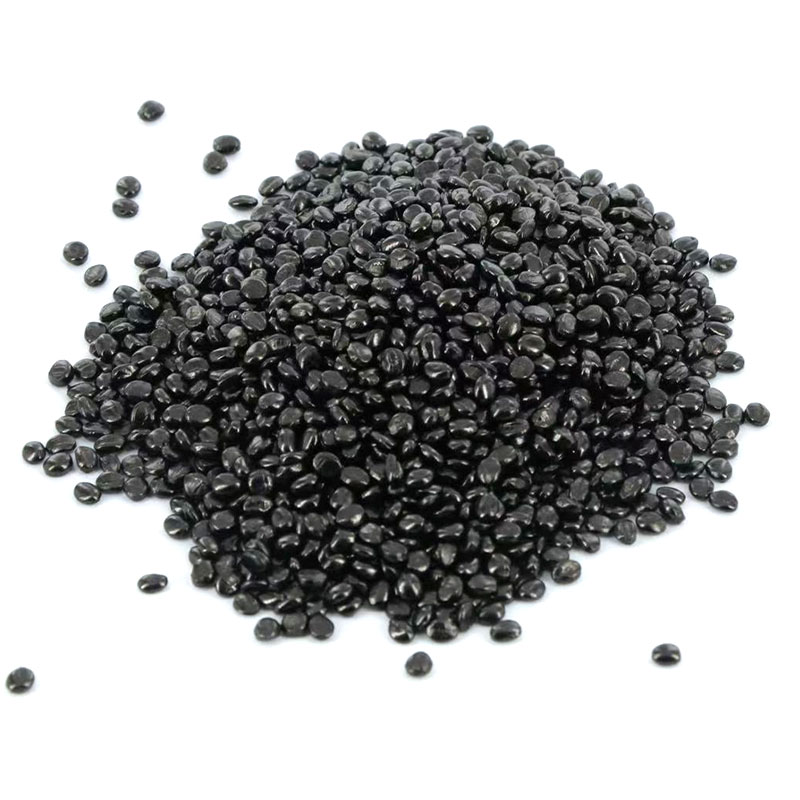
Structural-enhanced black masterbatch is a functional material based on polypropylene (PP) with 30% ± 2% carbon black and an appropriate amount of calcium carbonate filler. Its design focuses on enhancing the overall durability and structural strength of finished products while maintaining good dispersibility and stability during processing. This product is widely used in PP compounding, modification, and injection molding, effectively improving the mechanical properties and appearance of finished products. It is suitable for applications requiring both structural and aesthetic qualities.
The carbon black concentration of this structural-enhanced black masterbatch is optimally controlled to enhance impact and abrasion resistance while providing a stable coloring effect. The ash content is less than 1%, ensuring that the material's uniformity and strength are not affected during processing. Its light density makes it easy to mix with raw materials. A recommended addition level of 1-3% achieves performance improvements while maintaining cost-effectiveness.
Packaging is 25kg/bag, commonly in KP or PE bags, for easy handling and storage. The product should be stored in a dry, cool environment, protected from direct sunlight and rain, to maintain its functionality and processing performance. By properly applying this black masterbatch, manufacturers can ensure the structural reliability of their products while taking into account both appearance and processing efficiency.

Parameter

# BLACK MASTERBATCH PP30F

PP30F is made of PP. Carbon black concentration is 30%. Applicable for PP compounding, Modified, Injection

Ingredients Carbon Black: 30%±2
ASH: <1%
Usage Mixed with materials.
Dosage suggested 1-3%.
Technical Index Density: <2.0g/cm3
Melting Speed:>10g/10min(21.6kg/190℃)
Moisture:<0.50%
Package 25kg per bag, KP bag or PE bag
Storage Place in dry and cool warehouse, avoid sun shine and raining.
Note The above index is based on the testing result for reference only, not as the specific index.
Appliance Casing Series — PP Carrier

Structure-Enhanced Black Masterbatch — Grade PP30F

PP Carrier — Unique in This Series Every other masterbatch in E-LUCK's injection range uses a PE carrier. PP30F uses polypropylene — the same polymer family as its primary application substrate.

Grade PP30F is built on a carrier resin decision that sets it apart from every other product in this range: it uses polypropylene as its carrier instead of polyethylene. This is not a minor processing detail — it is a fundamental formulation choice that determines how the masterbatch integrates with PP-based compounds and injection resins at the molecular level. When you add a PE-carrier masterbatch to a PP melt, you introduce a minor immiscible polymer phase that must be mechanically dispersed. When you add PP30F to a PP melt, both the carrier and the base resin are thermodynamically compatible — they belong to the same polymer family, flow together, crystallize together, and form a homogeneous matrix without phase boundaries.

The 30% carbon black concentration reflects a deliberate formulation balance for the PP compounding and modification context: high enough to deliver full black coloration at 1–3% letdown, low enough to keep the pellet's own flow behavior within the PP processing window without requiring the masterbatch concentration alone to dominate melt rheology. And crucially, the ash content below 1% — achieved here without any mineral filler — means the structural integrity of the finished PP compound is uncompromised by inorganic residue from the colorant addition.

For PP compounders, modifiers, and injection processors who specify PP-system materials throughout their formulation, PP30F closes the one remaining gap: a black masterbatch where even the carrier is PP.

PP
Carrier Resin
Same polymer family as base resin — homogeneous integration
30%
Carbon Black
Balanced for PP compounding dosage window
<1%
Ash Content
No mineral filler — pure CB in PP carrier
>10
MFR g/10min
Matched to PP injection processing range

Technical Data Sheet

PP30F — Complete Parameter Reference

All values represent in-house QC testing results used as reference data. Contact E-LUCK for application-specific technical confirmation.

Parameter Specification Method / Context
Grade Code PP30F Structure-Enhanced — Appliance Casing Series
Carrier Resin Polypropylene (PP) Unique in E-LUCK injection range — PP carrier for PP substrates
Carbon Black Content 30% ± 2% Standard furnace grade — coloring and UV shielding balanced for PP modification
Filler None Zero mineral addition — pure CB in PP carrier matrix
Ash Content < 1% ISO 3451 — near-zero inorganic residue despite structural label
Density < 2.0 g/cm³ ISO 1183 — lower density than filled grades; easier volumetric blending
Melt Flow Rate > 10 g/10 min 190°C / 21.6 kg; ISO 1133 — compatible with standard PP injection MFR range
Moisture Content < 0.50% Controlled — PP carrier is less hygroscopic than PE + CaCO₃ systems
Recommended Dosage 1% – 3% Adjustable across PP compounding, modification, and injection contexts
Primary Applications PP compounding, PP modification, PP injection molding All three confirmed — see application section for process-specific guidance
Key Properties Impact resistance, abrasion resistance, stable coloring, structural reliability Structural enhancement via PP-compatible carbon black dispersion, not filler loading
Packaging 25 kg / bag (KP or PE bag) Hermetically sealed; dry warehouse, away from UV exposure
Shelf Life 24 months (sealed) No CaCO₃ filler — reduced hygroscopic moisture uptake over storage period

Carrier Resin Philosophy

Why the Carrier Resin Is the Most Consequential Specification on This Data Sheet

In polymer processing, like dissolves like — and like disperses like. A PP carrier masterbatch in a PP melt is not a foreign body to be distributed. It is the same material, carrying pigment.

Every masterbatch is a two-component system: the pigment and the carrier that delivers it. For the vast majority of black masterbatches — including most of E-LUCK's own range — that carrier is polyethylene. PE works well because it is inexpensive, widely compatible, and easy to compound with carbon black. But in a PP substrate, PE is technically an immiscible phase: PP and PE do not form a true solution in the melt. They disperse mechanically, and in most applications that dispersion is adequate. But "adequate" is not the same as "optimal."

PP30F uses a PP carrier precisely because PP compounders and modifiers increasingly work within all-PP material systems — PP base resins, PP-compatible additives, PP-carrier functional masterbatches — where every component is selected for polymer-family compatibility. PP30F is the black masterbatch that fits that system specification completely, without requiring a compatibility justification for a PE carrier in an all-PP formulation.

The practical consequences of carrier homogeneity show up at the compound level in three areas.

In mechanical testing, PP compounds colored with PP-carrier masterbatch consistently show marginally better impact and tensile retention at equivalent dosage versus PE-carrier equivalents, because there are no PE-PP interface zones acting as potential crack initiation sites in the crystalline PP matrix. The difference is small at 1–2% letdown but detectable in notched Charpy impact testing on thin-wall PP parts.

In crystallization behavior, PP carrier and PP base resin crystallize simultaneously and compatibly during mold cooling, producing a uniform spherulitic structure across the full cross-section of the part. PE carrier introduces a slightly different crystallization kinetics, which in thin-wall PP can produce minor surface-skin inhomogeneities visible under polarized light or in high-magnification surface inspection.

In rheology, PP-carrier masterbatch in a PP blend produces a single-phase melt with predictable viscosity behavior. The blend viscosity is directly calculable from the PP base resin MFR and the masterbatch addition rate — no PE-phase viscosity correction needed. This simplifies process engineering for compounders who model melt flow before tooling.


Carrier Comparison

PP Carrier (PP30F) vs PE Carrier in PP Applications — A Direct Assessment

The following comparison addresses the specific context of using each carrier type in PP-based compounding, modification, and injection. It is not a general evaluation of carrier performance across all substrates.

Criterion PP Carrier — PP30F PE Carrier — Standard Grade
Carrier/Matrix Compatibility Full thermodynamic miscibility — single-phase melt Mechanical dispersion — minor immiscible PE phase remains
Crystallization in Mold Carrier and base resin crystallize together; uniform spherulite structure Slight crystallization mismatch; detectable in polarized-light inspection of thin-wall parts
Impact Retention in Thin-Wall PP Marginally higher — no PE/PP interface zones as crack initiation sites Slightly lower at equivalent dosage in notched impact testing
Rheology Predictability Single-phase viscosity model — directly calculable from component MFRs Two-phase model — PE viscosity adds minor deviation from simple blend rule
All-PP Formulation Compliance Full compliance — no foreign polymer phase introduced Introduces PE as minor foreign phase — may conflict with all-PP system specifications
Ash / Filler Content <1% — no mineral filler Varies — 0% (clean PE grades) to 50%+ (filled grades)
Processing Temperature Range 180–240°C — PP injection and compounding window 180–240°C (PE carrier melts lower but integrates adequately in PP range)
Preferred Use Case PP compounding, modification, all-PP injection systems Multi-resin injection lines, PE-dominant applications, blown film

Formulation Balance

30% Carbon Black, Zero Filler, Ash Below 1% — Why This Combination Is the Right Balance for PP Structural Applications

30
30% CB — The Compounding-Appropriate Concentration

In PP compounding and modification, the masterbatch is often blended at higher letdown rates than in simple injection coloring — sometimes up to 3–5% when combined with other functional masterbatches in a multi-component formula. At 30% CB concentration, the 1–3% dosage recommendation puts 0.30–0.90% actual carbon black into the PP compound. This is the range where carbon black performs its full structural contribution: UV absorption sufficient for outdoor durability, enough reinforcing network effect to contribute to the stiffness of the PP matrix, and sufficient optical density for complete black saturation in parts above 1 mm wall thickness.

Higher CB concentrations (40–47%) make more economic sense in pure coloring applications where the masterbatch addition rate is kept minimal to avoid carrier dilution. In PP compounding where the masterbatch may be one of several co-additions, the 30% level allows slightly higher dosage flexibility without the extreme carrier-dilution sensitivity that comes with 40%+ grades.

0
Zero Mineral Filler — Structural Enhancement from CB, Not CaCO₃

The product name "Structure-Enhanced" might suggest that the structural benefit comes from mineral filler — CaCO₃ is the conventional filler used in other grades in this series. PP30F achieves its structural label differently: carbon black itself, when well-dispersed in a PP matrix at 0.3–0.9% by weight, functions as a micro-reinforcing agent. Carbon black particles at sub-micron dispersion create physical cross-link sites in the PP semicrystalline network that increase resistance to creep deformation and cyclic fatigue stress — effects that are well-documented in the carbon black compounding literature and distinct from simple colorant behavior.

Critically, this CB-based structural contribution comes without the mechanical property trade-offs of mineral filler: no reduction in impact strength, no reduction in elongation at break, no introduction of stress concentration points at particle-matrix interfaces. For PP appliance casings that must survive drop testing and vibration without cracking, the absence of mineral filler is a design advantage, not a deficiency.

<1
Ash Below 1% — Purity That Validates the PP Carrier Investment

In a PP-carrier system, an ash content below 1% means that what enters the PP compound from the masterbatch is essentially two things: polypropylene carrier and carbon black. Nothing else. No mineral filler, no processing aid residue above trace levels, no inorganic particles to interfere with the PP matrix crystalline structure. This purity level is the formulation outcome that makes PP30F genuinely suitable for compounding applications where the compound's final mechanical specification must be tightly controlled and where each component's contribution to the property profile must be independently accounted for.

For PP modification work specifically — where the compounder is engineering a specific property balance by combining PP with impact modifiers, compatibilizers, or reinforcing agents — the ability to predict exactly what the black masterbatch contributes (CB and PP carrier, nothing else) is a formulation control advantage that filled-grade masterbatches cannot offer.


Application Depth

PP30F Across Its Three Validated Use Contexts

Unlike single-application grades, PP30F is formulated to work across three distinct PP processing workflows. Each context has different requirements — and PP30F's PP carrier, low ash, and balanced CB concentration address all three without requiring process modification.

Use Context 01
PP Compounding

PP compounding lines run base PP resin with functional additives — talc, glass fiber, impact modifiers, stabilizers — through a twin-screw extruder to produce a compound pellet for downstream injection molding. Adding color at the compounding stage rather than at the injection stage allows tighter color control in the final part, eliminates color batch-to-batch variation at the injection machine, and simplifies the injection operator's material handling to a single-component input.

PP30F's PP carrier integrates with the compound twin-screw pass without creating a PE-PP phase boundary in the compound pellet. At 1–2% letdown during compounding (0.30–0.60% actual CB in the compound), PP30F delivers full black coloration that survives the subsequent injection molding step without color shift or surface defects. The low ash content means the compound's mechanical test data — impact, tensile, flexural modulus — reflects the performance of the base formulation without mineral filler contamination from the masterbatch.

Barrel temperature for PP compounding: 190–230°C barrel, 30–60°C die. PP30F integrates cleanly across this temperature range with no decomposition products at the extruder die.

Use Context 02
PP Modification

PP modification encompasses the engineering of specific property profiles — toughened PP, mineral-filled PP for stiffness, long-fiber PP, conductive PP — where the base resin is systematically modified by combining it with functional additives in precise ratios. Black coloring in modified PP must be integrated without disturbing the property balance that the modification is designed to achieve.

This is where PP30F's filler-free, PP-carrier formulation is most differentiated. In a toughened PP system (PP + POE rubber, for example), adding a filled masterbatch introduces mineral content that partially counteracts the toughening effect by reducing elongation at break and notch impact strength. PP30F introduces only PP carrier and carbon black — both of which are either compatible or beneficial in a toughened PP system — preserving the full toughening effect of the POE or other impact modifier.

For mineral-filled PP modification (PP + talc for stiffness), where ash content of the compound is already being managed to a specified loading level, PP30F's ash below 1% allows compounders to treat the masterbatch as effectively ash-free in their compound ash calculations — the contribution is below the error margin of typical ash content measurement methods.

Use Context 03
PP Injection Molding

Direct injection molding use — blending PP30F with base PP resin at the injection machine hopper and processing immediately — is the simplest application context and the one most comparable to PE-carrier alternatives. Here, the PP carrier advantage is present but less dramatic than in compounding: the injection molding process provides sufficient shear to adequately disperse a PE-carrier masterbatch in most PP grades, so the carrier compatibility advantage of PP30F is a refinement rather than a transformation.

Where PP30F's PP carrier creates measurable advantage in injection is in thin-wall appliance casing applications (wall thickness below 1.5 mm) processed at high injection speeds. At high shear rates in thin-wall tooling, the PE-PP interface behavior of PE-carrier masterbatches can produce surface defects — tiger-striping or micro-surface roughness — that are not present with a PP-carrier grade at equivalent shear rates. PP30F at 1–2% letdown in thin-wall PP casing tooling eliminates this variable, producing clean, uniform surface finish even at injection speeds optimized for fast cycle time.

Recommended processing conditions for PP injection with PP30F: barrel 190–230°C (adjust to base PP MFR), mold temperature 30–50°C, injection speed standard to mold geometry. No pre-drying required under normal storage conditions (<0.5% moisture on delivery). If stored in unsealed bags in high-humidity environment above 60% RH for more than 60 days, a 70°C / 2-hour pre-dry is recommended as precaution.


Processing Guide

PP30F Integration Parameters Across Processing Methods

Process Parameter
PP Compounding
Barrel Temperature
190–230°C (twin-screw); match to base PP compound formulation temperature
PP30F Addition Point
Side-feed or main hopper, depending on line configuration; side-feed preferred for compounds with high talc or fiber loading to avoid pre-melting
Dosage in Compound
1–2% of total compound weight; scale CB introduction relative to other functional additions
Screw Speed
Standard for PP compound type (typically 200–400 rpm); no adjustment needed for PP30F at 1–2%
Process Parameter
PP Injection Molding
Barrel Temperature
190–230°C; match to base PP MFR — lower MFR PP requires upper range, high MFR PP allows lower range
Mold Temperature
30–50°C for standard PP; 50–60°C for thin-wall parts requiring better surface finish
Blending Method
Hopper dry-blend with base PP pellets; gravimetric blending preferred for consistent dosage across shifts
Injection Speed
Standard for part geometry; no restriction from PP30F — PP carrier integrates at all standard injection speeds without flow-front segregation
Purge Between Grades
Standard PP purge compound; PP30F is PP-based and purges cleanly with natural PP in 3–5 shots at normal purge temperature

Dosage Reference

PP30F Addition Rate by Application and Wall Thickness

The 1–3% dosage window accommodates the full range of PP30F applications. The correlation between application context, wall thickness, and recommended dosage is as follows:

Application / Wall Thickness
CB Demand
PP30F Rate
PP compounding pre-blend (color in compound)
1–1.5%
PP modification — toughened or mineral-filled compound
1–2%
Injection — thick wall part (>3 mm), appliance casing
1–1.5%
Injection — standard wall (1.5–3 mm), household articles
1.5–2%
Injection — thin wall (<1.5 mm), covers and panels
2–3%
Multi-component compound (PP30F + other functional MB)
1.5–2%

Dosage figures are indicative. Adjust based on base PP resin color, part wall thickness, and target black depth. For PP modification formulas, calculate PP30F dosage as part of the total compound weight including all additives.


Technical FAQ

What PP Processors and Compounders Ask About PP30F

If a PE-carrier black masterbatch disperses adequately in PP, what is the practical justification for specifying PP30F instead? +

The justification depends on the application context. For simple PP injection of standard household parts at normal wall thickness and moderate performance requirements, a PE-carrier masterbatch disperses adequately and PP30F offers no compelling advantage over a well-formulated PE-carrier equivalent. The PP carrier advantage becomes meaningful in three specific situations: (1) thin-wall PP injection at high speed, where PE-carrier segregation can produce surface defects; (2) toughened or impact-modified PP compounds where PE introduction at the carrier level partially counteracts the impact modifier's function; and (3) all-PP material system specifications — common in automotive and premium appliance supply chains — where the compound formulation is required to contain only PP-family polymers throughout. If none of these conditions applies to your specific application, PP30F and a PE-carrier equivalent will perform comparably at identical dosage.

Does the PP carrier in PP30F affect its behavior when used in glass-fiber reinforced PP (GFPP)? +

PP30F is particularly well-suited for GFPP applications, more so than PE-carrier alternatives. In glass-fiber reinforced PP, the fiber-matrix interface quality depends on the PP matrix flowing uniformly around each fiber during compounding or injection. A PE-carrier masterbatch introduces minor PE-rich zones around the CB particles that can locally disrupt the fiber-matrix interface adhesion. PP30F's PP carrier integrates with the GFPP matrix as the same polymer, maintaining consistent interfacial conditions at the fiber surface. At 1–2% letdown in GFPP, PP30F does not detectably reduce fiber-matrix interfacial shear strength in standard pull-out testing. For GFPP compounds with fiber content above 30%, confirm at trial with your specific glass fiber sizing chemistry, as some specialty sizings are optimized for PP-matrix adhesion and may show sensitivity to any carrier introduction.

Why is the carbon black concentration at 30% rather than the 40–47% used in other grades? +

The 30% concentration reflects the different usage pattern of PP compounding versus standalone injection coloring. In compounding, the masterbatch is often one of several simultaneous additions — impact modifiers, stabilizers, compatibilizers — and the total addition of all functional masterbatches to the compound may sum to 5–10% or more. At this total addition level, using a 40–47% CB grade would either over-color the compound (requiring a very low addition rate that makes weighing accuracy critical) or require the CB masterbatch to be added at extremely low rates that limit its uniform dispersion in the compound. The 30% level allows a comfortable 1.5–2.5% addition rate in compound formulas, which is easy to weigh accurately and provides sufficient dwell time in the twin-screw for complete dispersion. For standalone injection coloring where the masterbatch is the only additive, a higher-concentration grade is more economical — PP30F is the right choice when the masterbatch is one component in a multi-additive PP formula.

How does PP30F perform in recycled PP (rPP) modification compounds? +

PP30F is well-suited for rPP modification applications for two reasons specific to the recycled PP context. First, rPP often has variable MFR and color across collection batches — introducing a consistent, well-characterized PP-carrier black masterbatch at 2–3% provides a stable coloring baseline that masks rPP batch-to-batch color variability effectively (black is highly opaque and covers underlying color variation better than any other color). Second, in rPP modification where compatibilizers or chain extenders are being added to restore rPP molecular weight, the last thing the compounder needs is an additional immiscible PE phase from a PE-carrier masterbatch that may interfere with the compatibilizer's function. PP30F's PP carrier is chemically identical to the rPP matrix and does not create additional compatibility challenges in rPP modification formulas.

Can PP30F be used alongside other functional masterbatches (e.g., flame retardant, UV stabilizer) in a single PP compound? +

Yes, and this is one of PP30F's designed use contexts. In multi-masterbatch PP compound formulas, PP30F can be co-added with UV stabilizer masterbatch, flame retardant masterbatch, anti-static masterbatch, or other functional PP-carrier additives in a single compound pass. The key formulation consideration is total carrier PP introduction: if all functional masterbatches in the formula use PP carrier, the cumulative PP carrier addition is straightforward to account for in the compound's PP balance. If some functional masterbatches use PE carrier and PP30F uses PP carrier, the formulation is still workable — the two carrier types co-disperse adequately in the PP matrix — but the formulation engineer should account for the mixed carrier contribution separately. For appliance casing compounds requiring black coloring plus UV stabilization plus flame resistance, a typical formula might combine PP30F at 1.5%, a UV stabilizer PP-carrier masterbatch at 2%, and a halogen-free FR masterbatch at 15–20%, all in the same compound twin-screw pass at 200–220°C.


PP-System Formulation Requires a PP-System Black Masterbatch
Send us your PP base resin grade, compound formula outline, and target application. Our technical team will confirm PP30F fit and recommend starting dosage and processing conditions.
About Us
E-LUCK .
E-LUCK .

As China Structure-Enhanced Black Masterbatch Factory and China Structure-Enhanced Black Masterbatch Suppliers, E-LUCK is a professional manufacturer and solution provider specializing in black masterbatch for industrial applications. Since our founding, we have remained committed to the core values of precision, consistency, and material intelligence, integrating advanced dispersion technology with rigorous quality systems to meet the increasingly complex demands of modern polymer processing. From pipes and fittings to automotive parts, from consumer electronics to packaging films, our black masterbatches play a quiet yet critical role in enhancing product appearance, performance, and lifecycle for a wide range of downstream industries.

News

