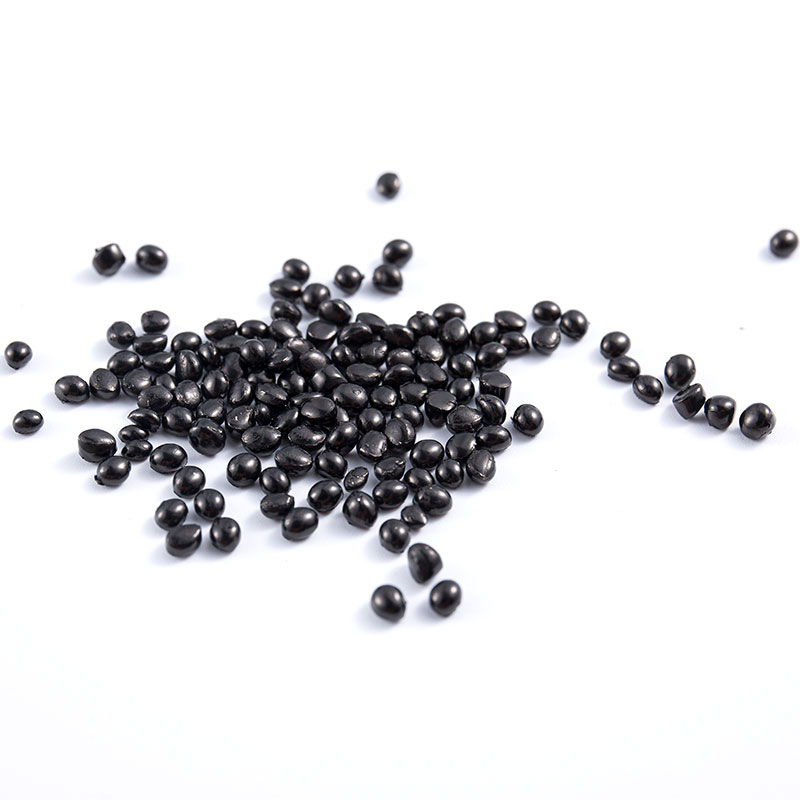
507C is made of PE, carbon black with calcium carbonate filler. Carbon black concentration is around 11%. Applicable for blowing film, pipe extrusion, and injection
Technical Insight
Inside 507C: Weather Performance & Application Guide
How this filler-based black masterbatch is formulated to keep buried and outdoor-exposed pipe stable, cost-efficient and consistently black.
507C is a PE-based weather-resistant black filler masterbatch combining roughly 11%±1 carbon black with a calcium carbonate filler system. It is built to give pipe, profile and molded parts a stable black finish that resists UV-driven surface degradation over time, while the filler-extended formulation keeps raw material cost efficient for large-volume production.
11%±1Carbon black tuned for weather stability
1–3%Standard letdown across processes
<72%Ash content from the filler system
<0.50%Moisture, limiting voids in pipe wall
What Goes Into 507C
For pipe-grade masterbatch, the balance between pigment and filler matters as much as the carbon black itself — too little filler and material cost climbs on long pipe runs, too little carbon black and UV screening drops. 507C is built from four functional components:
Carbon Black (≈11%±1)Provides jetness and absorbs UV radiation, converting it to heat rather than letting it attack the polymer chain.
Calcium Carbonate FillerExtends the formulation for large-volume, cost-sensitive pipe production while supporting dimensional stability as the pipe cools.
PE Carrier ResinCarries pigment and filler through the pellet and governs how cleanly 507C melts into the base pipe resin.
Processing AidImproves flow and helps the filler-heavy formulation disperse evenly instead of forming hard specks in the pipe wall.
This is why two masterbatches with the same carbon black percentage can perform very differently on a pipe line — filler quality, particle size and carrier compatibility all affect how cleanly the material processes at high output.
Performance Reference
| Property |
Common Test Reference |
Why It Matters for Pipe |
| UV / Weathering Behavior |
Accelerated weathering categories (QUV, Xenon-arc, ASTM G154 / ISO 4892 type methods) |
Carbon black absorbs UV radiation and dissipates it as heat, screening the polymer chain from direct UV attack |
| Melt Flow Rate |
21.6kg / 190°C |
Above 10g/10min supports stable output on high-volume pipe lines |
| Density |
Density testing (ASTM D1505 category) |
Below 2.0g/cm³, consistent with standard letdown calculations |
Results above describe general formulation behavior and commonly used industry test categories, not a guaranteed outdoor lifespan for a specific installation. Actual weathering performance depends on base resin grade, wall thickness, geographic UV exposure and burial conditions — converter trial is recommended for critical projects.
Processing & Dosage Guide
507C runs on standard HDPE and PP pipe extrusion lines without special screw modification. The table below is a starting-point guide — actual dosage should be adjusted for the target pipe diameter, wall thickness and required UV protection level.
| Application |
Suggested Dosage |
Note |
| Buried sewer / drainage pipe |
1.5–2% |
Standard range for pipe with limited direct sun exposure |
| Partially exposed pipe sections |
2–3% |
Slightly higher dosage improves UV screening during staging or installation |
| Injection-molded fittings |
1–2% |
Adjust based on part wall thickness and required surface finish |
Recommended processing temperature is generally 180–220°C depending on base resin and equipment; excessive shear or temperature can affect filler dispersion and surface finish.
Where 507C Sits in the Product Line
| Grade |
Carbon Black Level |
Best Fit |
| 507C (this product) |
11%±1 |
Sewer & drainage pipe, cost-sensitive buried applications |
| Standard Pipe Black |
15–18% |
Water supply pipe needing stronger UV screening |
| High-Carbon UV Grade |
20%+ |
Long-term above-ground exposure, cable protection duct |
Typical Applications
Most sewer and drainage pipe spends the majority of its service life buried, with only short windows of sun exposure during staging, installation or partial excavation. The 507C formulation is built around this reality — a filler-extended base keeps per-meter material cost down across long pipe runs, while the carbon black content still provides a protective UV screen and calcium carbonate adds dimensional stability as the pipe cools after extrusion.
Sewer & Drainage Pipe Corrugated Drainage Pipe Cable Protection Duct Irrigation Pipe Outdoor Profile Extrusion Injection-Molded Manhole Parts
Customization Options
507C is offered as a standard grade, but the filler-to-pigment ratio can be adjusted to match different project priorities. Common customization requests include:
Higher Carbon Black for Stronger UV Screening Adjusted Filler Ratio for Cost Targets Custom Carrier Resin (HDPE / PP) Adjusted Pellet Size Custom Bulk Packaging Weight
Storage & Shelf Life
Store 507C in its original sealed packaging in a dry, well-ventilated warehouse, away from direct sunlight, rain and heat sources above 40°C. Under these conditions, pellets typically remain stable for 12 months from the production date. Opened bags should be resealed promptly, since moisture pickup can lead to surface voids or reduced output stability during pipe extrusion.
Frequently Asked Questions
Is 507C suitable for pipe that stays exposed above ground?
It is well suited to short-to-medium term above-ground exposure, such as staging before installation or partially exposed drainage sections. For pipe runs with permanent, long-term direct sun exposure, a higher carbon black loading grade is generally the better fit for stronger UV screening.
Does the high calcium carbonate filler content weaken the pipe?
At the recommended 1–3% letdown into base pipe resin, the filler's actual share within the finished pipe wall is very small. Within this dosage range, the mechanical properties of the finished pipe are governed mainly by the base HDPE or PP resin rather than by the masterbatch.
Can 507C run across blown film, pipe extrusion and injection molding on the same line?
Yes — the carrier system is formulated for broad process compatibility. Processing temperature and screw configuration should still be tuned to the specific equipment and base resin in use.
How long can an unopened bag be stored before use?
Sealed bags stored in a dry, cool warehouse away from direct sunlight and rain maintain stable dispersion and processing performance well within a normal production cycle. Once opened, bags should be resealed and used within a reasonable timeframe to avoid moisture pickup.
Can the filler ratio be lowered if higher pipe stiffness is needed?
Yes, the filler-to-carbon-black ratio can be adjusted on request. Lowering the filler share generally raises material cost, so this is usually specified project-by-project based on the pipe's mechanical and UV protection requirements.
What is the minimum order quantity and lead time?
Order quantity and lead time depend on pellet packaging format and current production scheduling; please contact our team with your target pipe application and monthly volume for an exact quote.
Manufacturing & Quality Control
Incoming carbon black and calcium carbonate batches are checked for particle size and moisture before compounding. Formulation weighing is controlled by automated dosing rather than manual measurement, and each formulation is run through a lab-scale extruder trial to confirm dispersion and melt behavior prior to full production. A retained sample from every finished batch allows new shipments to be checked directly against prior orders for consistent blackness and processing performance.


 Español