

 Español


Typical Dosage Ranges: Start From Carbon Black Content, Not From the Bag
A 40% carbon black masterbatch dosed at 2.5% delivers 1.0% carbon black in the finished part. The same 2.5% of a 50% grade delivers 1.25%; a 30% grade delivers only 0.75%. That gap is why two plants can both report that they run 2.5% and still ship film with completely different opacity and pipe with completely different ultraviolet resistance.
Before anyone touches a feeder, confirm three numbers: the carbon black content of the masterbatch, the carbon black content the finished product has to reach, and the tolerance the end customer actually inspects against. Screw speed, let-down ratio and feeder calibration all sit downstream of those three figures.
Dosage Reference: Film, Pipe and Injection at a Glance
The ranges below assume the masterbatch carbon black content shown in the third column. If your grade sits outside that window, recalculate rather than copy the number across.
| Process | Typical masterbatch dosage | Masterbatch carbon black | Carbon black in the part |
|---|---|---|---|
| Blown film, 20 to 30 μm, courier and refuse bags | 4 to 7% | 40 to 50% | 2.0 to 2.8% |
| Blown film, 50 to 100 μm, agricultural and industrial liners | 2.5 to 4% | 40 to 50% | 1.2 to 2.0% |
| Stretch film, 12 to 23 μm | 2 to 4% | 40% | 0.8 to 1.6% |
| Drainage and corrugated pipe | 4 to 6% | 40% | 1.6 to 2.4% |
| Water supply pipe, outdoor exposure | 5 to 7% | 40 to 50% | 2.0 to 2.5% |
| Injection molding, visible housing | 1.2 to 2.5% | 40 to 50% | 0.5 to 1.2% |
| High-gloss injection, cosmetic surfaces | 1 to 1.5% | 40 to 45% | 0.4 to 0.7% |
| Engineering compounding, PA, PBT, PPS | 2 to 4% | 30 to 45% | 0.9 to 1.8% |
Where Typical Set-Points Actually Land
The Formula That Replaces Guesswork
Masterbatch dosage is a division problem, not a habit. Take the carbon black percentage the part must achieve, divide it by the carbon black fraction inside the masterbatch, and multiply by 100.
Masterbatch dosage (%) = target carbon black in the part (%) ÷ carbon black content of the masterbatch (%) × 100
Want 2.5% carbon black in a pipe and running a 50% grade? That is 2.5 ÷ 50 × 100 = 5.0% masterbatch. Running a 40% grade for the same pipe? The answer moves to 6.25%. The pigment requirement has not changed at all, only the concentration of the vehicle you bought.
| Target carbon black in part | 30% grade | 40% grade | 50% grade |
|---|---|---|---|
| 0.8% | 2.7% | 2.0% | 1.6% |
| 1.0% | 3.3% | 2.5% | 2.0% |
| 1.5% | 5.0% | 3.8% | 3.0% |
| 2.0% | 6.7% | 5.0% | 4.0% |
| 2.5% | 8.3% | 6.3% | 5.0% |
The carbon black itself shifts the answer as well. A high-structure grade develops colour and opacity at a lower loading than a low-structure grade of the same percentage, so two masterbatches labelled 40% can behave quite differently on the line. It is worth understanding how carbon black type and carrier selection change performance before locking a dosing window into a work instruction.
Blown Film: Thickness Decides, Not the Bag Type
A 20 μm courier bag has roughly half the polymer mass per square metre of a 40 μm liner, but it needs a similar pigment loading per unit of area to read as black. That is why thin film is where dosage complaints concentrate. Processors who try to save cost by dropping from 5% to 3% on a 20 μm bag usually find grey, translucent edges within the first production hour.
The practical rule is to fix the carbon black content in the film first, then choose the film gauge, then pick the masterbatch concentration that lets you hit both with a feeder setting inside its accurate range. A 50% grade at 4% is usually more stable than a 30% grade at 6.7%, because the higher dosage pushes the feeder closer to the top of its control band and increases the risk of screw slip.
Dispersion Failure Looks Like a Dosage Problem
- Gel spots and crystal points on thin film usually mean agglomerates, not too little pigment.
- Streaking along the bubble is a melt-blending issue, often caused by cold feed zone temperatures.
- Batch-to-batch shade drift points at carbon black variation, not at the let-down ratio.
If the film is uniformly grey rather than speckled, the answer really is dosage. If it is black with white or dark specks, adding more masterbatch will only make the specks more visible.
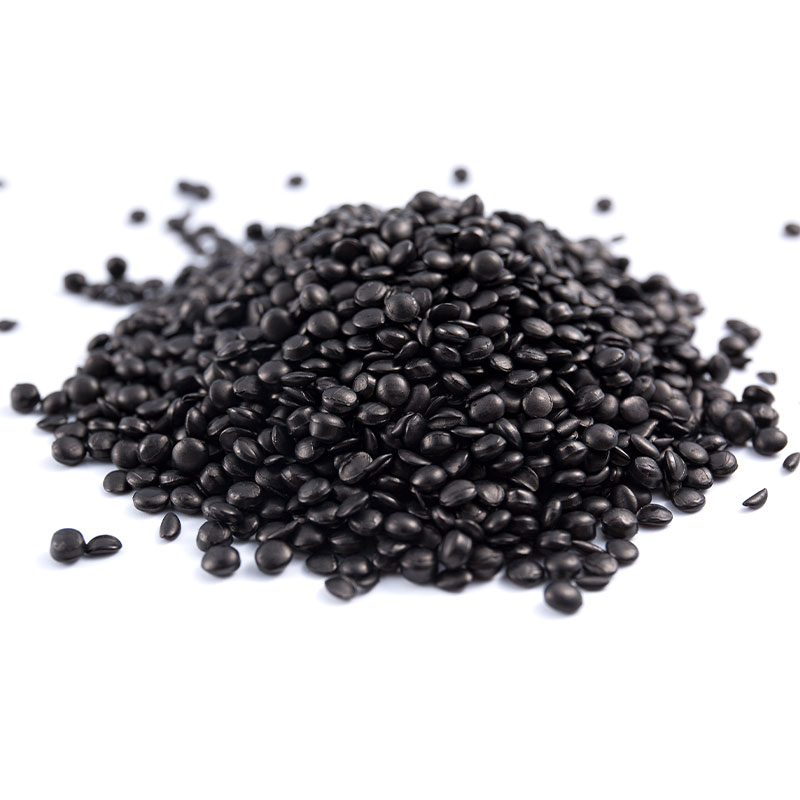 High Hiding Black Masterbatch for Film and PipePE-based black masterbatch with about 46% carbon black, designed for low-dosage opacity in film, pipe, injection molding, and sheet extrusion.View Product →
Pipe Extrusion: The Minimum Is Set by Ultraviolet Protection
Pipe is the application where under-dosing is most expensive and least visible. A drainage pipe that leaves the plant at 1.2% carbon black still looks black in the yard. Eighteen months of sunlight later, the surface has chalking, micro-cracks and a measurable drop in impact strength.
Outdoor-exposed polyethylene pipe generally needs around 2.0 to 2.5% carbon black in the wall to build a continuous ultraviolet screen. With a 40% masterbatch that means 5 to 6.25% dosage, and with a 50% masterbatch it means 4 to 5%. Indoor or fully buried drainage pipe has more room, and 4 to 5% of a 40% grade is common.
What Changes the Pipe Number
- Wall thickness: thin-wall corrugated pipe tolerates less pigment variation than thick solid wall.
- Service exposure: above-ground, coastal or high-altitude installations demand the upper end of the range.
- Surface requirement: gloss pipe shows dispersion defects that matte pipe hides.
- Downstream operations: socketing and butt-fusion behave differently when carbon black loading is too high.
Over-dosing pipe is a real risk too. Pushing beyond roughly 3% carbon black in the wall starts to affect weld strength and can produce surface roughness that fails a visual inspection. Keep the dosing window narrow and verify it with a carbon black content test rather than by eye.
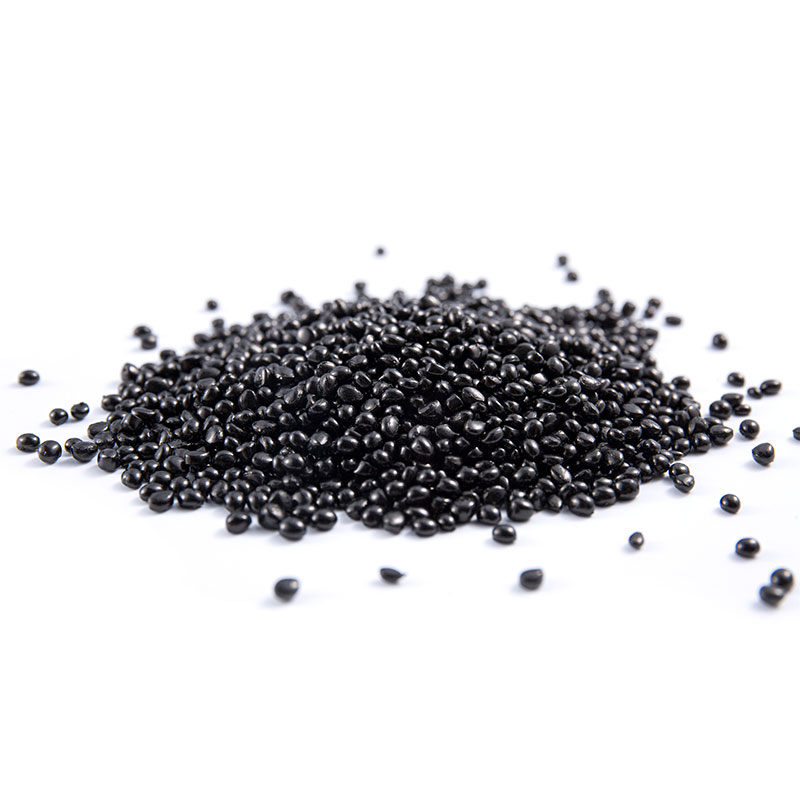 Enhanced UV Protection Black Masterbatch H6045PE-carrier grade with about 45% high-structure carbon black for UV-resistant water pipe and outdoor parts requiring uniform color and dispersion.View Product →
Injection Molding: Low Dosage, High Demand on Dispersion
Injection molding usually runs the lowest let-down ratio of the three processes, commonly 1 to 2.5%, because the part is thick, opaque by geometry, and judged almost entirely on surface appearance. A visible housing does not need 2.5% carbon black to look black. It needs enough pigment to hide flow marks, weld lines and gate blush, uniformly, across millions of shots.
For cosmetic and high-gloss parts, 1 to 1.5% of a 40 to 45% grade is often the ceiling, not the floor. Above that, surface gloss starts to drop and the part can pick up a faint bronzing tone under strong light. Below about 0.8% carbon black in the part, back-lit areas and thin ribs begin to show through.
The Three Injection Defects Tied to Dosage
Weld line halo is the one that gets blamed on dosage most often and deserves it least. It usually responds to melt temperature and injection speed far better than to an extra half percent of masterbatch.
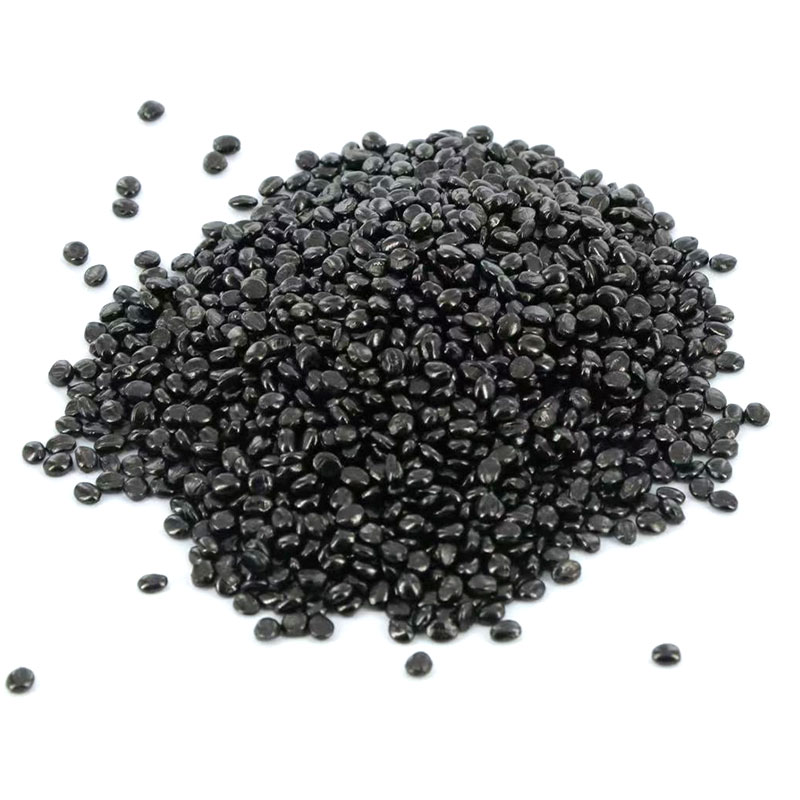 Bright Surface Black Masterbatch for Engineering PlasticsHigh-gloss black masterbatch for ABS, PP, PC and PS parts, with defined color values and a slight blue undertone for surface-critical applications.View Product →
Four Metering Errors That Quietly Shift the Real Dosage
The number written on the production sheet and the number actually entering the barrel are frequently different. These are the usual culprits.
- Volumetric feeders drifting. Bulk density differences between masterbatch and virgin resin change the volume-to-mass relationship as the hopper empties. Gravimetric dosing removes most of this error.
- Regrind loading. Regrind already contains carbon black. Adding 3% fresh masterbatch on top of 25% black regrind can push the part well past the intended pigment level.
- Moisture and caking. Damp masterbatch bridges in the throat and starves the screw intermittently, producing shade variation that looks random.
- Pellet size mismatch. When masterbatch pellets and resin pellets differ sharply in size and shape, they segregate in the hopper and the dosage oscillates through the run.
Feeding position matters as much as feeder accuracy. Downstream side feeding into the melting zone gives better control on high-dosage film lines, while a simple hopper addition is adequate for low-dosage injection work. Whichever route you use, the dosing method and ratio have to be validated on your own equipment, not borrowed from a data sheet.
Locking In Your Own Dosage: A Three-Point Trial
Every material combination behaves slightly differently, so treat published ranges as a starting bracket and confirm the final number on the machine that will run production.
- Run three points: nominal dosage minus 20%, nominal dosage, and nominal dosage plus 20%.
- For film, measure opacity and check for specks against a light box at each point.
- For pipe, cut a ring and send it for carbon black content testing rather than judging by colour.
- For injection, photograph the part under fixed lighting and compare gloss and weld line visibility side by side.
- Record screw speed, barrel temperatures and feeder setting for the winning point, and treat that as the baseline for the next order.
If a shift in shade appears between deliveries, test the incoming masterbatch for carbon black content before changing the feeder setting. Adjusting dosage to compensate for a material variation usually creates a second problem rather than solving the first.
Frequently Asked Questions
What is the maximum black masterbatch dosage?
Most processes stay below 8%. Above that, mechanical properties start to shift, surface quality drops and feeder stability becomes difficult. If you need more than 8% to reach the required opacity, the masterbatch concentration is too low for the job.
What happens if I add too little?
In film you get a grey, translucent appearance and poor light blocking. In pipe you get a product that passes visual inspection but fails ultraviolet ageing later. In injection you get read-through on thin sections and a washed-out surface.
Can the same masterbatch be used for film and injection?
Sometimes, but the economics rarely work. Film needs high hiding power and tolerates a higher dosage, while injection needs fine dispersion at low dosage and a carrier that matches the resin. A grade tuned for one process is usually a compromise in the other.
Does a carrier-free masterbatch change the dosage?
It changes the concentration, not the formula. Because there is no carrier resin diluting the pigment, a carrier-free grade typically delivers the same colour at a lower let-down ratio. Recalculate using the formula rather than reusing the previous setting.
Why is my part still grey at 5% dosage?
Either the masterbatch carbon black content is lower than assumed, or the dispersion is poor and the pigment is sitting in agglomerates. Check carbon black content first, then inspect a thin section under magnification before adding more material.