

 Español

What Is Carbon Black Masterbatch?
Deep black is one of the most difficult colors to control in plastics. A small change in pigment dispersion can cause surface streaks, black specks in thin film, or premature failure of an outdoor part. That is why processors rely on carbon black masterbatch instead of handling raw pigment in the plant.
A carbon black masterbatch is a concentrated pelletized mixture of carbon black pigment, carrier resin, and functional additives. It is introduced into a base polymer during extrusion or molding and diluted to the desired pigment level. Typical black loadings range from 15% to 50%, with some high-concentration grades above 50%.
The pellet form produces far less dust than raw carbon black powder. Powdered pigment is also difficult to wet out and prone to agglomeration. A masterbatch completes the wetting and dispersion work at the manufacturing stage, so the processor only needs to set a consistent addition rate. The final dosage still depends on part thickness, the degree of blackness required, and the level of opacity the application demands.
Why Use Carbon Black Masterbatch Instead of Raw Carbon Black?
Buying carbon black powder and mixing it into the polymer upstream is possible, but it creates problems that are easy to ignore until production is running. Masterbatch solves those problems before they reach the process:
- Consistent dispersion: high-shear mixing during masterbatch production breaks up carbon black agglomerates repeatably.
- Cleaner production: no airborne dust, simpler storage, and safer handling.
- Accurate metering: pellets flow and feed uniformly, so dosing is reproducible by weight or volume.
- Multi-functional formulation: UV stabilizers, antioxidants, and processing aids can be combined in the same pellet.
- Cost efficiency: a well-dispersed product often achieves the same hiding effect at a lower addition rate than raw powder, which lowers total cost per finished part.
The real comparison is not price per kilogram. It is whether you can run production smoothly and deliver an acceptable finished part on the first pass.
Key Performance Properties You Should Know
Dispersion
Dispersion is the first performance filter. Poor dispersion appears as black specks in film, dull surfaces in molded parts, and reduced impact strength. In extrusion lines, poorly dispersed black can also raise filter pressure and slow throughput.
A thin-film trial is a practical way to judge uniformity: hold the film up to a light source and look for agglomerates, streaks, or pinholes. If the film surface is clean at a low addition rate, the masterbatch is likely to behave well in thicker sections too.
Jetness and Hiding Power
Jetness depends on the particle size and surface chemistry of the carbon black. Fine particles give a deeper black but are harder to disperse. Hiding power determines how much masterbatch you need in thin-wall parts; insufficient hiding creates a gray or translucent appearance and drives material costs up while quality falls short.
UV Stability and Weather Resistance
Carbon black also works as a UV stabilizer in outdoor products such as films, pipes, and automotive parts. The specific carbon black grade and its surface treatment influence how well the final product resists chalking and embrittlement. A black surface that stays dark is not enough if the polymer underneath loses strength after months of exposure.
Heat Stability and Mechanical Properties
The masterbatch must survive the melt temperature of the target polymer without thermal degradation or unwanted color shift. It should also avoid harming impact strength, stiffness, or warpage. This is especially important in engineering plastics processed at high temperatures, where an off-spec carrier can create contamination-like defects.
How Carrier Resins Affect Performance: A Selection Guide
Why the Carrier Matters
The carrier is not a neutral binder. It determines compatibility, processing temperature, and the final property profile. If the carrier is not miscible with the base polymer, the part can show haze, delamination, or weak sections. The table below summarizes common carrier options.
| Carrier resin | Typical base polymers | Common uses | Selection notes |
|---|---|---|---|
| PE | LDPE, LLDPE, HDPE | Films, bags, pipes | Good flow, low processing temperature |
| PP | PP homopolymer, PP copolymer | Molded parts, sheet, automotive interiors | Needs heat stability above 220 C |
| PA | PA6, PA66 | Automotive parts, gears | Moisture-sensitive; match melt viscosity |
| PC | PC, PC/ABS blends | Housings, electronic enclosures | Carrier must tolerate high melt temperature |
| PBT / PET | PBT, PET | Connectors, electrical parts | Thermal stability and drying are critical |
| PPS | PPS compounds | High-temperature parts | Must survive very high processing heat |
| AS | SAN-based resins | Appliance parts | Improves compatibility in styrenic systems |
| PS | GPPS, HIPS | Household products | Styrenic carrier avoids haze |
| POE | Polyolefin blends | Impact-modified compounds | Soft carrier supports toughness |
| TPU | TPU | Cables, flexible parts, hoses | Needs elastic compatibility and bonding |
| PCTG | PCTG | Specialty packaging | Match polymer class to avoid stress whitening |
| Carrier-free | Multiple polymers | Compounding and modification | No carrier interference, high loading |
This list is not exhaustive. The key point is that carrier selection is a technical exercise, not a price comparison.
Polyolefin Carriers (PE and PP)
PE carriers are the default choice for film and pipe production on polyethylene bases. They offer a wide processing window and chemical similarity to the base polymer. PP carriers are common for polypropylene molding and sheet extrusion where melt temperatures are higher.
Engineering Plastic Carriers (PA, PC, PBT, PET, PPS, and More)
Engineering plastics process above the temperature range of standard polyolefins. A carrier such as PA, PC, PBT, PET, or PPS must tolerate the higher melt temperature and remain compatible with the base resin. Moisture sensitivity and thermal stability often decide which carrier is acceptable.
What About Carrier-Free Masterbatch?
Carrier-free masterbatch removes the carrier completely. It suits compounding operations where even a small amount of foreign polymer can change the final properties. It also enables very high pigment loading, although it requires careful mixing and more precise dosing in downstream processes.
For less common base resins, review a supplier's specialty black masterbatch options to confirm the carrier range matches your polymer.
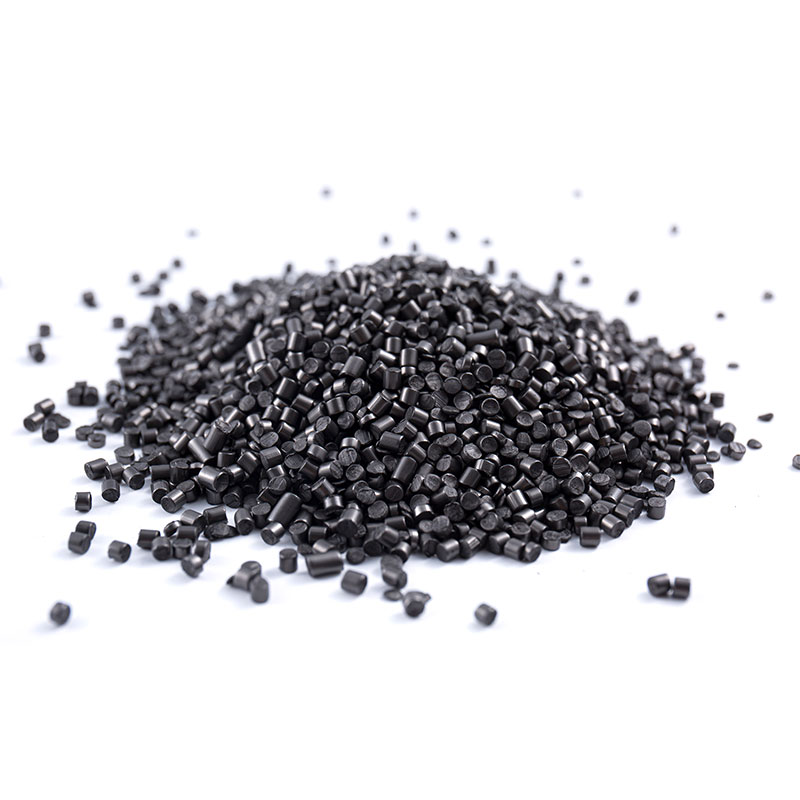 Specialty Black MasterbatchOur specialty black ...View Product →
Carbon Black Masterbatch Applications by Industry
Blown Film and Packaging
Blown film extrusion is a demanding test because defects become visible in thin walls. Black masterbatch is used for courier bags, shopping bags, garbage bags, and agricultural films to provide deep black color, opacity, and UV protection. For an example, learn more about carbon black masterbatch for courier bags.
Injection Molding and Extrusion
Appliance housings, toys, sheets, and profiles need consistent surface appearance and stable mechanical properties. A cleanly dispersed masterbatch prevents weak points and color difference between thick and thin sections of the same part.
Pipe and Profile
Water supply and sewer pipes remain in service for decades outdoors. Carbon black level and UV stability directly affect long-term durability. Choose a product designed for this environment, such as pipe-grade black masterbatch.
Food Contact Applications
Food packaging bags, tableware, and fruit and vegetable turnover boxes require masterbatch that complies with applicable food-contact regulations and is manufactured under controlled conditions. Light-blocking performance also matters when packaging protects light-sensitive contents. Ask for a dedicated food-contact black masterbatch when the application must meet these standards.
 Food Contact Black MasterbatchOur food contact bla...View Product →
Automotive
Automotive applications combine visual and functional demands: low volatile emission, scratch resistance, weatherability, and uniform gloss. Interior parts especially need low emission levels because they are used in confined spaces. Use a product formulated for this sector, such as automotive-grade black masterbatch.
How to Select the Right Carbon Black Masterbatch Supplier
Evaluating a supplier should be as structured as evaluating the product itself. A capable partner will help you avoid costly trial-and-error in production. The lowest price rarely wins once you include scrap rates, color complaints, and supply interruptions. Here are five criteria to check:
- Carrier coverage: Does the supplier offer masterbatches with the carrier resin you need, including less common systems such as AS, PA, PC, PBT, PET, POE, PPS, PS, PCTG, or TPU?
- Customization: Can the manufacturer adjust concentration, additive package, and flow behavior? For unusual requirements, customized black masterbatch services
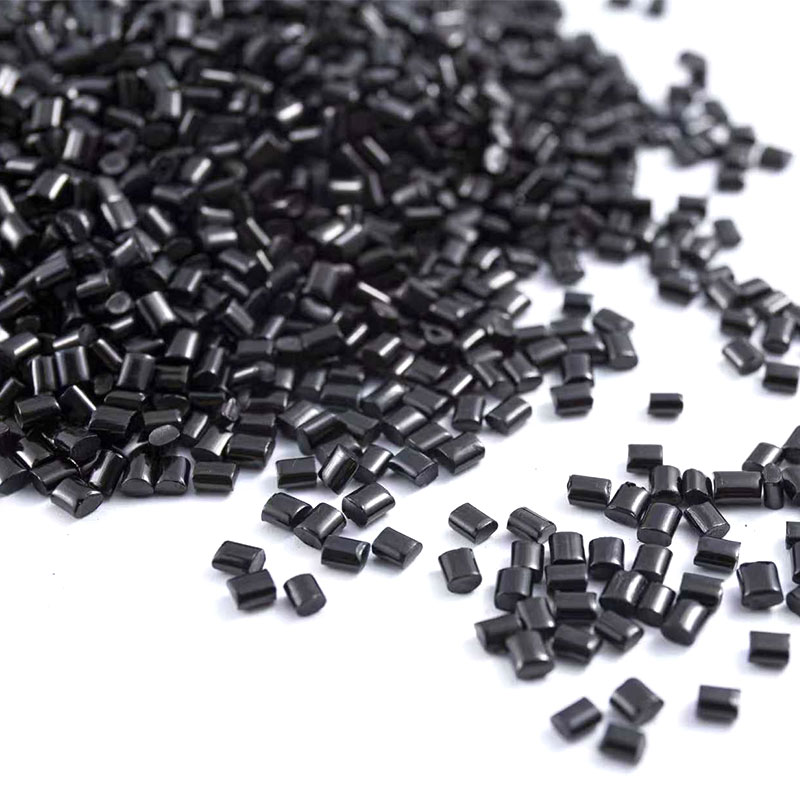 Customized Black MasterbatchOur customized black...View Product → make a practical difference.
 - Quality consistency: Ask about lot-to-lot color stability, pellet uniformity, and how the manufacturer verifies dispersion.
- Documentation: For regulated applications, the supplier should provide supporting documents that demonstrate compliance with the relevant standards.
- Technical support: A supplier who can troubleshoot process issues will save you more long-term than a slightly lower price per kilogram.
Conclusion
Selecting a carbon black masterbatch is not about buying the blackest pellet on the market. The carrier must match your base polymer, the concentration must suit your addition rate, and the performance properties should align with the final application environment.
Before you commit to a formula, bring your base resin, processing temperature, and part requirements to the supplier and ask for a recommendation. That approach reduces production risk and improves consistency from the very first trial.