

 Español


What PE Pipe Compounds Require from a Black Masterbatch
For a PE pipe line, the black masterbatch is not a cosmetic additive. It must deliver a UV screen that survives long-term outdoor exposure and a dispersion level that does not create weak points in the pipe wall. The practical target is usually a PE-compatible masterbatch that puts about 2.0–2.5% well-dispersed carbon black into the final pipe, supported by antioxidants and a carrier that matches the base resin. If either the UV load or the dispersion fails, the pipe can look correct at the factory and still show surface crazing, color drift, or slow crack growth after installation.
The first decision is therefore not “which black is darkest.” It is “which carbon black grade, at which loading, in which carrier, with which dispersion route.” A 40–50% carbon black masterbatch can be technically correct for one PE pipe and unsuitable for another if the carrier melt flow, carbon black structure, or filtration level does not match the extrusion line. Buyers who compare only price per kilogram usually miss the cost of scrap, rework, and field complaints.
Direct answer: Select a pipe-grade black masterbatch with a PE carrier, verified carbon black content, controlled moisture and ash, a dispersion rating agreed against a recognized test method, and a UV package matched to the pipe’s exposure. Confirm the let-down ratio by calculation and by a trial run, not by visual blackness alone.
PE pipes are used buried, above ground, in irrigation, drainage, water supply, cable protection, and industrial lines. Each duty changes the balance between UV protection, mechanical toughness, surface finish, and cost. A buried sewer pipe may not need the same UV load as an above-ground water line, but it still needs sufficient carbon black dispersion to avoid stress concentrations and surface defects. The masterbatch specification should follow the pipe standard, the installation environment, and the extrusion process window.
Why UV Protection Is a Pipe-Wall Property, Not a Color
Sunlight attacks the polymer at the pipe surface. UV energy, oxygen, and heat combine to break polymer chains, which reduces molecular weight and creates a brittle surface layer. In black PE pipes, carbon black absorbs a large part of the UV radiation and converts it into heat. That protection is only effective when the carbon black is present at the right concentration and is distributed as fine, separated particles and aggregates rather than large clusters.
A pipe can look uniformly black and still have UV windows. Large carbon black agglomerates leave zones where UV radiation passes between particles, while the surrounding polymer continues to degrade. The same agglomerates can act as stress concentrators. Under bending, soil load, or pressure cycling, those sites become starting points for microcracks. This is why UV protection and dispersion are linked: one cannot be judged separately from the other.
Surface appearance is a useful warning sign, not a complete test. Chalking, whitening, fine cracks, or a dull surface after weathering can indicate inadequate UV screening or polymer degradation. However, a pipe that passes a visual check at dispatch may still fail after months of exposure if the carbon black content is below the agreed target or if the antioxidant system is too weak for the extrusion history.
The pipe wall thickness also matters. UV degradation is a surface phenomenon, but surface cracks can grow into the wall under sustained stress. Thin-wall pipes and pipes with high surface-to-volume ratios need particular attention during specification. For pressure pipes, the UV package should be reviewed together with hydrostatic strength, slow crack growth resistance, and resistance to point loading.
Carbon Black Content and UV Screening Targets
For black PE pipes, a common technical target is 2.0–2.5% carbon black in the finished compound. The exact requirement depends on the product standard, the pipe application, and the exposure condition. Above-ground water lines, irrigation mains, and exposed drainage pipes usually justify the upper end of the range. Fully buried pipes may use a lower target only when the standard and the customer specification allow it, and when handling and storage exposure are still covered.
Carbon black content should be measured on the finished pipe, not only calculated from the masterbatch dosage. A loss-in-weight feeder can drift, material can remain in the hopper, and regrind can change the effective loading. Thermogravimetric analysis or a recognized carbon black content method gives a more reliable check. The result should be compared with the agreed specification and the test uncertainty, not with an assumed value from the masterbatch certificate alone.
Not all carbon black grades give the same UV performance. Primary particle size, surface area, structure, and impurities influence both UV absorption and dispersibility. A high-surface-area furnace black can provide strong UV screening, but it is also harder to disperse if the masterbatch is not properly compounded. High-ash or contaminated carbon black can introduce die deposits, specks, and inconsistent aging behavior. The masterbatch supplier should control the carbon black source and keep traceability by lot.
UV protection is not a single-ingredient task. Antioxidants protect the polymer during extrusion and service. Some formulations use hindered amine light stabilizers or other co-stabilizers, but the benefit depends on the polymer system and the exposure. Adding more carbon black cannot compensate for a poorly stabilized compound, and adding more stabilizer cannot compensate for large agglomerates that leave UV windows.
| Parameter | Typical target | Why it matters |
|---|---|---|
| Carrier resin | PE carrier matched to the pipe grade | Supports compatibility, feeding stability, and dispersion in PE |
| Carbon black content in masterbatch | 40–50% | Sets the let-down ratio and influences mixing energy |
| Carbon black content in pipe | About 2.0–2.5% | Provides the UV screen; verify by finished-pipe test |
| Dispersion | Agreed rating with no large agglomerates | Prevents UV windows and stress concentrations |
| Moisture | Low and controlled | Reduces voids, surface defects, and processing variation |
| Ash and contamination | Controlled by supplier specification | Limits die build-up, specks, and weak points |
| Antioxidant system | Matched to extrusion and service life | Protects the polymer during processing and aging |
Dispersion Requirements That Show Up on the Extrusion Line
Dispersion is the degree to which carbon black agglomerates are broken down and distributed through the polymer. Good dispersion means the carbon black is not simply mixed at a macro scale; it is separated into fine particles and small aggregates that are wetted by the PE matrix. In a pipe compound, poor dispersion can appear as black specks, surface roughness, filter pressure rise, or inconsistent mechanical performance.
Laboratory dispersion ratings are useful because they create an agreed reference. A common approach is to prepare a microtomed or pressed film and rate the remaining agglomerates under microscopy. The exact scale and acceptance limit should be written into the purchase specification. A general requirement such as “good dispersion” is not enough because two suppliers can interpret it differently. Define the test method, sample preparation, magnification, and maximum allowable agglomerate size.
The pressure filter test is a practical production check. Compound is passed through a screen pack under controlled conditions, and the pressure rise is recorded. A stable pressure trend indicates that the masterbatch is dispersing and that contamination is under control. A sharp rise can point to agglomerates, foreign particles, or poor mixing. The test is most useful when the screen size, temperature, flow rate, and starting condition are fixed and compared against a historical baseline.
Finished-pipe inspection adds another layer. The inner and outer surfaces should be checked for specks, bumps, and streaks. Wall sections should show uniform color and no visible clusters. For pressure pipes, dispersion should be reviewed together with hydrostatic test results and slow crack growth data. A masterbatch that gives a smooth surface but leaves large internal agglomerates is not a low-risk choice.
| Check | What to observe | Action if outside target |
|---|---|---|
| Microscopy dispersion rating | Size and number of remaining agglomerates | Review masterbatch lot, mixing, and screen pack |
| Pressure filter test | Pressure rise against an approved baseline | Check contamination and dispersive mixing energy |
| Surface inspection | Specks, bumps, streaks, or roughness | Inspect feed system, die, and masterbatch lot |
| Finished-pipe carbon black map | Uniform distribution through the wall | Adjust let-down and mixing; verify feeder accuracy |
How Carrier and Formulation Affect PE Pipe Performance
The carrier resin should be compatible with the PE pipe compound and the extrusion process. A carrier with an unsuitable melt flow can cause feeding fluctuations, localized over-plasticizing, or poor dispersion. For PE pipe grades, a PE-based carrier is usually the most straightforward route because it limits compatibility risk and keeps the let-down system simple.
Carbon black concentration in the masterbatch affects the amount of material that must be added. A 50% masterbatch added at 5% gives approximately 2.5% carbon black in the pipe. A 40% masterbatch added at 5% gives only 2.0%, and the same 5% dose may be below the target for an exposed pressure pipe. The calculation must be based on the certified carbon black content, not on a nominal “black masterbatch” label.
The formulation should also consider lubrication and stabilizer balance. Too much lubricant can reduce dispersion and create surface defects. Too little can raise torque and melt temperature. Antioxidants must survive the actual extrusion history, including residence time and filtration. If the masterbatch is designed for film or injection molding, it may not be optimized for the longer residence time and pressure conditions of pipe extrusion.
For demanding exposure, the UV system should be reviewed as a whole. Carbon black provides the primary UV screen, but the polymer still needs protection against thermal oxidation and long-term aging. The supplier should be able to explain the carbon black grade, the carrier, the antioxidant package, and the dispersion route without hiding behind a generic data sheet. That information is more valuable than a long list of unrelated product features.
Water Supply Pipes: UV Protection and Pressure-Class Consistency
Water supply pipes often combine buried and above-ground sections, and they may spend time in outdoor storage before installation. The black masterbatch should deliver a stable UV screen, good surface finish, and consistent dispersion at the approved let-down ratio. Because pressure pipes are designed for long service, lot-to-lot variation is a real risk: a small change in carbon black content or dispersion can shift the balance between toughness and aging resistance.
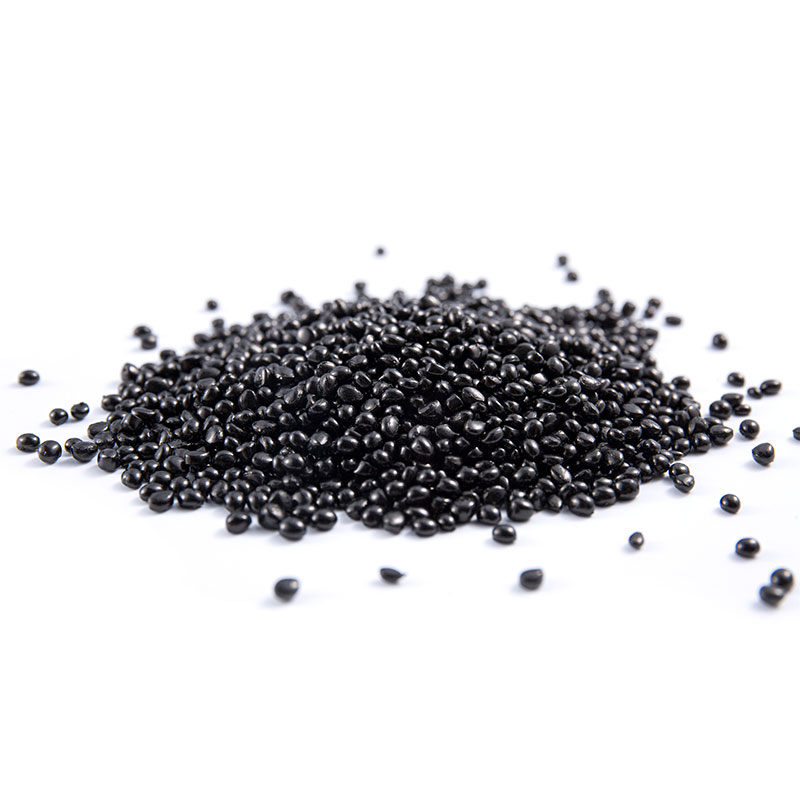 H6045 Enhanced UV Protection Black MasterbatchPE-carrier grade with about 45% carbon black and no mineral filler, suited to HDPE/MDPE pressure and potable water pipe extrusion.View Product →
UV protection focus
For exposed water lines and outdoor storage, confirm the carbon black content on finished pipe and review weathering test data. The target is not merely a dark surface; it is a continuous UV screen through the outer wall.
Pressure-class consistency
Review dispersion, antioxidant protection, and lot variation together. A pressure pipe specification should not accept a masterbatch on color alone when hydrostatic and slow crack growth performance are part of the duty.
Approval data
Ask for the carbon black content method, carrier type, dispersion test report, and recommended let-down. Compare those values with your pipe standard and your own trial results.
For buyers reviewing the wider pipe-grade range, the PE pipe black masterbatch range provides a useful starting point, but the final choice should be based on the pipe class, wall thickness, exposure, and extrusion line.
Sewer and Drainage Pipes: Weather Resistance and Cost Control
Drainage and sewer pipes may be buried for most of their service life, but they are often stored outdoors and installed in open trenches. UV exposure during storage and construction still matters. The specification can be adjusted to the duty, but it should not ignore the carbon black network, surface quality, and dispersion needed for impact resistance and long-term durability.
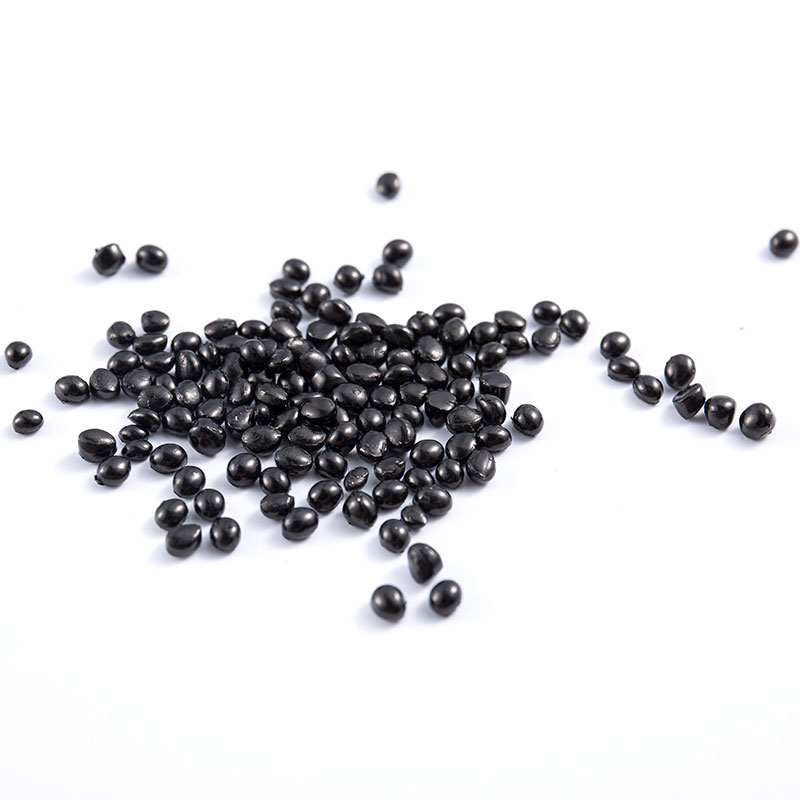 507C Weather-Resistant Black Filler MasterbatchPE-based black masterbatch with about 11% carbon black and calcium carbonate filler for cost-efficient coloring and UV resistance in drainage pipes, films, and molded parts.View Product →
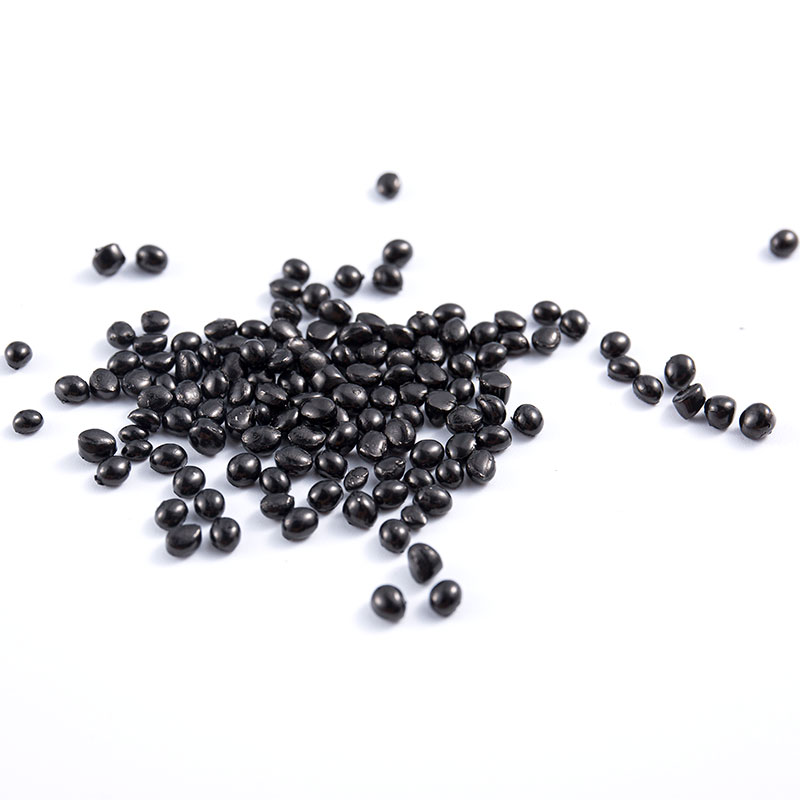 508C General Low Carbon Black MasterbatchCost-optimized PE-carrier black masterbatch with about 13% carbon black and calcium carbonate filler for sewer and drainage pipe coloring and basic UV protection.View Product →
Weather-resistant route
Use when pipes are exposed during storage, transport, or installation and when the project specification asks for a defined UV package. Verify carbon black content and surface appearance after weathering.
General low-carbon route
Use when the duty and standard allow a more economical formulation. Do not treat the lower cost as a reason to skip dispersion checks, because agglomerates can still reduce impact performance.
Duty-based selection
Match the masterbatch to wall thickness, installation method, and expected exposure. A buried sewer line and an exposed irrigation line should not be treated as the same application.
Cost control is legitimate, but it should come from the correct dosage and stable processing, not from cutting the UV screen below the standard. A lower-cost masterbatch that requires higher dosage or causes filter pressure rise can erase the apparent saving within one production shift.
Dosing, Extrusion, and Filtration Control
The let-down ratio should be calculated from the target carbon black content in the pipe and the certified content in the masterbatch. For example, a 50% masterbatch requires about 5% addition to reach 2.5% carbon black, while a 40% masterbatch requires about 6.25% addition for the same target. The feeder should be calibrated on the actual bulk density and pellet shape, and the setting should be locked in the production recipe.
Feeding stability matters more than many operators expect. Interrupted masterbatch flow can create bands of low carbon black content that are difficult to see in a black pipe. Loss-in-weight feeding, regular hopper checks, and a clear start-up purge procedure reduce this risk. If regrind is used, its carbon black content and dispersion history should be understood before it is blended back into pressure pipe compounds.
Extrusion conditions should provide enough dispersive and distributive mixing without over-shearing the polymer. Barrel temperature, screw speed, screen pack, and die pressure all interact. A masterbatch that disperses well on one line may need a different screen pack or mixing section on another. The trial should record torque, melt pressure, melt temperature, output, and surface quality so that the process window can be repeated.
Check certificate, carbon black content, moisture, and dispersion report before unloading.
Confirm the let-down ratio by weight and lock the recipe.
Balance temperature, screw speed, and screen pack for stable pressure.
Check surface, wall section, carbon black content, and dispersion.
Filtration is a useful early warning system. A rising screen pressure at stable output can indicate agglomerates or contamination. Do not simply increase the dosage to hide the problem; that can raise cost and make dispersion harder. Investigate the masterbatch lot, feeder, and mixing section before changing the formulation.
Quality Control: From Incoming Masterbatch to Finished Pipe
Incoming inspection should confirm identity, lot number, carbon black content, moisture, and dispersion. The certificate of analysis is a starting point, not a replacement for receiving checks. Keep a retained sample from each lot so that future surface defects or aging complaints can be traced back to a specific delivery.
In-process checks should focus on the variables that change the pipe wall: feeder accuracy, melt pressure, screen pack condition, output, and surface appearance. A shift in filter pressure or a sudden increase in specks is a signal to stop and inspect. For pressure pipes, finished-pipe testing should include carbon black content and dispersion in addition to the standard mechanical and hydrostatic tests.
Finished-pipe records should be linked to the masterbatch lot and extrusion recipe. If a field issue appears later, the link between material lot, process window, and test result is the fastest route to root cause. This is also where a practical quality guide such as pipe-grade black masterbatch quality control can help align receiving, production, and laboratory teams.
Weathering verification should use an agreed method and an agreed evaluation criterion. Color change alone is not a complete measure of UV protection. Surface cracking, gloss loss, and mechanical retention after exposure are more meaningful. The test should represent the actual exposure and wall thickness, not a thin film that overstates performance.
Procurement Risks and Supplier Questions
The most common procurement risk is a specification that describes the masterbatch only by color and carrier. That leaves carbon black content, dispersion, antioxidant protection, and contamination undefined. A second risk is lot-to-lot variation: a supplier may meet the first sample and then drift in carbon black source or dispersion quality. A third risk is an unrealistic cost target that quietly removes the UV or dispersion margin.
Ask the supplier to state the carbon black content in the masterbatch and the recommended let-down ratio for your target pipe content. Ask which dispersion method is used, what the acceptance limit is, and whether the report is from a production lot or a laboratory sample. Ask for moisture, ash, carrier melt flow, and antioxidant information. A supplier that cannot answer these questions is asking the buyer to carry the technical risk.
Is the grade controlled and traceable by lot?
Which method, limit, and sample preparation are used?
How is UV performance verified for the intended exposure?
What temperature, screen pack, and let-down are recommended?
What is the historical variation in carbon black content and filter pressure?
Can finished pipe tests be linked to the masterbatch lot?
Do not accept a generic “UV stabilized” statement without a test basis. Carbon black is an effective UV screen only when it is present at the right load and dispersion. The purchase order should reference the test method, the acceptance limit, and the sample retention period.
Cost Model: Why Dispersion Changes the Economics
The price per kilogram of masterbatch is only one line in the cost model. The real cost includes dosing level, scrap rate, filter changes, downtime, surface rejects, and field risk. A lower-priced masterbatch that needs a higher dose to reach the carbon black target may cost more per ton of pipe. A masterbatch that disperses poorly can raise screen pressure and reduce line output even when the purchase price looks attractive.
A simple trial can expose the difference. Run the candidate masterbatch at the calculated let-down, record filter pressure for a fixed period, inspect the pipe surface, and test carbon black content and dispersion. Compare the result with the current approved material. If the candidate requires a higher dose or causes more frequent screen changes, the delivered cost per acceptable meter of pipe is the correct comparison.
For long-life PE pipes, the cost of a field failure is far larger than the difference between two qualified masterbatches. The procurement decision should protect the UV screen and dispersion first, then optimize price within that qualified group. That order keeps the specification technically sound and commercially defensible.
FAQ: Black Masterbatch for PE Pipes
Is 2% carbon black enough for a PE pipe?
It can be enough for some buried applications if the standard and exposure allow it, but 2.0–2.5% is a common target for black PE pipes. Above-ground exposure, thin walls, and long storage usually justify the upper end. Verify the requirement against the pipe standard and test the finished pipe rather than relying on the masterbatch label.
Can I use a 40% masterbatch at the same dose as a 50% masterbatch?
No. The carbon black content in the pipe will be lower. A 40% masterbatch at 5% dose gives about 2.0% carbon black, while a 50% masterbatch at 5% gives about 2.5%. Recalculate the let-down ratio from the certified content and confirm it by finished-pipe analysis.
Does carbon black replace all UV stabilizers?
Carbon black is a strong UV screen, but it does not remove the need for a balanced stabilization system. Antioxidants protect the polymer during extrusion and service. Some formulations also use light stabilizers. The correct package depends on the polymer, wall thickness, exposure, and service life.
What dispersion test should be written into the purchase specification?
Use a recognized method agreed by both parties, and define the sample preparation, magnification, acceptance limit, and sampling frequency. A pressure filter test can be added as a production check. Avoid accepting “good dispersion” as a verbal requirement.
Why does a black pipe show surface specks if the masterbatch is black?
Specks can come from undispersed carbon black agglomerates, contamination, die build-up, or feeder instability. Inspect the masterbatch lot, screen pack, and extrusion temperature. Increasing dosage is not a reliable fix because it may make dispersion harder.
How should PE pipe black masterbatch be stored?
Keep it dry, cool, and protected from direct sunlight. Follow the supplier’s shelf-life guidance and use first-in, first-out stock rotation. Moisture and contamination control at storage are part of the quality system, especially when the same silo or feeder is used for different materials.
Can a masterbatch designed for film be used in PE pipe?
It may feed and color the pipe, but it may not be optimized for pipe dispersion, filtration, or long residence time. Film grades often use different carrier viscosity and additive balances. A pipe trial should confirm dispersion, surface, pressure stability, and finished-pipe carbon black content before approval.
Trial Run and Approval Plan Before Release
Start with a documented specification: target carbon black content in the pipe, allowed range, dispersion method and limit, carrier type, moisture limit, and UV test basis. Calculate the let-down ratio from the certified masterbatch content. Confirm the feeder can hold that ratio within the agreed tolerance and that the hopper and conveying system do not cause segregation.
Run a controlled trial at production screw speed and temperature. Record melt pressure, melt temperature, torque, output, screen pack condition, and surface quality at fixed intervals. Collect pipe samples from the beginning, middle, and end of the run. Test carbon black content, dispersion, and the relevant mechanical or hydrostatic properties. Retain samples from both the masterbatch lot and the finished pipe.
Compare the trial result with the current approved material and with the pipe standard. If the candidate passes, write the approved let-down, temperature window, screen pack, and test frequency into the production recipe. If it fails, identify whether the cause is carbon black content, dispersion, contamination, or process settings. Do not release the material on a single visual check.
The approval plan should also cover storage exposure. Keep a pipe sample outdoors or in an agreed weathering test and inspect it for surface cracking, chalking, and color drift. This step connects the masterbatch specification to the installed pipe, which is the condition that matters most.