

 Español


Start With Particle Size and Dispersion, Not With the Word Black
The fastest way to judge a carbon black masterbatch is not the color of the pellet in the bag. It is the relationship between primary particle size, aggregate structure, and how completely those aggregates are separated inside the carrier resin. A masterbatch can look intensely black and still fail in a 25-micron blown film if undispersed agglomerates remain above the visible threshold. The same masterbatch can pass a visual check in a thick injection-molded part and then create weak points, dull patches, or filter-pressure spikes in a demanding extrusion line.
Carbon black exists at three practical scales. Primary particles are the smallest units, typically in the nanometer range. Those primary particles fuse into aggregates, which are the structures that actually deliver color, hiding power, and reinforcement. Aggregates then cluster into agglomerates, and agglomerates are what dispersion must break down. If the agglomerates stay intact, the converter sees specks, gels, surface roughness, inconsistent gloss, or reduced mechanical performance. The buyer sees a batch that behaves differently from the approved sample even though the certificate of analysis reports the same carbon black content.
The commercial consequence is simple: particle size and dispersion are not laboratory details. They determine dosing level, scrap rate, surface appearance, tensile performance, and how much confidence a processor can place in repeat orders. A grade with finer carbon black may offer deeper jetness and stronger tinting strength, but it also demands more wetting, more shear energy, and better compatibility between carbon black and carrier. A grade with coarser particles may disperse more easily, yet it can sacrifice hiding power and surface smoothness. Quality comes from matching the particle-size band to the application window, not from choosing the smallest number on a datasheet.
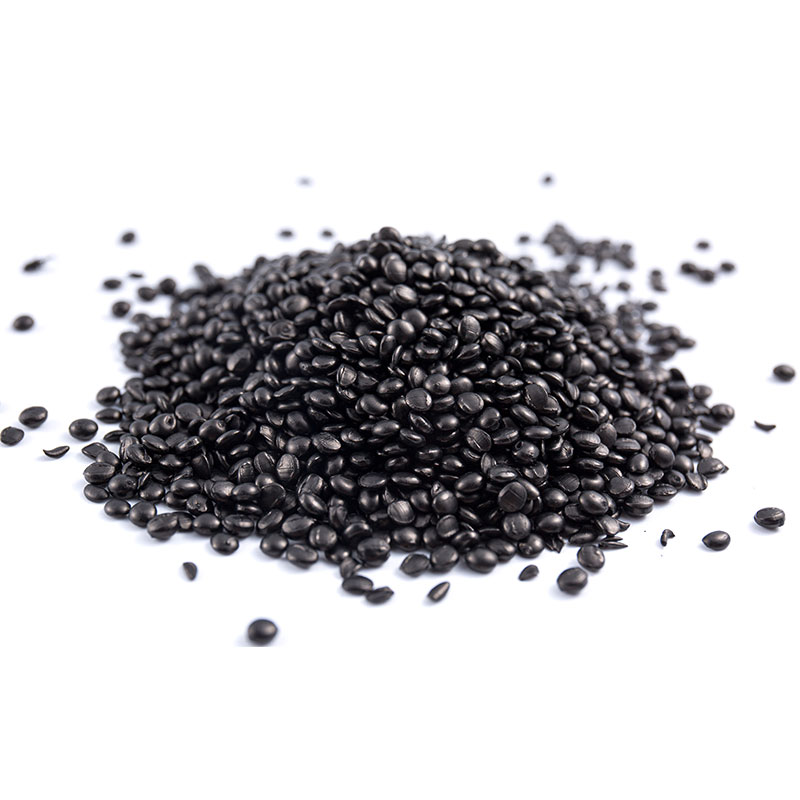 Stable Dispersion PE Black Masterbatch N4032PE-based 41% carbon black grade for thin films and pipes, with low ash/moisture and consistent dispersion for agricultural and injection-molded parts.View Product →
Why Smaller Carbon Black Particles Are Not Automatically Better
Finer carbon black offers more surface area per unit of weight. That surface area interacts with light and with the polymer matrix, which is why fine grades often produce higher jetness, stronger blue undertones in white reduction, and better opacity at lower loading. The trade-off appears during compounding and conversion. As particle size decreases, the attractive forces between particles increase, wetting becomes more difficult, and the viscosity of the masterbatch or letdown compound can rise. The extruder then needs a better dispersion screw design, more specific mechanical energy, or a more effective dispersant package to reach the same dispersion level.
This is why two suppliers can quote the same carbon black percentage and deliver completely different performance. One may use a fine, high-structure carbon black with a well-matched carrier and dispersant system. Another may use a coarse grade with weak wetting and rely on high loading to hide the difference. The first grade may cost more per kilogram but use a lower letdown ratio. The second may look cheaper per bag but generate more rejects, more color correction, and more downtime.
Relative behavior as primary particle size decreases
A practical purchase specification should state the target particle-size band, the acceptable dispersion level, the carrier system, and the intended letdown ratio. It should also define the test method used to verify dispersion. “Good dispersion” is not a specification. “No visible specks above 50 microns in a 30-micron film at 4% letdown, with filter pressure rise below the agreed limit” is a specification that a converter can audit.
Reading Dispersion Quality Beyond the Visual Black
Dispersion quality is often judged by eye because the eye is fast and free. The problem is that the eye sees only the largest agglomerates and only at the surface. A part can look acceptable and still contain internal agglomerates that reduce elongation, create stress concentration points, or cause a filter to block downstream. A film can look uniform under office lighting and show pinholes or specks under backlighting. A glossy injection-molded housing can hide dispersion problems behind a polished surface until the part is scratched or weathered.
For production control, combine visual checks with instrumented or physical checks that reflect the actual process. Filter pressure testing is useful for film, fiber, and thin-wall extrusion because it responds to agglomerates that can block a screen pack. Microscopy of a thin film or microtome section shows the size and distribution of remaining agglomerates. Gloss and surface roughness measurements catch changes in surface finish. Tensile and impact tests catch the mechanical penalty of poor dispersion or excessive filler loading. Color measurement under defined illuminants catches batch-to-batch shifts that the eye may miss.
| Observed signal | Likely cause | What to check first |
|---|---|---|
| Small dark specks in thin film | Undispersed carbon black agglomerates or contamination | Filter Pressure Value, screen residue, film microscopy, feeder accuracy |
| Dull patches or gloss variation | Poor surface wetting, moisture, or inconsistent dispersion | Carrier match, drying profile, melt temperature, screw configuration |
| Lower tensile or impact strength | High filler loading, poor dispersion, or polymer degradation | Letdown ratio, dispersion level, melt history, regrind ratio |
| Color looks brown or weak | Coarse carbon black, low tint strength, or excessive letdown | Carbon black grade, actual dosing, masterbatch concentration |
| Pressure rise across a screen pack | Agglomerates, gels, or incompatible carrier | Dispersion test, carrier compatibility, contamination scan |
For a broader selection framework, the carbon black masterbatch guide covers carrier types and selection logic. Use it as a planning reference, then validate the final grade on the actual production line. A laboratory dispersion result is valuable only when it predicts the behavior of the converter’s screw, die, screen pack, and cooling profile.
The Loading-Level Trade-Off: Hiding Power, Strength and Process Window
Carbon black masterbatch concentration is usually expressed as the percentage of carbon black in the masterbatch pellet, not the final part. A 40% masterbatch added at 5% letdown gives roughly 2% carbon black in the final compound. A 20% masterbatch added at 10% gives the same final loading but introduces twice as much carrier resin. That difference matters. High-concentration masterbatch can reduce packaging, storage, and carrier dilution, but it demands better dispersion capability and more precise feeding. Low-concentration masterbatch is easier to disperse and dose, but it can limit the formulator’s ability to adjust mechanical properties.
Hiding power
Higher carbon black loading improves opacity and light blocking, but once the film or part reaches full hiding, extra loading adds cost without visible benefit. The useful target is the lowest loading that meets the opacity standard under the final thickness.
Mechanical balance
Carbon black can reinforce and toughen some systems, but excessive loading or poor dispersion creates stress concentration points. Impact strength and elongation are often the first properties to reveal an overfilled or poorly dispersed batch.
Surface and process
High loading can raise viscosity, torque, and die pressure. That may reduce output or force higher temperatures that damage heat-sensitive carriers. The process window narrows before the color target is reached.
A useful starting point is to define the final carbon black loading by application, then work backward to masterbatch concentration and letdown ratio. For a black refuse bag, a cost-effective loading that meets opacity and tensile requirements may be sufficient. For an automotive exterior part, the grade must also meet weathering, surface gloss, and low-volatility requirements. For a food-contact article, the carbon black source, carrier, and additives must meet the relevant compliance standard. The same “black” masterbatch cannot serve all three simply because the final color matches.
High-concentration carrier-free grades are especially useful when the carrier resin would dilute or disturb the final formulation. They can deliver high carbon black content with minimal carrier interference, but they require robust feeding and dispersion control. The cost per kilogram may be higher, while the cost per finished part may be lower because less material is needed and the mechanical property balance is easier to protect.
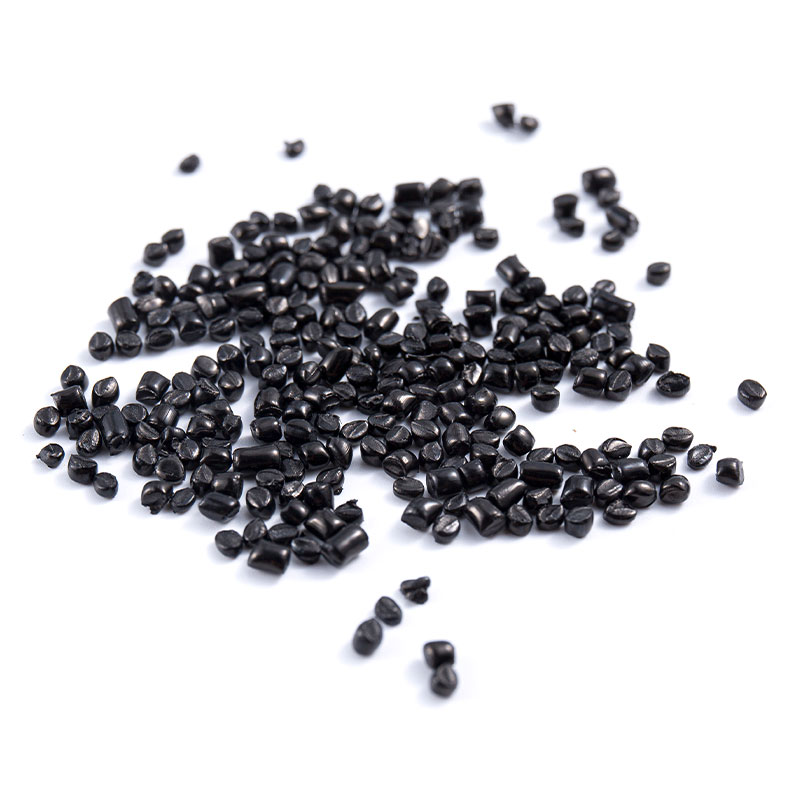 High-Concentration Carrier-Free Universal Black Masterbatch Y02VCarrier-free 50% carbon black masterbatch for PVC and varied resins, offering flexible dosing and uniform dispersion in injection molding, extrusion, and blown film.View Product →
Carrier Compatibility Decides Whether Good Dispersion Stays Good
Carbon black dispersion is not finished when the masterbatch pellet leaves the pelletizer. It must remain stable when the converter melts the masterbatch with the base resin. Carrier compatibility controls wetting, viscosity matching, and whether the carbon black stays uniformly distributed during the short residence time in the extruder. A polyethylene carrier is a natural match for PE film and pipe. A polypropylene carrier suits PP injection molding and fiber. Engineering resins need more careful selection because processing temperatures, shear sensitivity, and chemical compatibility vary widely.
In polyamide, for example, the carrier must tolerate higher melt temperatures and avoid reactions that cause degradation or odor. In PC and PC blends, the carrier must not trigger hydrolysis or stress-cracking. In PBT, PPS, PPA, and other high-temperature systems, the dispersant system must remain active long enough to wet the carbon black without degrading the polymer. In TPU and POE, flexibility and elasticity change the wetting behavior, so a grade that works in rigid PP may not disperse cleanly in a soft compound.
Where carrier mismatch shows up first
- Surface defects such as flow lines, dull spots, or silver streaks.
- Higher torque or pressure than the approved formulation predicted.
- Odor, volatiles, or discoloration after prolonged residence time.
- Poor mechanical properties despite a correct carbon black percentage.
- Batch-to-batch variation when the base resin changes supplier.
The purchasing lesson is to treat carrier resin as part of the performance specification. Ask for the carrier type, the recommended letdown range, and the processing temperature window. Confirm compatibility with the actual base resin, not just the resin family name. A “PE-compatible” masterbatch may behave differently in LLDPE, HDPE, mLLDPE, or a filled PE compound. A “PC-compatible” grade may need different stabilization for optical parts than for structural housings.
A Quality-Control Plan Buyers Can Audit
A carbon black masterbatch supplier should be able to explain how particle size, dispersion, and carrier compatibility are controlled from incoming carbon black to final pellet. The control plan does not need to be complicated, but it must be specific. “We check quality” is not a control plan. The buyer should see measurable checkpoints, acceptance criteria, and a traceable link between the test result and the production batch.
- Incoming carbon black: record grade, supplier, lot, tint strength, volatile content, and sieve residue. Confirm that the carbon black grade matches the approved formulation.
- Carrier and additive verification: confirm resin grade, melt flow rate, moisture, and dispersant identity. A carrier substitution can change dispersion even when the carbon black lot is identical.
- Compounding control: monitor feed accuracy, melt temperature, specific mechanical energy, and pellet uniformity. Dispersion is created by wetting and shear, so the process window must be documented.
- Masterbatch release tests: check carbon black content, pellet appearance, filter pressure, and dispersion in a reference letdown. Keep a retained sample for each batch.
- Application simulation: run a small film, plaque, or tube sample at the agreed letdown ratio and thickness. Measure specks, gloss, tensile strength, elongation, and color difference against the approved standard.
- Packaging and traceability: record batch number, production date, quantity, and shipping condition. Moisture pickup during storage can cause surface defects that look like poor dispersion.
An audit should also ask how nonconforming batches are handled. Is the batch reworked, blended, or rejected? Are retained samples kept long enough to investigate a field complaint? Can the supplier trace a finished part problem back to a carbon black lot and a compounding run? These questions reveal whether the quality system is active or only documented.
Application-Specific Selection: Film, Pipe, Automotive and Food Contact
Different applications expose different failure modes. A blown film converter worries about specks, pinholes, bubble stability, and tensile strength. A pipe producer worries about UV resistance, long-term weathering, and color consistency along the extrusion run. An automotive molder worries about gloss, low volatility, scratch resistance, and weathering. A food-contact converter worries about compliance, odor, and migration. The same carbon black masterbatch cannot be optimized for all four without compromise.
Blown film and bags
Use a grade with strong wetting and controlled agglomerate size. Check filter pressure and speck count at the final film thickness. For agricultural film, balance carbon black loading with UV protection and mechanical toughness.
Pipe and profile
Look for uniform dispersion along the wall, stable color, and weathering performance. High hiding power is useful, but overloading can reduce impact resistance and increase die pressure. Confirm UV package compatibility.
Automotive parts
Prioritize low volatility, heat stability, and surface appearance. Interior grades must control odor and fogging. Exterior grades must resist UV and maintain gloss after weathering. Dispersion defects become visible quickly on high-gloss surfaces.
Food-contact articles
Confirm the carbon black source, carrier, and additives against the relevant compliance requirement. Do not assume that a visually identical grade is acceptable. Odor and extraction behavior matter as much as color.
For automotive interior work, low-volatile formulations deserve early attention. A low-volatile grade reduces fogging risk and odor during prolonged use, and it helps protect the surface appearance of parts that spend hours in a hot cabin. The grade selection should be confirmed with the actual resin, pigment loading, and molding conditions because volatiles can also come from the base resin or from excessive melt temperature.
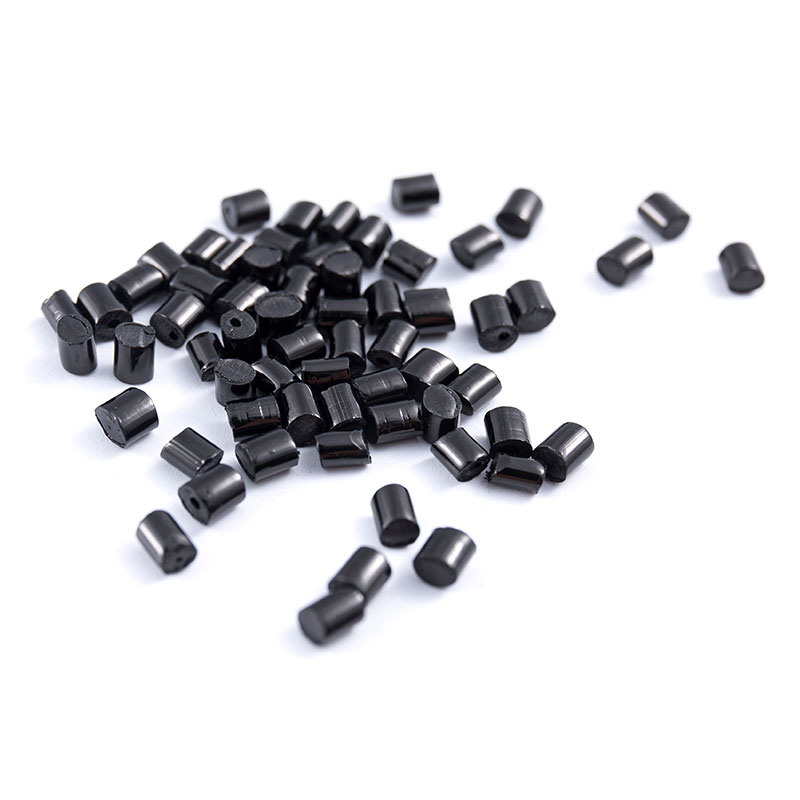 Low-Volatile AS-Carrier Black Masterbatch for InteriorsAS(SAN)-carrier grade with 40% carbon black for low-VOC ABS/PC interior parts, supporting uniform blue-black color and high-gloss or matte finishes.View Product →
Common Misdiagnoses and Fast Fixes
Many “dispersion problems” are actually feeding, drying, or contamination problems. Before changing the masterbatch grade, isolate the step where the defect appears. This prevents unnecessary reformulation and shortens the troubleshooting cycle.
- Specks that appear only in the final film: check feeder accuracy, screen pack condition, and film thickness before blaming carbon black agglomerates. A worn screen or a partially blocked die can create repeated marks.
- Gloss loss after a resin change: compare melt flow and carrier compatibility. A higher-viscosity base resin may not provide enough wetting at the existing screw speed and temperature profile.
- Color drift with the same masterbatch batch: verify letdown ratio and regrind content. A small feeder error becomes visible when the masterbatch is highly concentrated.
- Surface bubbles or silver streaks: check moisture in the masterbatch, base resin, and additives. Hygroscopic carriers can pick up moisture during storage and handling.
- Reduced impact strength: check carbon black loading, dispersion level, and polymer degradation. Higher loading is not automatically stronger; it can embrittle a compound if the dispersion is poor.
- Pressure rise during extrusion: examine agglomerate size, screen pack design, and carrier compatibility. A dispersion test on a lab extruder should reproduce the production pressure trend before a grade change is approved.
A fast-fix mindset often changes one variable at a time. Keep the base resin, machine settings, and letdown ratio stable while testing a new masterbatch. If the defect follows the masterbatch, investigate the grade. If it follows the machine or the resin lot, investigate the process. This simple discipline prevents a good masterbatch from being rejected because of an unrelated production issue.
Cost Model: Where Poor Dispersion Saves Nothing
Poor dispersion rarely appears as a line item called “dispersion loss.” It hides in scrap rate, downtime, color correction, customer complaints, and warranty risk. A masterbatch that costs less per kilogram can become more expensive per finished part when it forces a higher letdown ratio, creates visible rejects, or reduces mechanical performance enough to require reformulation. The true comparison is cost per accepted part, not cost per bag.
Visible rejects
Specks, gels, and surface defects increase inspection burden and scrap. In thin film and high-gloss molding, the acceptable defect size is small, so the cost of poor dispersion rises quickly.
Hidden mechanical loss
Agglomerates act as stress concentration points. A part may pass a visual check and still fail an impact or elongation test. Field failures are far more expensive than a batch rejection.
Process instability
Pressure spikes, torque changes, and die buildup reduce output. Operators compensate with temperature or speed changes, which can create a new set of defects and make root-cause analysis harder.
Color correction
Weak tint strength or inconsistent dispersion forces higher dosing. The extra carbon black may improve appearance temporarily but can push mechanical properties out of specification.
A better cost model compares three scenarios: the current grade, a lower-dosage high-dispersion grade, and a high-concentration grade with a carrier matched to the base resin. Measure output rate, scrap rate, screen changes, color approval time, and mechanical pass rate. In many cases, the higher-performance grade wins because the process window is wider, even when the price per kilogram is higher. In other cases, the standard grade wins because the application does not require fine particle size or high jetness. The correct answer depends on the final part, not on a general claim about premium masterbatch.
FAQ: Carbon Black Masterbatch Particle Size and Dispersion
Does smaller carbon black particle size always improve quality?
No. Smaller particles can improve jetness, tint strength, and hiding power, but they also increase dispersion difficulty and viscosity. Quality improves only when the particle-size band matches the carrier, dispersant system, and processing equipment. A fine grade that remains agglomerated performs worse than a slightly coarser grade that is fully dispersed.
What dispersion level should a buyer specify?
Specify the test method, sample thickness, letdown ratio, and acceptance limit. For many thin-film and general applications, a maximum agglomerate size below roughly 50 microns is a practical starting point, but demanding optical or mechanical applications may require tighter limits. The specification should reflect the final part, not a generic laboratory target.
How can I tell whether specks come from carbon black or contamination?
Run a filter pressure test and inspect the screen residue. Carbon black agglomerates usually appear as clusters with a similar color and texture. Foreign contamination may show irregular shape, different color, or metallic fragments. Also check feeder cleanliness, regrind quality, and drying conditions before changing the masterbatch.
Is higher carbon black loading always more cost-effective?
Only when the application can use the higher concentration without increasing scrap or narrowing the process window. A high-concentration grade can reduce carrier dilution and shipping cost, but it requires accurate dosing and good dispersion capability. Once full hiding is reached, extra loading adds cost without visible benefit.
Why does the same masterbatch perform differently on two lines?
Screw design, residence time, melt temperature, screen pack, die design, and base resin viscosity all affect dispersion. A grade that works on a high-shear line may fail on a low-shear line. The approved grade should be validated on the actual production equipment, not only on a laboratory reference machine.
When should a carrier-free grade be considered?
Consider a carrier-free or high-concentration grade when the carrier resin would dilute the final formulation, when the base resin is sensitive to foreign polymers, or when the converter needs maximum carbon black content with minimal carrier interference. These grades demand robust feeding and dispersion control, so they are best selected with application testing.
What to Put in the Inquiry Before Asking for a Quote
A clear inquiry shortens grade selection and reduces sample cycles. State the base resin and whether it is virgin, filled, or regrind. Give the final part thickness or wall section, the target carbon black loading or opacity requirement, and the processing method. Mention the surface requirement, whether the part is outdoor or indoor, and any food-contact, automotive, or weathering standard that applies. Include the current defect if there is one, such as specks, gloss variation, pressure rise, or low impact strength.
Ask the supplier to recommend the carrier system, the expected letdown range, and the dispersion test that will be used for approval. Request a retained sample and a batch record for the trial lot. Confirm the packing size, storage condition, and shelf life. If the application is sensitive to moisture, odor, or volatiles, state that before the trial rather than after the first production run. These details turn a general black masterbatch request into a specification that can be tested, compared, and repeated.