

 Español


Set the Carbon Black Target Before the Masterbatch Dose
A 40% carbon black masterbatch added at 5% by weight puts 2.0% carbon black into the final film or pipe. That calculation, not the phrase “dosage ratio,” is the first thing to agree on. When a film line runs grey at 4% masterbatch or a pipe sample fails a UV check at 5%, the useful question is not whether the number is high or low in isolation. The useful question is how much carbon black the finished part must contain, how much carbon black the masterbatch actually carries, and how evenly that carbon black is distributed in the wall or film.
Film and pipe buyers often receive a recommendation such as “use 2% to 5%.” That range covers different masterbatch concentrations and different final carbon black targets. A 30% masterbatch at 4% gives 1.2% carbon black. A 50% masterbatch at 4% gives 2.0% carbon black. Both are “4% masterbatch,” but they are not the same product. The ratio has to be built from the application target outward, then checked on the line with a gravimetric feeder and a simple output test.
For film, the target is usually a balance of opacity, UV protection, drawdown stability, surface quality and tensile behaviour. For pipe, the target is usually a balance of UV protection, long-term weathering, dispersion quality, wall smoothness and pressure performance. The same black masterbatch family can be used in both, but the dose and the carrier design are rarely interchangeable without a trial.
A practical starting point is to write the specification as final carbon black content, not masterbatch percentage. For example: “2.5% carbon black in the finished PE pipe wall, 40% carbon black masterbatch, PE-compatible carrier, dispersion verified by microscope.” That sentence gives the operator a formula, the laboratory a check, and the purchasing team a clear material brief. It also prevents a common error: accepting a lower-cost masterbatch with lower carbon black content and keeping the same masterbatch dose, which quietly lowers the final carbon black level.
There is also a thickness effect that is easy to miss. A 60-micron film and a 6-mm pipe wall can use the same final carbon black percentage and still look different to the eye. Thin film shows undispersed spots, gels and die lines quickly. Thick pipe hides surface specks in the wall but can expose them later as weak points or roughness after machining. The dose has to be right, and the dispersion has to be right for the geometry being produced.
The Conversion Formula and a Working Dose Table
The core formula is simple and works for film, pipe, sheet, injection moulding and compounding as long as the percentages are on a weight basis.
If the target is 2.5% carbon black in a PE water pipe and the masterbatch contains 40% carbon black, the starting dose is 2.5 ÷ 40 × 100 = 6.25% masterbatch. If the same target is met with a 50% masterbatch, the starting dose is 5.0%. If the supplier offers only a 30% masterbatch, the starting dose is 8.3%. The final carbon black target has not changed, but the masterbatch consumption, feeder setting, silo space and cost per tonne have changed.
The reverse calculation is just as useful during a trial: Final carbon black (%) = Masterbatch dose (%) × Carbon black content in masterbatch (%) ÷ 100. If an operator runs 5% of a 40% masterbatch, the final carbon black is 2.0%. If the laboratory later measures 1.6% carbon black, the real masterbatch dose may have been 4.0%, or the masterbatch may contain closer to 32% carbon black, or some material may have been lost in startup and purging. The formula points to the checks rather than to a guess.
| Target carbon black in final part | 30% masterbatch dose | 40% masterbatch dose | 50% masterbatch dose |
|---|---|---|---|
| 1.0% | 3.3% | 2.5% | 2.0% |
| 1.5% | 5.0% | 3.8% | 3.0% |
| 2.0% | 6.7% | 5.0% | 4.0% |
| 2.5% | 8.3% | 6.3% | 5.0% |
| 3.0% | 10.0% | 7.5% | 6.0% |
Use the table as a starting point, not as a release specification. The final setting depends on the carbon black grade, the carrier resin, the letdown resin, the screen pack, the output rate and the quality standard for the finished article. A pipe that must pass a long-term UV test may need a tighter band than a black refuse bag that is judged mainly on appearance. A film that must remain tough after outdoor exposure may need both the right carbon black percentage and a well-dispersed, UV-stabilised formulation.
When regrind is part of the recipe, do not ignore the carbon black already in the regrind. If 20% regrind containing 2.0% carbon black is added to a virgin mix, that regrind contributes 0.4% carbon black to the final part before any new masterbatch is counted. The virgin masterbatch dose should be reduced accordingly, or the final black level will drift upward. The same logic applies to off-spec start-up material that is ground and reused without separation.
Film Dosing Windows by Application
Blown film is where dosage discussions most often become vague, because “black film” covers agricultural mulch film, packaging film, courier bags, shopping bags, garbage bags and stretch film. Each has a different target for opacity, UV exposure, mechanical strength and surface appearance. A useful way to begin is to keep a 40% carbon black masterbatch as the reference and then convert to the actual masterbatch concentration in use.
Agricultural film and mulch film usually need a higher final carbon black level because they face sunlight, moisture, soil contact and a long service life. A starting band of 2.0% to 3.0% carbon black in the final film is common in many specifications. With a 40% masterbatch, that is 5.0% to 7.5% masterbatch. At the lower end, the film may look black but still lack the UV screening expected outdoors. At the upper end, the line may see higher screen pressure, more die lines or reduced elongation if the carbon black is not well dispersed.
General packaging film often needs a lower carbon black level because the purpose is opacity or a deep black appearance rather than long-term outdoor exposure. A starting band of 1.0% to 2.0% carbon black in the final film is common, which is 2.5% to 5.0% of a 40% masterbatch. Courier bags and garbage bags commonly sit in a similar range, although a premium courier bag may use a higher loading to hide contents and improve UV resistance during transport. Stretch film has its own balance: too much carbon black can affect puncture resistance, cling behaviour and roll appearance, so a trial at two or three dose levels is more reliable than copying a number from another line.
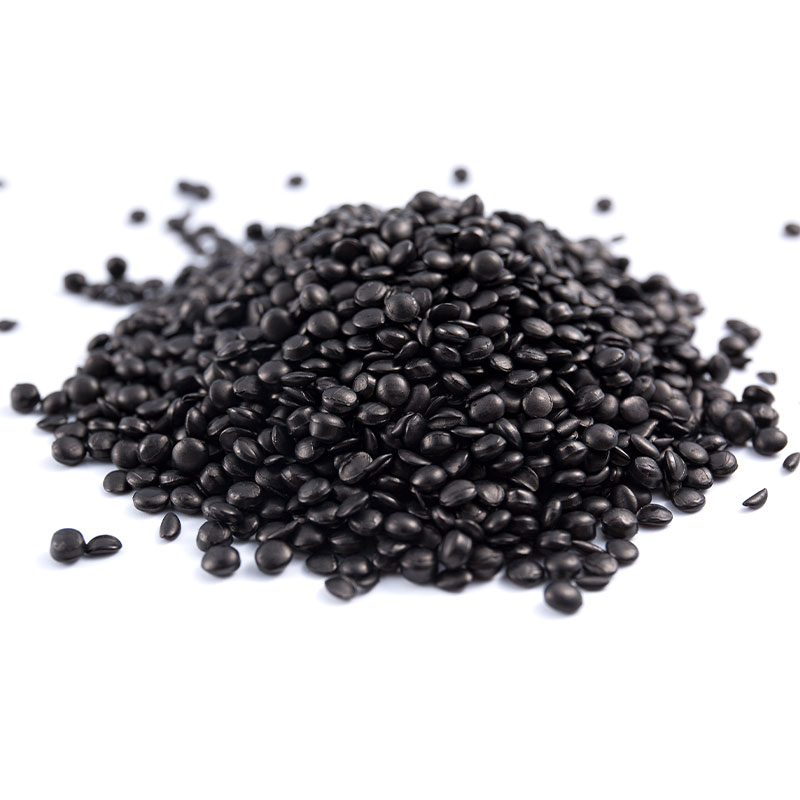 High Hiding Black Masterbatch N4066/EN4066PE-based masterbatch with about 46% carbon black, designed for high hiding power in agricultural film, courier bags, opaque packaging and pipe applications.View Product →
Film thickness changes the appearance result. A 15-micron film with 1.5% carbon black may look lighter than a 40-micron film with the same percentage because there is less material in the light path. If the buyer judges by eye, agree on a sample under the same lighting and at the same thickness. If the buyer judges by UV transmission or weathering, use a measured carbon black content and a dispersion check, not a visual match alone.
| Film application | Typical final carbon black target | 40% masterbatch starting dose | Main dose risk |
|---|---|---|---|
| Agricultural film and mulch film | 2.0% to 3.0% | 5.0% to 7.5% | Low UV screening, surface specks, reduced elongation |
| General packaging film | 1.0% to 2.0% | 2.5% to 5.0% | Grey tone, poor opacity, gels at high loading |
| Courier and garbage bags | 1.0% to 2.5% | 2.5% to 6.3% | Uneven appearance, die lines, weak seals |
| Stretch film | 1.0% to 2.0% | 2.5% to 5.0% | Loss of cling, puncture faults, filter pressure rise |
The chart is a visual comparison of starting masterbatch ranges, not a precise process curve. The useful operating window is usually narrower than the table. Once the line is stable, record the feeder setting, output, screen pack, melt pressure, film thickness, opacity and tensile result together. That record becomes the real dosage standard for that product, machine and resin lot.
Pipe Dosing Windows by Service Condition
Pipe dosing is less about a deep black appearance and more about maintaining performance over time. PE water supply pipe exposed to sunlight usually needs enough carbon black to screen UV, and the carbon black must be dispersed well enough that it does not create weak points in the wall. Many PE pipe specifications sit around 2.0% to 2.5% carbon black in the final compound. With a 40% masterbatch, that is 5.0% to 6.3% masterbatch. With a 50% masterbatch, it is 4.0% to 5.0%.
Sewer and drainage pipe covers a wider range because the service condition, wall thickness, installation method and appearance requirement vary. A starting band of 1.5% to 3.0% carbon black in the final pipe may be used, which is 3.8% to 7.5% of a 40% masterbatch. The upper end should not be chosen simply to make the pipe look darker. Higher loading can raise melt pressure, increase screen changes and affect impact or elongation if the dispersion is poor or the carrier does not match the base resin.
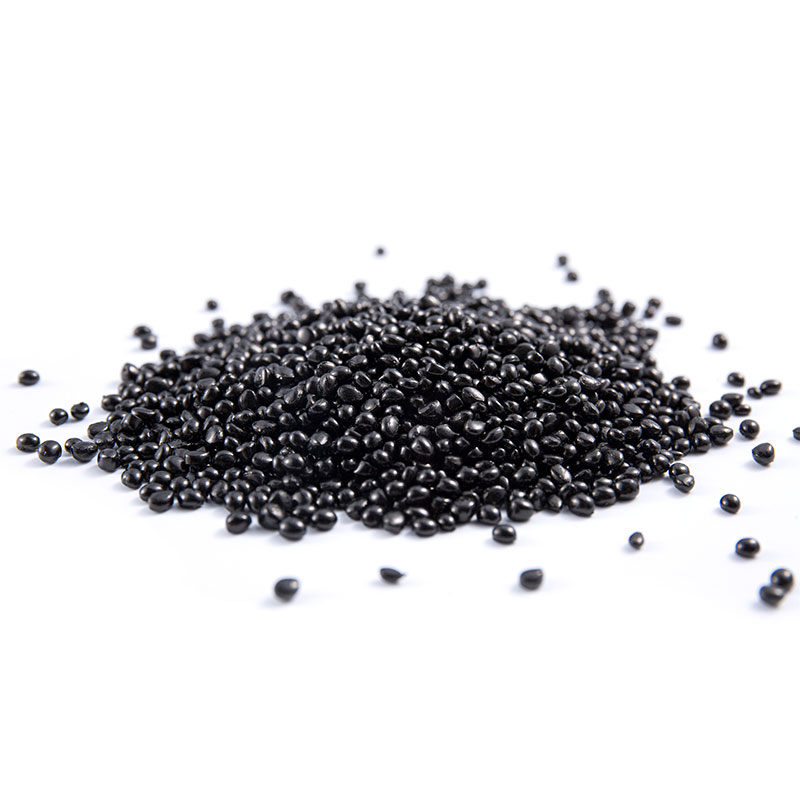 H6045 UV Protection Black Masterbatch for PipePE-carrier black masterbatch with about 45% carbon black for water supply and pressure pipe extrusion, offering UV aging protection and uniform black color.View Product →
For pressure pipe, the carrier matters as much as the dose. A carrier with an MFI far away from the PE pipe grade can create flow marks, poor mixing or a localised change in properties. A PE-compatible carrier designed for pipe extrusion is easier to disperse at the screw and die conditions used for thick-wall production. For drainage pipe, surface smoothness and colour consistency may be the main concerns, but UV exposure during storage and installation still matters in many markets.
| Pipe application | Typical final carbon black target | 40% masterbatch starting dose | 50% masterbatch starting dose | Main dose risk |
|---|---|---|---|---|
| PE water supply pipe with UV exposure | 2.0% to 2.5% | 5.0% to 6.3% | 4.0% to 5.0% | Dispersion faults, surface roughness, pressure drift |
| Sewer and drainage pipe | 1.5% to 3.0% | 3.8% to 7.5% | 3.0% to 6.0% | Colour variation, screen pressure, impact loss |
| Irrigation pipe | 2.0% to 3.0% | 5.0% to 7.5% | 4.0% to 6.0% | UV weakness, die build-up, uneven wall appearance |
Thick-wall pipe also needs a sampling plan that looks beyond the outer surface. Cut a section, inspect the wall under light, and check for agglomerates or streaks through the thickness. A pipe can look acceptable outside and still contain a cluster of undispersed carbon black inside the wall. For critical pressure applications, the dispersion check belongs in the incoming material approval and in the periodic line audit, not only in the final visual inspection.
Why Film and Pipe Respond Differently to the Same Dose
A 5% dose of a 40% masterbatch gives 2.0% carbon black in both a film and a pipe. The number is the same, but the process and failure modes are not. Film is drawn thin, cooled quickly and judged on pinholes, gels, die lines and appearance over a large area. Pipe is extruded thick, cooled slowly, and judged on wall integrity, surface quality, pressure performance and long-term weathering. The same carbon black cluster can be a visible speck in film and an internal weak point in pipe.
Film priorities
Thin-gauge opacity, clean drawdown, low gel count, stable bubble, good seal strength and controlled screen pressure. A small dispersion fault is visible over a large surface.
Pipe priorities
Uniform wall colour, good carbon black distribution through the thickness, stable melt pressure, smooth inner and outer surfaces, and retention of impact and pressure properties.
Shared priorities
Actual carbon black content, carrier compatibility, moisture control, lot-to-lot consistency and a feeder setting that can be repeated at production output.
The carrier resin is often the hidden reason a masterbatch that works in film performs poorly in pipe, or the reverse. In film, a carrier that is too incompatible can form gels or fisheyes. In pipe, a carrier with the wrong viscosity can disperse unevenly in a thick wall or create flow lines near the die. The carbon black grade also matters: a high-structure grade may be easier to disperse in one system and harder in another, while a finer particle grade may give better hiding but demand more mixing energy.
Temperature is not a universal fix. Raising barrel temperature can improve wetting in one formulation, but it can also increase odour, degrade the carrier or change the pressure balance in the die. Lowering temperature can protect the polymer but leave carbon black agglomerates intact. The correct response is to match the masterbatch carrier and dispersion package to the process, then confirm the dose with output and laboratory checks.
Dosing Equipment, Calibration and Line Verification
Many dose problems are feeding problems. A gravimetric loss-in-weight feeder controls the masterbatch mass flow and can maintain a ratio as the line output changes. A volumetric feeder is lower cost but depends on bulk density, pellet shape and hopper fill level, so it can drift during the run. Manual preblending can work for short runs, but it is difficult to repeat at high output and easy to disturb when regrind is added.
| Feeding method | Typical use | Main control point | Common risk |
|---|---|---|---|
| Gravimetric loss-in-weight feeder | Continuous film and pipe production | Calibration, refill logic, screw speed response | Incorrect bulk density input or poor refill stability |
| Volumetric feeder | Shorter runs or less critical colour work | Hopper level, pellet consistency, screw speed | Output drift as bulk density changes |
| Batch preblend | Small lots or trial quantities | Weighing accuracy, mixing time, segregation | Uneven dose from segregation in the hopper |
| Manual addition | Startup or emergency adjustment | Recorded weight and time | Operator variation and poor traceability |
Calibrate the feeder with the actual masterbatch, not with a generic pellet. Catch a sample over a known time, weigh it, and compare the result with the set point. Then run the line for a stable period and calculate consumption from the masterbatch weight used and the resin weight used. This gives a practical check that includes refill losses, purging and startup scrap. The related guide to dosing methods and ratios is useful for operators who need to compare feeding options before a trial.
For film, verify the dose together with output, frost line, bubble stability and screen pressure. For pipe, verify it together with output, melt pressure, wall thickness and surface quality. Record the results in the same unit every time. A change from “5%” to “5 kg per 100 kg” should not be left to memory. If the feeder display uses grams per minute, convert it back to percentage of resin throughput so that the trial remains comparable when line speed changes.
Quality Checks That Predict Dose Success
A supplier certificate is useful, but a dose trial should be supported by a few simple checks that predict whether the masterbatch will behave at the target loading. These checks do not need to be complicated, and they are more valuable than a single appearance sample.
Carbon black content by TGA
Confirms the actual carbon black percentage in the masterbatch. Use it to recalculate the dose instead of relying on the product name or a nominal figure.
Dispersion check
Thin-film press-outs, microscope slides or a filter pressure test reveal agglomerates that a visual check of a black pellet cannot show.
Carrier MFI and compatibility
Compare the carrier with the base resin and the process. A close match reduces flow marks, gels and localised property changes.
Moisture and volatile content
Moisture can create silver streaks, bubbles and voids, especially in engineering resins or humid workshop conditions. Dry where required.
Odour and volatile organic compounds
Important for interior parts, packaging and enclosed spaces. A dose that passes colour may still fail an odour or emission requirement.
Lot-to-lot consistency
Ask for the carbon black content range and the dispersion limit for each lot. A dose set on one lot should not need a large correction on the next.
Set acceptance limits before the trial. For a pipe compound, agree on a carbon black content band and a dispersion limit that reflect the pipe standard and the end use. For a film, agree on gel count, appearance and tensile or puncture performance at the target dose. If the trial passes appearance but fails dispersion, the answer is not simply to add more masterbatch. More masterbatch at poor dispersion can make the defect worse and increase cost.
Troubleshooting Dose-Related Defects
Not every black film or pipe defect comes from the dose. Die lines can come from die build-up, gels can come from the carrier, and surface roughness can come from cooling or calibration. Still, the dose and dispersion are the first checks because they are fast and repeatable.
Grey or brownish black
Usually low carbon black content, low masterbatch dose, high letdown with uncoloured resin, or poor dispersion. Check feeder output and TGA result before changing the colour formulation.
Dark surface with visible specks
Often undispersed carbon black or contamination. Inspect the masterbatch, screen pack and regrind. Raising the dose will not remove an agglomerate that is already present.
Die lines or flow marks
Can come from carrier mismatch, low melt temperature at the die, poor mixing or carbon black build-up. Check the carrier MFI and die condition before assuming the dose is low.
High screen pressure
A higher carbon black loading, poor dispersion or a high-structure grade can raise pressure. Compare the pressure rise with the dose step and the screen change interval.
Loss of elongation or impact
Excess filler loading, poor dispersion or an incompatible carrier can reduce toughness. Reduce the dose to the target carbon black level and confirm with mechanical testing.
Odour or bubbles
Check moisture, volatiles, carrier degradation and storage conditions. Drying the masterbatch or adjusting the temperature profile may be more effective than changing the dose.
For film, a quick dose ladder is often the fastest way to separate a dose issue from a formulation issue. Run three short samples at the target masterbatch dose, a dose about 10% lower and a dose about 10% higher, keeping all other conditions fixed. If the defect changes with dose, the dose window is the likely cause. If it does not change, check dispersion, carrier compatibility, moisture and equipment condition. For pipe, use the same logic but add wall-section inspection, because a surface-only check can miss internal agglomerates.
Procurement Brief: What to Confirm Before a Trial
A dosage trial is more useful when the material brief is specific. Ask for the actual carbon black content by TGA, the carrier resin type, the carrier MFI, the recommended starting dose at a known final carbon black target, the dispersion limit and the moisture specification. Ask how the supplier controls lot-to-lot variation and what trial quantity is practical for the line. These questions turn a colour discussion into a repeatable material specification.
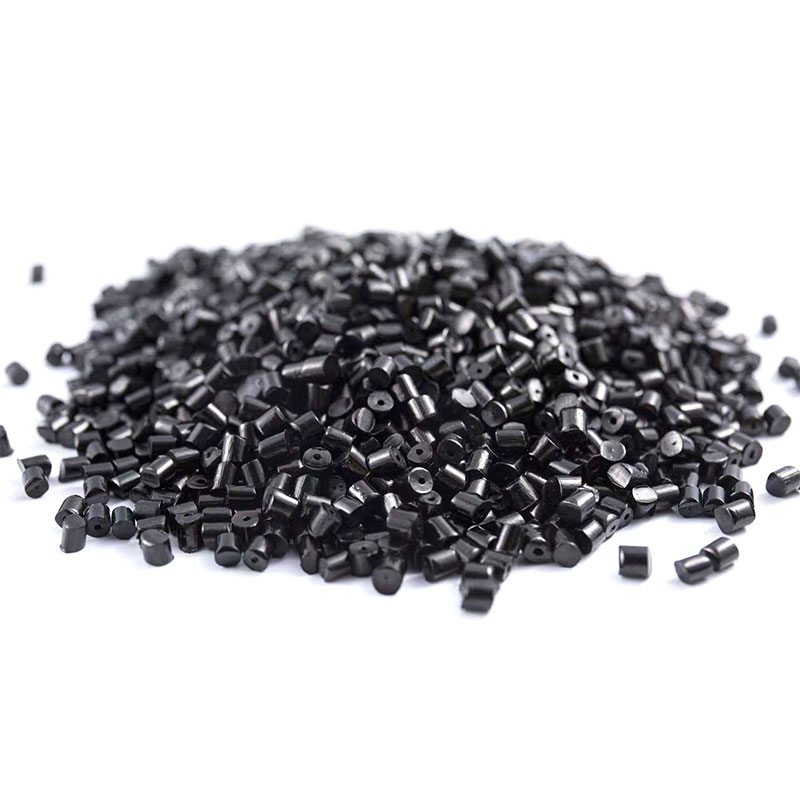 Customized Black Masterbatch for Industrial Polymer ProcessingCustomizable black masterbatch for pipes, automotive parts, consumer electronics and packaging films; formulation details are tailored rather than published.View Product →
For a new film or pipe project, a three-point trial is usually enough to find the operating window: a low dose, the calculated target dose and a high dose. Run each long enough to flush the previous setting, then record output, feeder setting, screen pressure, surface quality and the laboratory result. If the target dose gives the required carbon black content but the surface is still poor, the next step is a dispersion or carrier review, not a higher loading.
Material data to request
Carbon black content, carrier type, MFI, density, moisture, dispersion method and typical dosage range at a stated final carbon black target.
Line data to share
Base resin, film thickness or pipe diameter and wall thickness, output, screw configuration, screen pack, melt temperature and the finished product standard.
Trial data to keep
Feeder calibration, masterbatch consumption, resin consumption, dose in percent, carbon black result, dispersion result and the defect observed at each step.
Custom formulation is often the cleanest route when a standard grade sits between two applications. A film grade may need a different carrier and dispersion package from a pipe grade even when both use the same carbon black target. A custom masterbatch can be built around the base resin, the processing temperature and the final property requirement, while keeping the carbon black content and the dose formula clear from the start.
Frequently Asked Questions
Is a 1:50 masterbatch ratio universal for black film and pipe?
No. A 1:50 ratio is 2% masterbatch. With a 40% carbon black masterbatch, that adds only 0.8% carbon black to the final part. That may be enough for light tinting or a low-opacity appearance, but it is usually below the target for agricultural film and UV-exposed pipe. Calculate from the final carbon black target, then convert to the actual masterbatch concentration.
What is a typical starting dose for agricultural film?
A common starting band is 2.0% to 3.0% carbon black in the final film. With a 40% masterbatch, that is 5.0% to 7.5% masterbatch. Confirm the target against the film standard, the expected outdoor life and the thickness, then run a short dose ladder to find the lowest stable setting that meets the requirement.
What dose should be used for PE water supply pipe?
Many PE water pipe specifications sit around 2.0% to 2.5% carbon black in the final compound. That is 5.0% to 6.3% of a 40% masterbatch or 4.0% to 5.0% of a 50% masterbatch. Check the pipe standard and the supplier’s dispersion data before fixing the production setting.
Can the same black masterbatch be used for film and pipe?
It can be tested, but it is not automatically the best choice. Film usually needs a carrier that avoids gels and supports thin drawdown. Pipe usually needs a carrier that matches the base resin and disperses well in a thick wall. The carbon black content may be the same, while the carrier, dispersion package and MFI position are different.
How do I adjust the dose when the masterbatch changes from 40% to 50%?
Use the formula with the new carbon black content. For a 2.0% final carbon black target, a 40% masterbatch needs 5.0%, while a 50% masterbatch needs 4.0%. Do not keep the old feeder setting and assume the final colour will stay the same.
Why do I see specks when the calculated dose is correct?
The dose can be correct while the dispersion is poor. Check carbon black agglomerates, carrier compatibility, moisture, screen pack condition and mixing energy. Raising the dose adds more carbon black but does not necessarily break down existing agglomerates, and it can increase cost and pressure.
How can I confirm the real dose on the line?
Calibrate the feeder with the actual masterbatch, record the weight used over a known production period, and compare it with the resin throughput. Then check the final carbon black content by TGA and inspect the film or pipe wall for dispersion. The feeder display alone is not enough, because refill losses, startup scrap and volumetric drift can change the real ratio.