

 Español


A black masterbatch fails in the field long before it fails in a lab test. A blown film line running 60-micron agricultural film at 4% loading looked clean at the extruder. Two seasons later, the film cracked along the fold lines. The resin met specification. The UV stabiliser package met specification. The carbon black grade did not: primary particle size was too coarse, dispersion was inconsistent, and the loading had been set for colour rather than for ultraviolet demand.
Black masterbatch is a concentrated pellet made from carbon black, a carrier resin and a dispersant system. It is used at roughly 2–5% let-down to colour plastic, absorb ultraviolet radiation, and modify processing or mechanical behaviour. The carbon black type, the loading and the carrier decide which of those three jobs it actually performs. Get one wrong and the part still looks black on the day it ships.
What Black Masterbatch Is Doing Inside the Part
Three functions sit inside every black masterbatch pellet. Colour is the obvious one. UV absorption is the one that decides service life outdoors. The third is process behaviour: how the carbon black disperses, how the melt flows at the die, and how the surface finishes.
Carbon black is not a single material. It varies by primary particle size, structure, and surface chemistry. A furnace black with a 20 nm particle size and high structure will absorb UV and hold jetness at 2–3% loading. A coarse thermal black at the same loading will colour the part and leave the polymer chain exposed to sunlight.
| Function | Mechanism | What to check |
|---|---|---|
| Colour and hiding power | Carbon black absorbs visible light across the spectrum | Jetness, tint strength, dispersion rating |
| UV protection | Fine particles scatter and absorb UV before it reaches the polymer chain | Primary particle size, loading above 2% |
| Processing stability | Carrier wets out the carbon black and matches the base polymer | Carrier MFI, compatibility with base resin |
The Main Uses, Application by Application
The same black pellet is not interchangeable across applications. A courier bag, a sewer pipe and a food tray each put different demands on the carbon black and the carrier. The list below covers the applications that account for most black masterbatch volume.
Agricultural film
UV absorption for multi-season exposure. Dispersion must survive high shear without gels or crystal spots.
Courier and garbage bags
Hiding power, seal strength and consistent colour from lot to lot at 2–4% loading.
Stretch film
Fine carbon black and clean dispersion to avoid die lines and surface defects on thin gauges.
Sewer and water pipe
Long-term UV protection and low extraction. Loading is set by outdoor exposure, not by colour depth.
Automotive exterior and interior
Weatherability, gloss control and low volatile content for interior air quality.
Appliance housings
Surface gloss, colour consistency and impact retention after repeated processing.
Food-contact packaging
Compliance documentation, low migration and high light shielding for dairy and produce.
Wire and cable
UV screening plus mechanical retention in insulation and jacket compounds.
Profiles and sheet
High carbon black concentration for opacity and weathering in exterior building products.
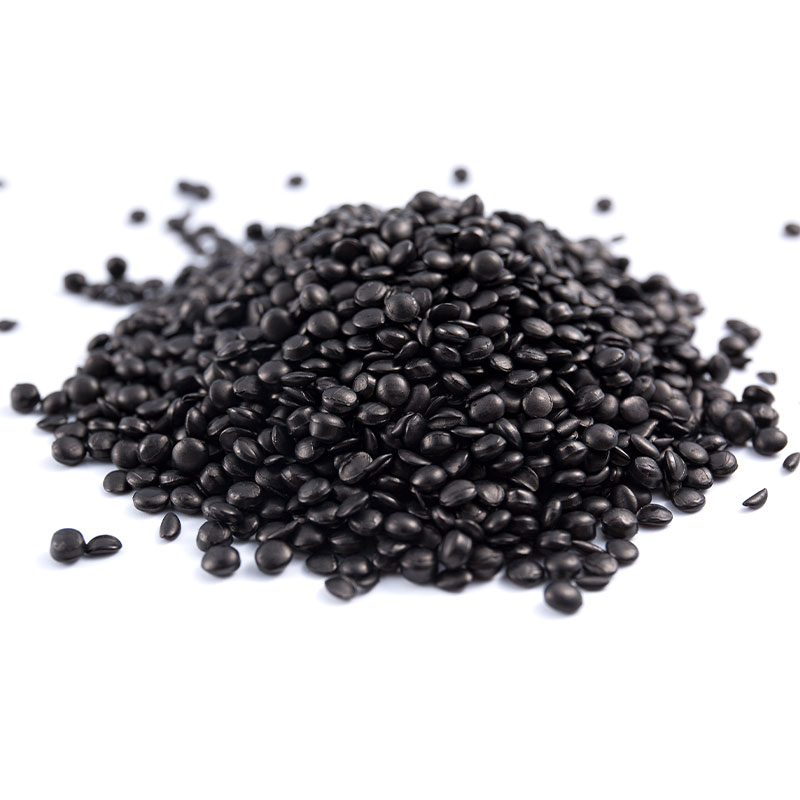 High-Hiding N4066 Black Masterbatch for PE Film and PipePE-based grade with about 46% carbon black for thin films and pipe walls, offering high opacity at low dosage while balancing UV screening and dispersion.View Product →
How Much Carbon Black Goes In? Loadings That Actually Work
Loading is usually quoted as a percentage of the final part. The useful range is narrower than most data sheets suggest, because above 5% dispersion becomes difficult and below 2% UV screening falls away in thin sections. A 60-micron film and a 6 mm pipe wall do not need the same carbon black density to achieve the same protection.
| Application | Typical loading | Primary requirement |
|---|---|---|
| Agricultural film | 2–5% | UV absorption over multiple seasons |
| Courier bag | 2–4% | Hiding power and seal strength |
| Sewer pipe | 2–3% | Long-term UV and cost control |
| Water supply pipe | 2–3% | UV plus pressure-pipe standards |
| Automotive exterior | 2–4% | Weatherability and gloss |
| Food-contact packaging | 2–4% | Compliance and low migration |
| Wire and cable | 2.5–5% | UV screening plus mechanical retention |
The numbers are starting points. A pipe compound that passes a 3,000-hour weathering test at 2.5% does not need 4% to compensate for an unrelated stabiliser problem. Increasing loading to fix dispersion issues usually makes them worse.
UV Protection Is the Reason Outdoor Black Parts Last
Carbon black absorbs UV radiation and converts it to heat. The effect depends on particle size and dispersion. Particles between roughly 15 and 25 nm perform best. Below that, cost rises without a proportional gain. Above 30 nm, UV screening falls off quickly, even when the part still looks black.
Loading matters as much as grade. Below 2% carbon black, a thin film or a pipe surface does not have enough particle density to screen the full UV spectrum. Above 5%, dispersion becomes harder, and impact strength can drop because the carbon black network starts to interfere with the polymer morphology.
For a side-by-side comparison of carrier types and selection criteria, this carbon black masterbatch guide covers the trade-offs in more detail.
Carrier Resin Choice Changes the Outcome
A black masterbatch is only as good as its carrier. The carrier must wet out the carbon black, disperse it, and then blend into the base resin without creating separate domains. A PE carrier in a PA part will not disperse. A high-MFI carrier in a pipe extrusion line can shift melt pressure and change the wall thickness tolerance.
| Base resin | Recommended carrier | Reason |
|---|---|---|
| PE film | LDPE or LLDPE | Matches film MFI and disperses at low shear |
| PP injection | PP homopolymer | Compatible melt viscosity and shrinkage |
| PA | PA carrier | Avoids phase separation and surface bloom |
| PC | PC carrier | Maintains impact strength and surface finish |
| PBT | PBT carrier | Heat stability during compounding |
| ABS or PS | PS or ABS carrier | Surface gloss and colour uniformity |
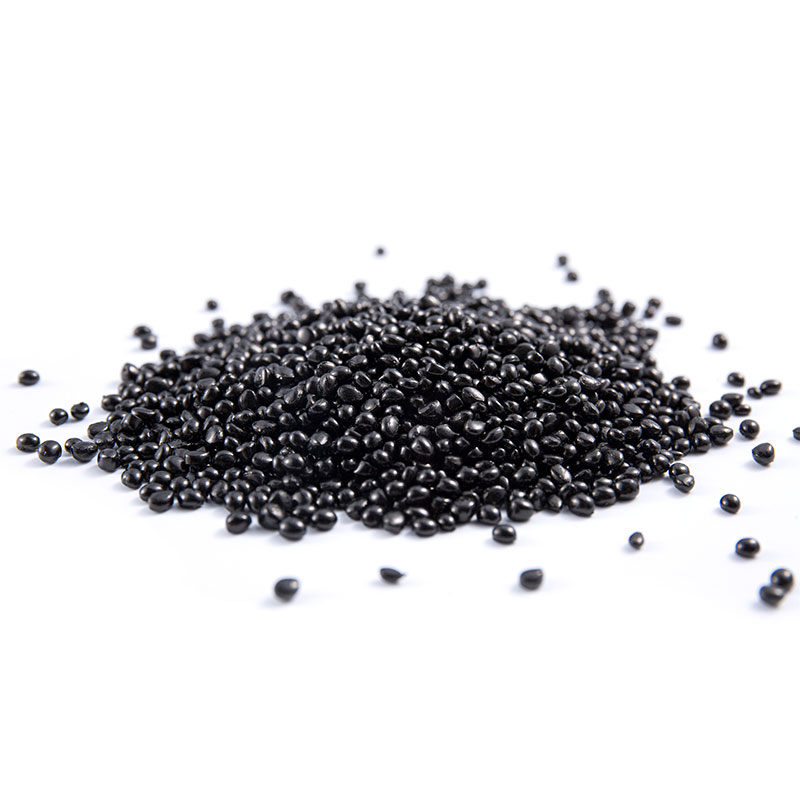 H6045 UV-Protection Black Masterbatch for PE Pipe and FilmA filler-free PE-carrier grade with about 45% carbon black, formulated for HDPE pipe and film applications where carrier compatibility and long-term UV protection matter.View Product →
Where Black Masterbatch Goes Wrong: Buying Risks
Most field failures trace back to one of five specification gaps. None of them show up on a colour chip.
- Dispersion failure. Agglomerates appear as specks, die lines or weak points in film. A dispersion rating below the application threshold is the usual cause.
- Under-loading. A grey tone in thick sections and poor UV life in thin sections. The colour may pass visual inspection while the UV package fails.
- Carrier mismatch. Delamination, bloom or impact loss when the carrier does not match the base resin.
- Volatile content. Odour and mould deposits in automotive interior parts. Low-volatile grades cost more because the carbon black is treated differently.
- Compliance gap. A food-contact application without migration data or a documented grade. The part may run, but it will not pass an audit.
Matching Grade to Process
Blown film needs a carrier with a similar MFI and a dispersion package that survives high shear without creating gels. Injection moulding needs a carrier that flows at the same temperature as the base resin and leaves a uniform gloss. Pipe extrusion needs UV performance that survives decades of outdoor exposure and a carrier that does not migrate into the water contact layer.
Food-contact packaging adds another constraint: the carbon black grade and the carrier must both meet the relevant migration limits, and the documentation has to follow the lot. A high-hiding grade that performs well in a courier bag is not automatically suitable for a dairy tub.
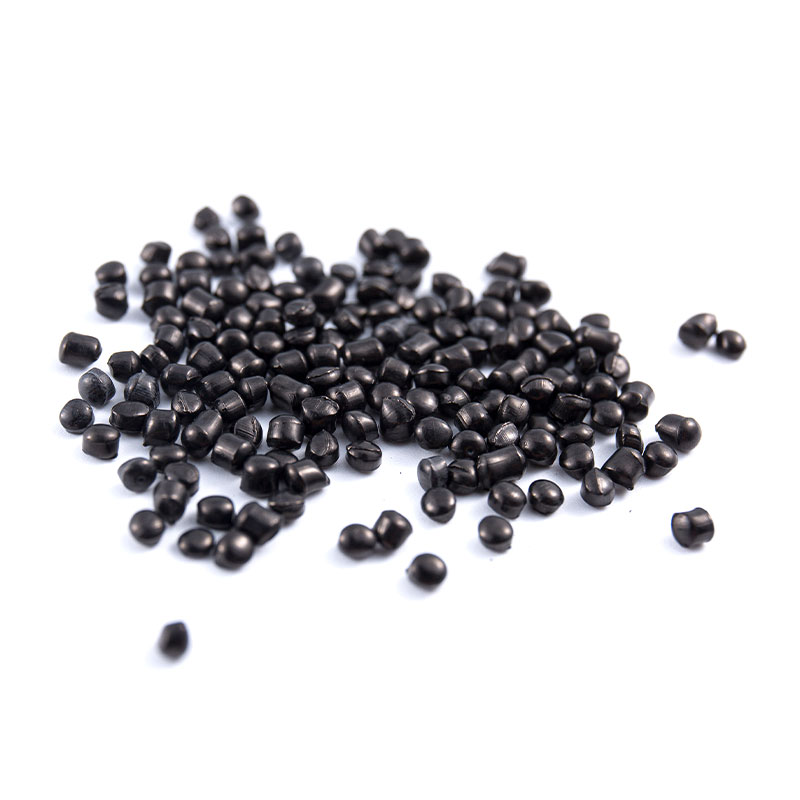 AM4018 Light-Shielding Black Masterbatch for Food-Contact PackagingPE-based grade with about 40% carbon black and calcium carbonate filler for food-contact films needing uniform color and strong light blocking.View Product →
FAQ
Is black masterbatch the same as carbon black?
No. Carbon black is the pigment. Black masterbatch is a formulated pellet that combines carbon black with a carrier resin and dispersant. The masterbatch is what gets dosed at the machine; the carbon black is what does the colouring and UV absorption inside the part.
Can black masterbatch be used in food-contact plastic?
Yes, but only with a grade that is documented for food contact. The carbon black, the carrier and the dispersant all need to meet the relevant migration limits. A general-purpose black masterbatch should not be used for food-contact parts even if it looks identical.
What loading should I start with?
Start with the application range: 2–3% for pipe and general extrusion, 2–4% for bags and packaging, 3–5% for agricultural film and wire. Then verify UV performance and dispersion at that loading before scaling up.
Does black masterbatch improve or reduce mechanical strength?
It depends on loading and dispersion. Well-dispersed carbon black at 2–3% can reinforce the polymer slightly. Poor dispersion or loading above 5% can reduce impact strength because agglomerates act as stress points.
How do I check dispersion before production?
Run a thin film or a small plaque at the intended loading and inspect it against a light source. A dispersion rating on the supplier data sheet is useful, but the check has to be done in your own process, at your own screw speed and draw ratio.
Before the next production run, ask the supplier for the primary particle size, the carrier MFI, and a dispersion rating at the intended loading. Those three numbers predict more about field performance than the colour chip does.