

 Español

When a blown-film plant first switched from loose carbon black powder to a well-compounded black masterbatch, the most visible change was not the color of the film. It was the workshop floor. There was no more black dust settling on pallets, machines, and operator clothing. The less visible changes showed up on the production screen: filter pressure stayed stable for an entire shift instead of climbing toward the change-out alarm, die deposits appeared less frequently, and the film surface remained uniform from the first roll to the last. That is what a properly formulated black masterbatch does in practice, and it is why processors keep moving away from raw pigment in favor of pelletized concentrates.
This article explains what black masterbatch actually contains, how it is manufactured, which features translate into measurable performance, and why the same product category behaves very differently across film extrusion, injection molding, pipe production, and automotive part manufacturing. It is intended as a practical reference for technical buyers, production engineers, and procurement teams who need to select the right concentrate without relying on guesswork.
What Is Black Masterbatch?
Black masterbatch is a concentrated solid mixture of carbon black pigment, a carrier resin, and selected additives that has been melt-compounded and cut into pellets. The purpose of the compound is to deliver a pre-dispersed form of carbon black that a plastics processor can add to a base resin in precise, small quantities. Instead of handling dusty pigment, the processor doses pellets that are identical in size, density, and pigment concentration, which makes color dosing reproducible from batch to batch.
The term "black" refers to the pigment, but the product is more than a colorant. Carbon black provides ultraviolet (UV) screening, thermal stabilization, and electrical conductivity at certain loading levels. The carrier resin makes the concentrate compatible with a target polymer family, and the additives improve wetting, dispersion, and processing stability.
| Component | Typical share (weight %) | Function |
|---|---|---|
| Carbon black | 20 to 45% | Pigment, UV absorber, electrical modifier |
| Carrier resin | 35 to 70% | Binds pigment and ensures compatibility with the base polymer |
| Dispersing agents | 2 to 8% | Wet carbon black aggregates and reduce shear required for dispersion |
| Additives | 0 to 10% | Antioxidants, UV stabilizers, process aids, or low-VOC packages |
Black masterbatch is the highest-volume masterbatch category in the plastics industry. The reason is straightforward: black offers the strongest visual contrast, and carbon black is one of the most cost-effective pigments available on a per-unit-of-hiding-power basis. Products that must hide their contents, protect against sunlight, or show a deep jet-black surface all rely on it.
Why concentration and let-down ratio matter
The carbon black content in the masterbatch and the let-down ratio used by the processor are two sides of the same calculation. A typical black masterbatch for film and injection molding contains between 25% and 40% carbon black, and the processor adds it at a rate of 1 to 4% by weight of the finished product. High-opacity grades, such as those used for pipe or food packaging, may be dosed at 3 to 6%. The practical result is that even a small addition of masterbatch delivers complete opacity, while the remaining 94 to 99% of the product is the processor's own base resin and additives.
When you read a technical data sheet, pay attention to three numbers: the carbon black content, the recommended let-down range, and the carrier resin type. These three values tell you more about product suitability than the product name alone.
How Black Masterbatch Is Manufactured
Manufacturing quality is determined long before the pellets reach the extruder. The process starts with precise weighing of carbon black, carrier resin, dispersing agents, and functional additives. The ingredients are premixed to create a uniform powder-pellet blend, then fed into a twin-screw compounding extruder.
Inside the extruder, the resin melts and the rotating screws generate shear that breaks down carbon black agglomerates. This step is critical because commercial carbon black is supplied as loose aggregates and agglomerates, with primary particle sizes often between 10 and 80 nanometers. The aggregates cluster into much larger structures that, if left intact, would show up as black specks, rough film surfaces, or weak spots in molded parts. The compounding process must wet every aggregate with polymer and separate it down to a finely dispersed state without destroying the carbon black structure that gives the product its tinting strength.
- Premixing of carbon black, carrier resin, and additives in a high-speed mixer for batch uniformity.
- Melt compounding in a twin-screw extruder with controlled shear and temperature zones.
- Pelletizing through a die, followed by cooling and cutting into cylindrical or spherical pellets.
- Quality testing, including carbon black content checks, filter-pressure tests, and color strength measurement.
Reputable manufacturers also run a blown-film or injection test on every significant batch. The film test reveals specks, gels, and dispersion faults immediately, while the filter-pressure test quantifies how quickly a fixed amount of masterbatch blocks the fine mesh screens used in real film lines. These tests are the difference between a supplier who can prove consistency and one who can only claim it.
Key Features of Black Masterbatch
The features described below are what a technical buyer should evaluate when comparing products. Each feature is traceable to a specific resin, pigment, and additive decision made by the compounder.
High tinting strength
Carbon black has an extremely high surface area per gram compared with most color pigments, so a small amount produces a deep, intense black. A high-tinting-strength grade allows you to reduce the let-down ratio without sacrificing color, which lowers your finished-product cost and minimizes any effect on mechanical properties.
Strong hiding power
Fully dispersed carbon black absorbs almost all visible light. This makes black masterbatch the most reliable way to achieve opacity in packaging films, garbage bags, pipe, and protective covers. Even at a let-down ratio of 2%, light transmission can fall to near zero.
UV and weather resistance
Carbon black is one of the oldest known UV stabilizers for polymers. It absorbs damaging radiation and converts it into harmless heat. Outdoor products such as agricultural film, pipe, and automotive exterior parts benefit from the extended service life that well-dispersed carbon black provides.
Thermal stability
Black masterbatch is processed at temperatures from 180 degrees Celsius for polyethylene film to above 300 degrees Celsius for specialty polymers such as PPS. The pigment itself is stable far beyond normal processing temperatures, but the carrier resin must be selected for the process window, which is why high-temperature carrier grades exist for PET, PA, PC, and PPS.
Clean, stable dispersion
Good dispersion means no agglomerates large enough to block screens, no surface roughness, and no localized weak points. It is measured indirectly by filter pressure value and directly by the number of specks observed in a test film. Products with a track record of low filter pressure allow higher output rates and longer screen life.
Carrier compatibility
The carrier resin determines whether the masterbatch will blend with the base polymer or act as a contaminant. A polyethylene carrier is correct for PE films and most HDPE pipes, while a PA carrier is needed for nylon compounding, and specialized carriers are required for PC, PBT, PET, TPU, and PPS. Matching the carrier to the base resin preserves mechanical strength and surface quality.
Carbon black loading varies with application requirements. Higher loading reduces the let-down ratio and is preferred when minimizing carrier influence or logistics cost.
Core Benefits for Plastic Processors
It is useful to evaluate black masterbatch not as an expense but as a replacement for a more expensive way of working. When carbon black powder is purchased, stored, weighed, and added on the production floor, the true cost includes dust cleaning, metering inaccuracy, rejected product, and extra machine wear. A masterbatch moves the compounding cost upstream to the manufacturer, where the mixing is done under controlled conditions with laboratory verification.
| Criterion | Loose carbon black | Black masterbatch |
|---|---|---|
| Material form | Fine powder, easy to spill and inhale | Clean, free-flowing pellets |
| Dosing accuracy | Depends on operator and scale | Gravimetric or volumetric dosing with stable concentration |
| Dispersion | Must be achieved on your own extruder | Pre-dispersed by the compounder |
| Batch consistency | Varies with supplier lot and handling | Checked by color and filter-pressure tests |
| Housekeeping | Black dust contaminates surrounding lines | No dust generated during normal handling |
| Total cost per finished part | Lower ingredient price, higher waste and scrap | Higher ingredient price, lower total cost |
The most important practical benefit is predictability. A well-controlled black masterbatch gives a color strength that stays within a tight tolerance, typically plus or minus a few percent, from one container to the next. That means you do not have to adjust your let-down ratio mid-run to compensate for a darker or lighter shipment. Production planners can calculate material costs accurately, and quality departments can reduce inspection frequency once the supplier's consistency has been confirmed.
Handling safety is another factor that is easy to overlook. Carbon black dust is classified as possibly carcinogenic when inhaled in high concentrations, and housekeeping requirements for pigment storage are strict. Pellet form eliminates airborne pigment, reduces cleaning time, and prevents cross-contamination of adjacent white or light-colored products. In food-contact and consumer goods plants, this separation of colored and uncolored materials is often the decisive argument for switching.
Industry Uses of Black Masterbatch
Black masterbatch appears in almost every polymer-processing sector. The common thread is the need for a deep, stable black color that also performs a functional role, whether that is blocking light, absorbing heat, resisting UV, or simply giving the product a premium surface appearance.
Agricultural film
Mulch film, silage film, and greenhouse film rely on black masterbatch for light blocking and weed suppression. The black layer absorbs sunlight and warms the soil, and the UV protection keeps the film usable for a full growing season.
Packaging film
Courier bags, shopping bags, garbage bags, and stretch film use black masterbatch to hide contents and provide a consistent retail appearance. High hiding power is essential because printed or labeled packaging needs a uniform base.
Injection molded parts
Home appliance housings, electrical enclosures, toy parts, and high-gloss consumer products require a deep black surface without weld lines or flow marks. Injection grades combine high tinting strength with good flow and thermal stability.
Pipe and conduit
Sewer pipe, water supply pipe, and cable conduit are exposed to sunlight and soil chemicals. Black masterbatch provides the color, UV barrier, and long-term weathering performance that standards require.
Automotive components
Interior parts demand low volatility to prevent window fogging, while exterior parts demand weather resistance and scratch resistance. These requirements call for dedicated automotive grades rather than general-purpose products.
Food contact products
Food packaging film, tableware, and fruit and vegetable crates require masterbatch made with approved raw materials and strictly controlled migration properties. The full product formulation must meet the relevant national regulations.
Sheet, profile, and wire
Window profiles, wall panels, and cable jacketing need black concentrates that disperse well in extrusion processes, where a single specks can cause a product rejection that costs the entire length of the profile.
Engineering plastics
Polyamide, polycarbonate, PBT, PET, and PPS parts often require black coloring without sacrificing mechanical strength. Specialized carrier-based masterbatches maintain compatibility at high processing temperatures.
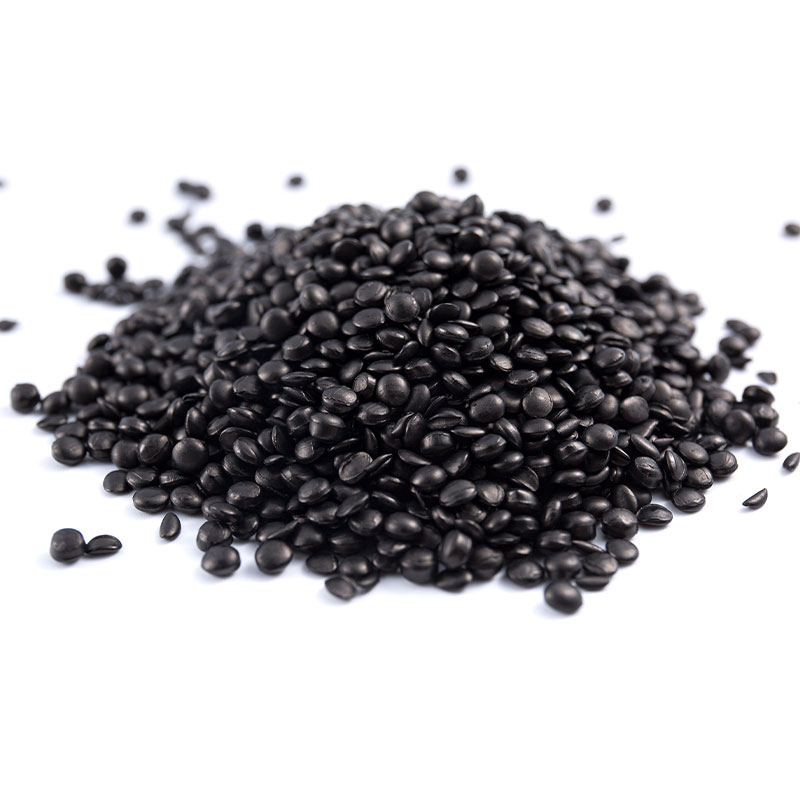 High Hiding Black Masterbatch with 46% Carbon Black for Film and InjectionThis PE-based black masterbatch offers high hiding power with about 46% carbon black, low ash and moisture content. It suits blown film, pipe extrusion, and injection molding, providing deep color at lower addition levels.View Product →
 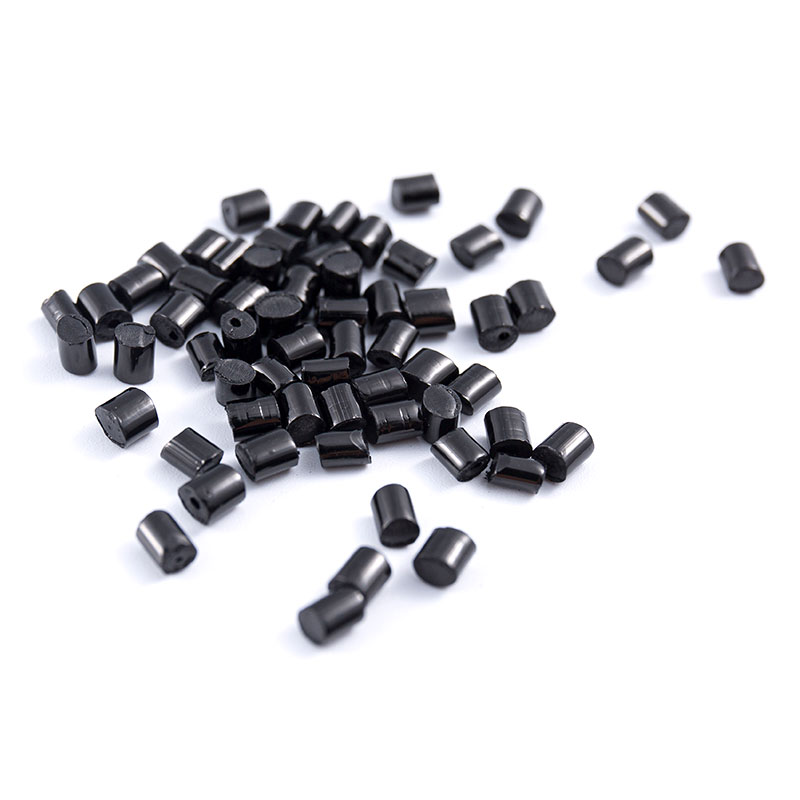 Low VOC Black Masterbatch for Automotive and Home Interior PlasticsFormulated for automotive and interior applications, this AS(SAN) carrier masterbatch delivers low volatile emissions, low migration, and consistent blue-black coloring in ABS and PC. It supports matte or gloss finishes and passes RoHS and PAH testing.View Product →
 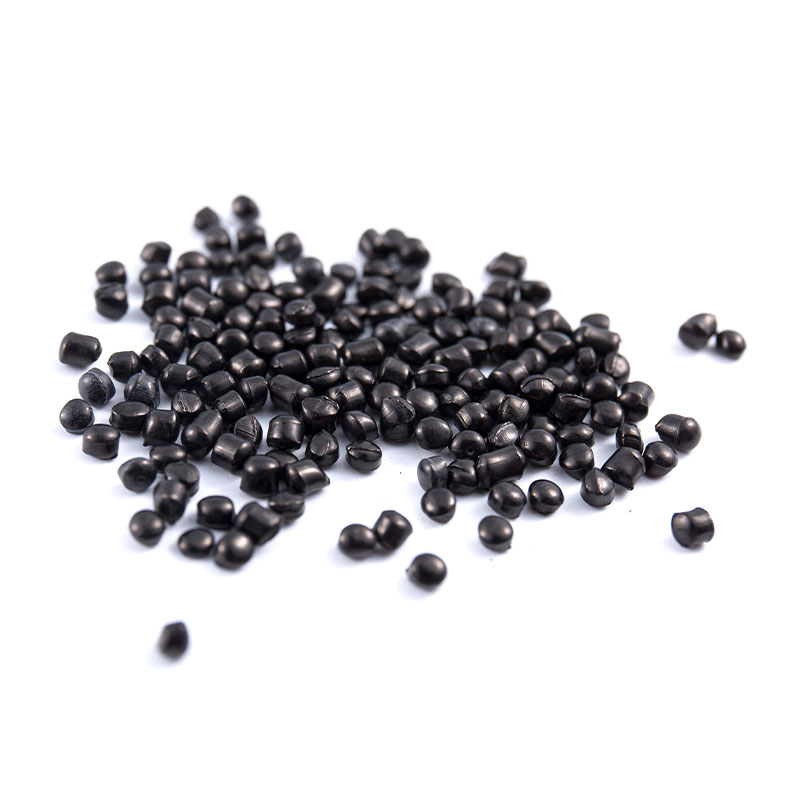 Light-Shielding Black Masterbatch for Food Packaging FilmA PE-based masterbatch with around 40% carbon black and calcium carbonate filler, designed for food-contact packaging. It blocks visible light to protect food quality, improves temperature resistance and mechanical strength, and resists aging.View Product →
Application reference table
The table below maps the main sectors to their typical processes and the reason for using black masterbatch. It is a useful starting point when discussing requirements with a supplier.
| Industry | Typical process | Typical let-down | Primary reason for black masterbatch |
|---|---|---|---|
| Agricultural film | Blown film extrusion | 2 to 4% | Light blocking, soil warming, UV stability |
| Packaging film | Blown film extrusion | 1 to 3% | Opacity, appearance, content privacy |
| Injection molding | Injection molding | 1 to 3% | Deep black color, surface quality, strength |
| Pipe and conduit | Pipe extrusion | 2 to 5% | UV barrier, weathering, identification |
| Automotive | Injection molding | 2 to 4% | Low VOC, weather resistance, scratch resistance |
| Food contact | Injection and film | 1 to 3% | Compliance, opacity, safe raw material package |
How to Select a Black Masterbatch
Selecting the right black masterbatch is a matter of matching three variables: the pigment type, the carrier resin, and the additive package. Each of these affects processability, final properties, and cost in a different way.
Carbon black type and its properties
Carbon black is not a single product. Furnace black is the most common type used for plastics, and it is available in grades that differ by primary particle size, structure, and surface chemistry. Fine-particle carbon black gives a jetter, more intense black but is harder to disperse. Coarser grades are easier to process but produce a grayer shade. A good masterbatch formulation balances these two tendencies for the target application. If your product requires a deep blue-black appearance, for example, the compounder may select a finer grade and invest more shear during compounding.
Carrier resin and compatibility
The carrier must be compatible with your base resin. A polyethylene carrier works naturally with LDPE, LLDPE, and HDPE; a polypropylene carrier is required for PP parts; and nylon, polycarbonate, PBT, PET, TPU, and PPS each need their own carrier family. When the carrier is incompatible, the masterbatch acts like a foreign phase in the polymer melt. The result can be delamination, reduced impact strength, surface defects, or hazy appearance. This is why a single "universal" black masterbatch is rarely the best technical choice for a processor running multiple resin families.
Let-down ratio and tolerance
Once the masterbatch and carrier are matched, the let-down ratio is calculated from the target color strength and opacity. It is wise to start with the supplier's recommendation and then adjust in small steps, measuring color with a spectrophotometer rather than judging by eye. A tolerance of plus or minus 5% in let-down is common in production, but a tighter control can be achieved with gravimetric dosing equipment.
Adding a small amount of black masterbatch to the finished product reduces light transmission dramatically. Beyond roughly 2% loading, the curve flattens and additional pigment adds little visible benefit.
What to ask before ordering
- Request the filter pressure value test data for the specific masterbatch grade under consideration.
- Confirm the carrier resin family and compare it with your base polymer and additives.
- Send the supplier a sample of your actual resin, not just the grade code, because melt flow and additive packages vary between brands.
- Specify your process temperature window so that the additive package can be adjusted for thermal stability.
- Calculate cost per kilogram of finished product, not per kilogram of masterbatch, when comparing quotes.
A good way to benchmark the market is to review the full black masterbatch product range of a manufacturer that covers multiple application sectors. A broad catalog usually indicates that the compounder has already solved the dispersion problems that are specific to your process.
Common Processing Problems and Solutions
Even a well-formulated black masterbatch can cause problems if the interaction between the masterbatch and the base resin is not understood. The table below lists the most frequent complaints and the corrective actions that address the root cause rather than the symptom.
| Problem | Likely cause | Corrective action |
|---|---|---|
| Black specks or "fish eyes" in film | Poor dispersion or overheated polymer degrading in dead zones | Switch to a higher-dispersion grade; check screw profile and melt temperature |
| Gray or weak color | Let-down too low or low-tint-strength carbon black | Increase dosage; specify a finer-particle carbon black grade |
| Die buildup or plate-out | Carrier incompatibility or excess processing aids | Match carrier to base resin; reduce lubricant package |
| Fogging in automotive interior parts | Volatile components in the additive package | Use a low-VOC interior grade designed for this application |
| Reduced impact strength | Incompatible carrier acting as a contaminant | Select a carrier from the same polymer family as the base resin |
| Batch-to-batch color shift | Loose pigment handling or inconsistent supplier QC | Ask for spectrophotometer data; switch to a supplier with documented color tolerance |
When a problem appears, the first step is not to change the dosage but to isolate where it occurs. Inspect the film, the fractured surface of a molded part, or the interior of a pipe. Specks close to the surface often indicate poor dispersion, while specks distributed through the wall may indicate contamination from the previous run or degradation of the resin itself.
Beyond Standard Grades: Specialty Carriers, Carrier-Free and Custom Formulations
Standard black masterbatch solves the needs of most polyolefin applications, but a growing number of processors work with engineering polymers that place much higher demands on the concentrate. Polycarbonate, polyamide, PBT, PET, and PPS are processed at higher temperatures, are sensitive to moisture, and cannot tolerate a carrier resin that is not chemically matched to the base polymer.
Specialty carrier masterbatches address this problem directly. Instead of using a generic PE or PP carrier, the compounder uses a carrier that is the same as, or highly compatible with, the target resin. For example, a PC-compatible black masterbatch carries carbon black in a PC-based carrier, which preserves the transparency potential, heat resistance, and mechanical properties of the finished part. The same logic applies to PA, PBT, PET, TPU, PPS, and PPA grades. When the seller is a specialized masterbatch manufacturer with familiarity with these carrier systems, the technical risk during qualification trials is significantly lower.
Carrier-free black masterbatch is another useful option. It contains very high carbon black loading without a traditional resin carrier, or with a minimal binder that does not affect the base polymer's properties. It is chosen when the processor wants to add only pure pigment to a highly customized compound without altering the resin ratio or introducing an unwanted polymer into the formulation. It is also an efficient way to achieve maximum concentration while keeping the pellet size and handling convenience of a masterbatch.
Custom formulation is the natural next step for a manufacturer with its own factory and laboratory. A customer running a demanding application may need a color that is not a standard deep black, a migration package for food contact, a UV stabilizer blend for a ten-year outdoor warranty, or a carrier that matches an unusual resin blend. A factory-based supplier can adjust the pigment type, loading, additive package, and even the pellet size to suit the customer's dosing equipment. For more detail on the selection considerations, our technical note on how a blown-film black masterbatch improves film durability covers the failure modes and data that matter for film processors.
Frequently Asked Questions
What materials constitute black masterbatch?
Black masterbatch contains carbon black pigment, a carrier resin, and a small portion of additives such as dispersing agents, antioxidants, and process aids. The carrier resin is the main body of the pellet and is chosen for compatibility with the plastic being processed.
What is the typical let-down ratio for black masterbatch?
For most coloring applications, the let-down ratio is between 1% and 4% by weight of the finished product. Higher opacity requirements, such as pipe or food packaging, may use 3% to 6%. Always confirm the ratio experimentally on the actual production line.
Can one black masterbatch be used for all plastics?
No. The carrier resin must be compatible with the base polymer. A masterbatch with a PE carrier will not perform properly in PP, PA, PC, or PPS parts. Using a mismatched carrier risks delamination, reduced mechanical properties, and surface defects.
Does black masterbatch affect mechanical properties?
When the carrier is matched to the base resin and the let-down ratio is kept in the 1 to 4% range, the effect on mechanical properties is minimal. A well-dispersed carbon black can even improve UV resistance and reduce the rate of property loss during outdoor exposure.
How can I quickly test dispersion quality?
Blow a thin film with a known let-down ratio and inspect for specks and gels. For a laboratory measurement, use a filter pressure value test with a fine screen. The lower and more stable the pressure curve, the better the dispersion.
Is black masterbatch food-safe?
Only if the product is specifically formulated and documented as a food-contact grade. The raw materials, including carbon black and the carrier resin, must meet the applicable national migration and purity requirements. General-purpose grades are not automatically suitable.
What does a carrier-free black masterbatch mean?
Carrier-free masterbatch contains a very high carbon black concentration with a minimal or non-traditional binder. It allows the processor to add pure pigment without introducing an extra polymer, which is useful when the base resin formulation must remain exactly as designed.
A Final Practical Note for Buyers
Black masterbatch is a performance product, not a commodity, even though it looks like a simple black pellet. The cheapest quote is rarely the least expensive option once you factor in screen consumption, reject rate, color adjustment time, and end-customer complaints. What you need from a supplier is not only a product but also documented evidence that the product is consistent.
Before you place a production order, run a controlled trial under your normal conditions. Measure filter pressure, inspect the first film or molded parts, record the color values, and keep a reference sample. Ask the supplier to confirm the carbon black content, carrier type, and recommended let-down in writing, and request the relevant compliance documents if the application is food-contact or automotive interior. A manufacturer with its own factory and laboratory will normally provide these documents without hesitation, because the data already exists from its own production control.
When you have a qualified grade that performs well at a competitive cost per finished part, you have more than a material. You have a stable input for your production planning, a lower rejection rate, and a supplier relationship that can support new products as your requirements evolve.