

 Español

Suppose you are running a blown film line for agricultural mulch film. The first roll looks deep, uniform black. After two hours, thin streaks appear, then tiny specks that cause film breaks. Your current supplier insists the masterbatch is "the same as always." The machine settings have not changed. This is the moment when many processors discover that black masterbatch is not a commodity.
Black masterbatch rarely fails obviously. It fails economically, in the form of downtime, rejected rolls, failed impact tests, or returns after three months of outdoor exposure. Selecting the right black masterbatch means matching the grade to your polymer, your process, your product's end-use conditions, and your compliance obligations. This guide is written from the perspective of our factory at E-LUCK, where we produce black masterbatch for blown film, injection molding, pipe extrusion, food-contact packaging, and automotive components. Below we share the selection logic we apply to our own customers' requests, including the numbers, tests, and tolerances that separate a good purchase from a costly one.
What Black Masterbatch Is and Why the Right Choice Matters
Black masterbatch is a concentrated dispersion of carbon black pigment in a thermoplastic carrier, produced by melt-compounding and pelletizing. A typical grade contains 20% to 50% carbon black plus carefully dosed dispersants and functional additives such as antioxidants, UV stabilizers, slip agents, or antistatic agents. The processor mixes the masterbatch with natural resin at a let-down ratio, usually 1% to 8%, to color the final product.
Using masterbatch instead of raw carbon black solves practical problems: it eliminates dust in the workshop, shortens color changeover time, and improves consistency from batch to batch. But the masterbatch is not an inert colorant. Its carrier resin and additive package enter the final formulation, and they influence melt flow, crystallization, surface quality, weld-line strength, and long-term aging. That is why a masterbatch that works well in a shopping bag can be disastrous inside a nylon gear or a polycarbonate housing.
What is inside a black masterbatch
- Carbon black pigment (Color Index Pigment Black 7), which determines blackness, undertone, UV protection, and electrical properties.
- Carrier resin, selected to match the base polymer or to act as a compatible vehicle in blends.
- Polymeric dispersants and wetting agents, which keep carbon black particles separated during melt compounding.
- Functional additives, including antioxidants, processing stabilizers, UV absorbers, and flame retardants where required.
Carbon Black Grade and Loading: Two Decisions That Set Performance Limits
Carbon black is not a single material. Manufacturers produce dozens of grades that differ in primary particle size, aggregate structure, and surface chemistry. These properties affect blackness (jetness), tint strength, dispersion difficulty, melt viscosity, conductivity, and price. When you specify black masterbatch, you are really specifying a carbon black grade and a concentration.
How carbon black properties influence the final part
| Carbon black property | Effect on masterbatch and end product |
|---|---|
| Smaller primary particle size | Higher jetness, stronger tint, better UV protection, but more difficult to disperse and higher cost |
| Larger primary particle size | Easier dispersion, lower cost, lower blackness, often bluer or browner undertone |
| Higher aggregate structure | Higher melt viscosity, better conductivity, can increase stiffness but raises screen pressure |
| Lower aggregate structure | Lower viscosity, good gloss, lower conductivity |
| Surface oxidation | Changes interaction with the carrier, affects dispersion in polar polymers such as PA and PET |
For most applications, the practical choice is between high-pigment furnace black (small particle size, very high blackness), medium-color furnace black (balanced blackness and dispersion), and standard or low-color furnace black (easy dispersion, economical). A blue undertone is often preferred in packaging and consumer goods because it reads as "deeper black"; brown undertones appear in some low-cost grades.
Carbon black loading: more is not always better
| Loading level | Carbon black content | Typical use | Trade-off |
|---|---|---|---|
| Low | 15% - 25% | Color matching, high let-down ratios, low viscosity processes | More masterbatch needed per part; lower pigment cost per kilogram |
| Standard | 25% - 35% | General injection molding, blow molding, most film applications | Balanced cost and handling; wide processing window |
| High | 35% - 50% | Agricultural film, pipe, high-hiding packaging | Lower dosage per part; requires strong compounding capability |
| Ultra-high | 50% - 60% | Specialty functional grades, conductive compounds | Very demanding process; limited carrier options |
When you increase carbon black loading, the masterbatch becomes harder to produce and the melt viscosity rises. At the same time, you need a lower let-down, so logistics and storage costs fall. The optimum loading depends on your extruder's mixing capability, the required dispersion quality, and the final blackness target. Our high-concentration grades around 40% carbon black are designed to be used at 2% to 3% let-down in blown film, which often lowers total cost while improving opacity.
Carrier Resin Matching: The Selection Rule That Prevents Most Failures
The carrier resin holds the carbon black in a compatible plastic matrix. The first rule is simple: the carrier should be chemically compatible with the base polymer, or at least with one of its main components. When the carrier is incompatible, the masterbatch forms a separate phase, which leads to agglomerates, streaking, delamination, loss of impact strength, or surface roughness.
| Base polymer | Recommended carrier | Why it matters |
|---|---|---|
| LDPE / LLDPE film | LDPE or LLDPE | Best film clarity, no gels, high compatibility |
| HDPE / PP pipes | HDPE or PP | Maintains hydrostatic strength and stable die behavior |
| PP injection parts | PP | Avoids impact reduction and surface mottling |
| ABS / PS | AS / SAN or PS | Prevents gloss loss and visible carrier streaks |
| PA (nylon) | PA | Prevents blooming and mechanical degradation |
| PC | PC or PC-compatible alloy | Prevents micro-cracks and haze; maintains impact resistance |
| PET / PBT | PET / PBT | Maintains crystallization and avoids hydrolysis |
| PPS / PPA / high-temperature | Specialty high-temperature carriers | Must survive high melt temperatures without degradation |
We sometimes meet buyers who want to use one "universal" black masterbatch for everything to reduce inventory. The universal approach works only for compatible polyolefin blends and low-specification applications. For engineering plastics, the carrier is not a detail; it is the main factor that determines whether the black pigment stays finely dispersed and whether the part passes its required mechanical tests. When a customer cannot share the exact resin grade, we ask for the melt flow rate and the final application; that is usually enough to select a safe carrier.
Carrier warning: if the carrier melts far below your processing temperature and is not chemically related to your base polymer, the risk of a compatibility problem is high. Always ask the supplier to state the carrier type in writing.
Choosing by Process and Application
The next filter is your production process, because each process imposes a different shear history, residence time, and melt temperature on the masterbatch. A grade meant for injection molding may look fine in a film test but produce gels at high film-line speeds. A film grade used in injection molding may not deliver the required impact retention. Selecting by process first avoids many surprises.
Blown film
Blown film processors need black masterbatch with excellent filterability, low gel count, and stable rheology. Blackness is important, but a masterbatch that blocks the screen pack every four hours destroys productivity. Typical film grades contain 30% to 45% carbon black in an LDPE or LLDPE carrier, with let-down ratios of 2% to 4%. For agricultural film, the masterbatch must also provide long-term UV protection and often withstand contact with agrochemicals.
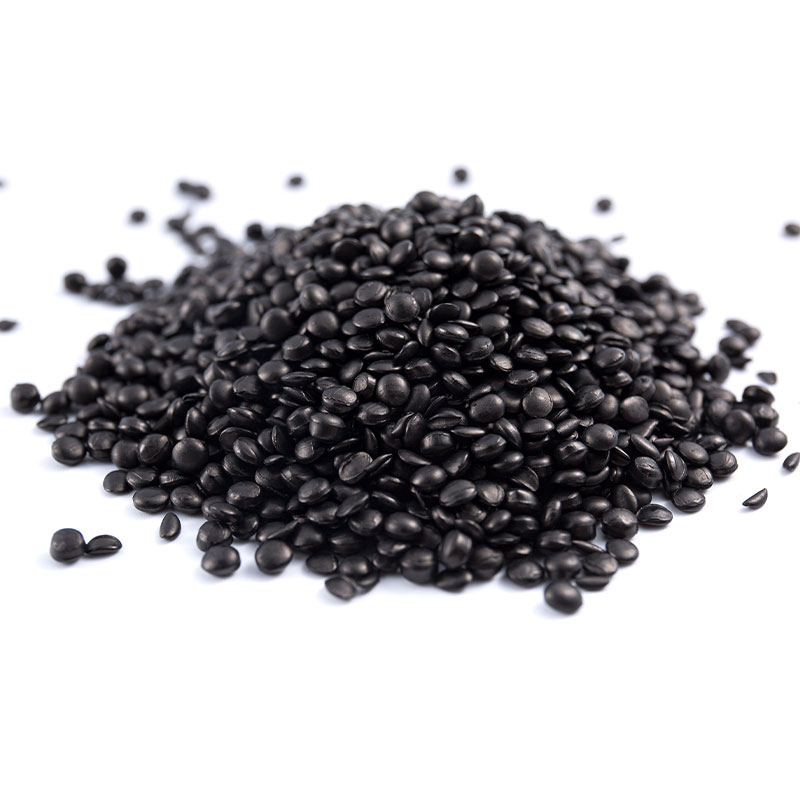 High Hiding Black Concentrated Masterbatch for Film and MoldingThis PE-based masterbatch with about 46% carbon black offers strong hiding power and stable processing for blown film, pipe, and injection molding, addressing filterability and flow concerns raised in the discussion.View Product →
Injection molding
Injection molders should evaluate how the masterbatch affects impact strength, weld-line appearance, surface gloss, and mold deposit. High-carbon-black masterbatches with poor wetting can reduce notched impact strength by 10% to 30% in PP or ABS. If the part is thin-walled, the flowability of the masterbatch also matters. Let-down is generally 2% to 5%, and a carrier matched to the base resin is essential to keep weld-line marks less visible.
Pipe extrusion
Pipe grades are judged by dispersion quality and long-term performance. For PE water pipes, the final carbon black content should be around 2% to 2.5% for UV resistance, and the dispersion level is evaluated according to ISO 18553. Poorly dispersed carbon black creates stress concentration points that reduce pressure resistance and crack-growth resistance. The carrier should not change the pipe's melt flow, or wall thickness control becomes unstable.
| Process | Key selection criteria | Typical let-down | Failure symptoms if wrong |
|---|---|---|---|
| Blown film | Gel count, filterability, opacity, blackness | 2% - 4% | Streaks, pinholes, film breaks |
| Casting film | Surface gloss, additive compatibility | 2% - 3% | Die lines, haze, blocking |
| Injection molding | Impact retention, weld-line, gloss, flow | 2% - 5% | Weak weld lines, mottled surface |
| Pipe extrusion | ISO dispersion rating, UV, pressure resistance | 2% - 6% | Brittle pipe, early cracking |
| Blow molding | Drop impact, wall distribution, surface quality | 2% - 4% | Uneven wall, low drop resistance |
If you are unsure whether a masterbatch is suitable for your line, we recommend a practical trial: run the grade at your normal let-down for one shift, inspect film or parts against a light source, and record filter pressure. Our team follows the same protocol when qualifying a new grade in our own factory.
Food-Contact Black Masterbatch: Compliance Is a Design Requirement
When black masterbatch is used in food packaging, tableware, cutlery, or fruit and vegetable containers, the pigment, carrier, and additives all must meet food-contact regulations. In the European Union, the relevant framework is Regulation (EU) No 10/2011 on plastic materials and articles intended to come into contact with food; in the United States, FDA 21 CFR sets rules for colorants and polymer components; in China, the GB 4806 series applies. These regulations limit the migration of substances from the finished article and require compliant quality data.
Raw carbon black can contain impurities such as polycyclic aromatic hydrocarbons (PAHs), heavy metals, and residual sulfur. Food-contact black masterbatch is formulated from purified pigment grades and high-purity carriers, and the compounding line is cleaned and controlled to prevent cross-contamination. Simply adding more dispersant is not enough: the full formula must pass migration testing, and the production process must demonstrate traceability.
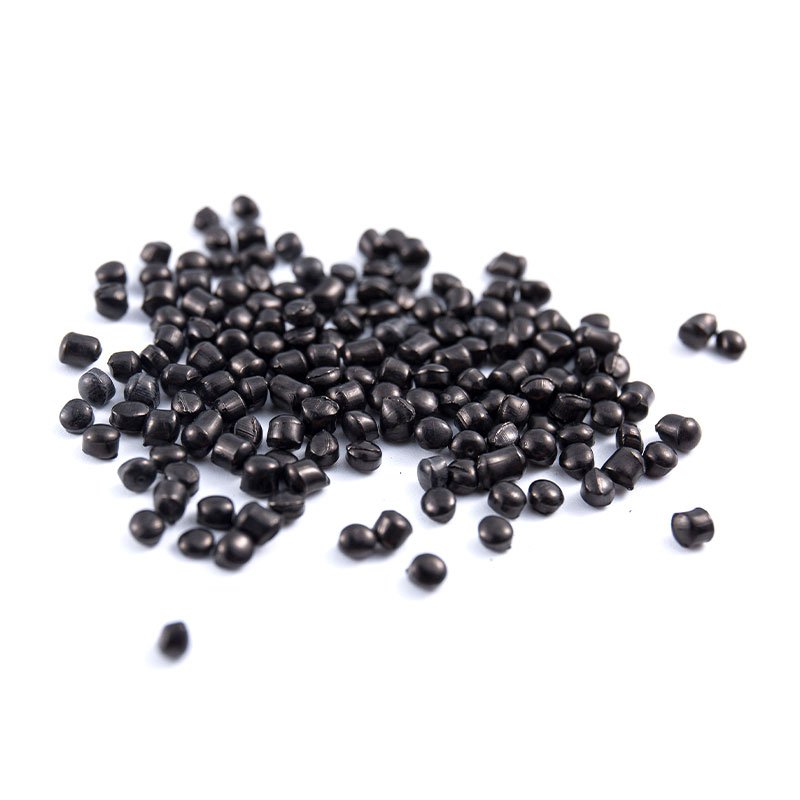 Food-Contact Black Masterbatch for Shatter-Resistant TablewareDeveloped for food-contact tableware, this PE-based masterbatch with 40% carbon black and calcium carbonate provides uniform coloring, enhances heat and impact resistance, and meets food safety standards, supporting the migration testing requirements highlighted nearby.View Product →
When evaluating a food-contact grade, ask the supplier for the specific regulation that the product was tested against, the test conditions (temperature, time, food simulant), and the migration result. A general "food grade" statement without test data is not a sufficient basis for a purchasing decision.
For tableware and containers, the product also has to survive repeated washing and mechanical stress. A food-contact black masterbatch should therefore be evaluated for impact resistance, dishwasher stability, and absence of surface peeling, not only for migration compliance. We covered the practical compliance questions in more detail in our guide on food contact black masterbatch safety and compliance.
UV Resistance and Long-Term Weathering
Carbon black is one of the most effective and economical UV stabilizers for polyolefins, provided it is well dispersed and present in sufficient concentration. Fine-particle carbon black absorbs UV radiation and converts it into heat, protecting the polymer chain from photo-oxidation. The relationship between carbon black content and outdoor life is non-linear: small increases in concentration can lead to large increases in service life.
This is why agricultural film, geomembranes, and outdoor pipes almost always specify a carbon black content of at least 2% in the finished product. Using a 40% masterbatch at 5% let-down gives exactly 2% final carbon black content. But concentration alone is not enough: carbon black agglomerates act as failure points where cracks can initiate, so the dispersion rating is just as important as the dosage.
For parts that must retain appearance under long-term sunlight, such as automotive exterior trim or outdoor furniture, masterbatch suppliers should be able to provide weatherability data from xenon-arc or QUV testing, including color change (delta E) and gloss retention after specified exposure hours. Ask for the test method, the cycle parameters, and the acceptance criteria.
Automotive-Grade Black Masterbatch: Tight Tolerances, Real Consequences
Automotive parts are where black masterbatch selection becomes truly demanding. Interior parts must meet volatile organic compound (VOC) and fogging limits, because the confined cabin environment makes off-gassing visible on windows and detectable by smell. Exterior parts must withstand years of sunlight, heat, humidity, and contact with road chemicals without fading, chalking, or cracking. Functional structural parts must retain stiffness and impact strength after aging.
For interior applications, low-VOC black masterbatch is produced with carefully chosen carrier resins and additives that do not generate aldehydes or other volatiles at molding temperatures. The test standards commonly cited are VDA 278 for VOC/TSN analysis, PV 3015 for condensation or fogging, and various OEM specifications for total carbon emissions. When our customers ask for automotive interior grades, we confirm which OEM specification is the target before recommending a product.
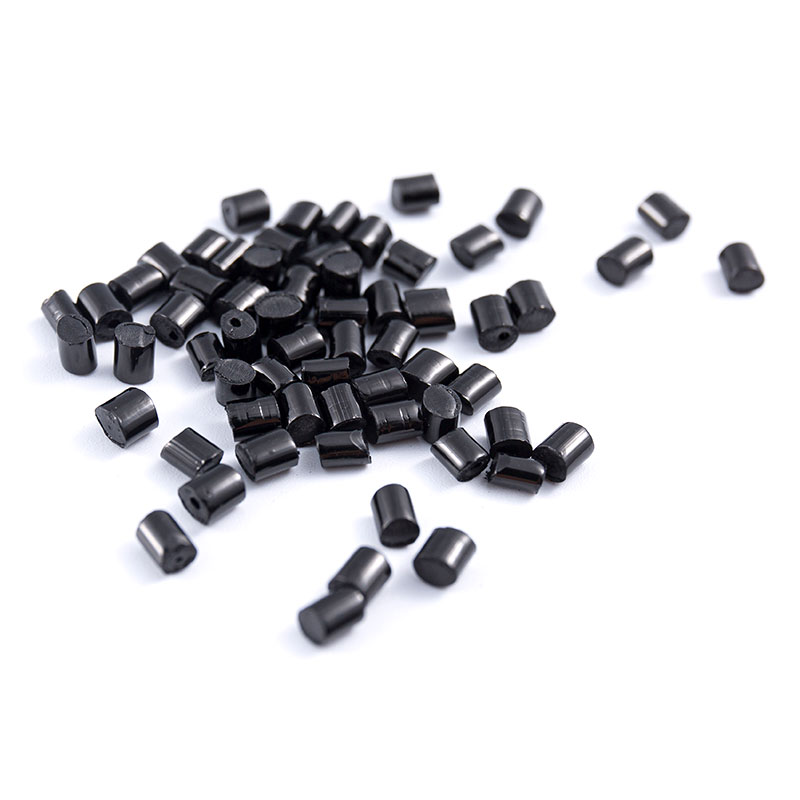 Low Volatile Environmentally Friendly Interior Black MasterbatchThis product is designed specifically for automotive and home interiors, emphasizing low VOC (volatile organic compound) emissions and low migration, effectively reduc...View Product →
For exterior parts, the key properties are weatherability, scratch resistance, and stable gloss. A masterbatch with very high jetness often contains finer carbon black particles, which can slightly reduce surface hardness; balancing blackness with scratch resistance requires adjustment of the carbon black grade and additive package. This is why automotive exterior grades are not simply "high-black" grades; they are finely tuned systems.
Dispersion Quality and How to Verify It
Dispersion quality is the single most important factor that separates good black masterbatch from poor black masterbatch. Poor dispersion means carbon black agglomerates remain in the plastic matrix. Under stress, these agglomerates become crack initiators; in film, they cause pinholes and tears; in pipe, they reduce pressure resistance; in a molded part, they create dull spots and weak points.
Practical verification methods
- Film test: press or blow a thin film (20 to 30 micrometers) from a sample of the compound and inspect it against a strong light source. Count the number of visible specks larger than about 30 micrometers per square meter.
- Filter pressure value: force the melt through a fine filter screen (for example, 15 or 25 micrometers) under controlled conditions and measure the pressure increase with time. A higher increase rate indicates poorer dispersion.
- Mechanical check: injection mold test bars at the same conditions as your production parts, then compare elongation at break, notched impact strength, and weld-line performance with an unfilled reference.
- Surface check: compare the gloss and color of molded plaques on the same tool under identical parameters; significant variation suggests dispersion or carrier problems.
For pipe producers, ISO 18553 specifies a method for assessing the degree of pigment dispersion in a section of pipe wall. The rating divides the observed agglomerates into size classes and assigns a score; lower scores indicate better dispersion. If your supplier cannot provide a dispersion micrograph or rating, that is a warning sign before you place a large order.
Cost per Kilo vs Total Cost of Use
The most common purchasing error in black masterbatch is comparing price per kilogram and ignoring the dosage required to achieve the target blackness and opacity. A low-cost grade with weak tint strength may need 5% let-down, while a higher-priced high-concentration grade works at 2.5%. The total masterbatch contribution per ton of finished product is the number that matters.
| Factor | Standard grade | High-load grade |
|---|---|---|
| Masterbatch price | $2.6 / kg | $3.6 / kg |
| Let-down ratio | 4% | 2.5% |
| Masterbatch per ton of product | 40 kg | 25 kg |
| Color cost per ton | $104 | $90 |
| Warehouse space per 10 tons of product | 400 kg | 250 kg |
In this example, the high-load grade costs more per kilogram but saves money per ton, reduces storage space, and shortens color changeover time because less material is handled. The comparison, however, is valid only if the high-load grade achieves the same blackness, gloss, dispersion, and mechanical performance. If it fails any of those requirements, the apparent saving disappears quickly.
Cost rule: compare masterbatch on the basis of cost per ton of finished product, never on cost per kilogram alone. And never accept a price benefit that depends on lowering your dispersion standard.
There is also a hidden cost in batch-to-batch inconsistency. If the shade or melt flow of the masterbatch drifts, every batch of your product is at risk of rejection. When we release a production lot, we verify jetness, tint strength, carbon black content by ash test, moisture, and filter pressure value; the certificate of analysis is included with every shipment.
Common Selection Mistakes
- Screening only the blackness, not the dispersion. A high-jetness grade with agglomerates will fail more often than an easier-dispersing grade with slightly lower blackness.
- Ignoring the carrier resin. Using a PE carrier for a PA product or an ABS product can reduce mechanical properties significantly, even if the color looks correct.
- Choosing a masterbatch for the cheapest price per kilogram without measuring the let-down ratio needed to pass your own color standard.
- Adding the masterbatch to a blend of different polymers without checking whether the carrier is compatible with all of them.
- Assuming all black masterbatch is food-compliant because it is black. Compliance is a formulation issue, not a color issue.
- Switching masterbatch suppliers without qualifying the new grade on the actual production line under normal operating conditions.
- Forgetting additive interactions: a masterbatch containing slip and antiblock may not be suitable for lamination or printing adhesion.
Many of these mistakes surface only after the product is in the field, which makes them expensive to correct. A simple qualification procedure at the beginning, including a dispersion test and a small-scale production trial, can prevent most of them.
When Standard Products Are Not Enough: Custom Development
Standard black masterbatch covers the majority of applications, but some requirements cannot be met by an off-the-shelf grade. You may need a carrier that matches an uncommon polymer, a carbon black level higher than 50%, an additive package for flame retardancy or antistatic performance, a specific color undertone for brand recognition, or a processing aid that prevents die buildup in a very fast film line. In these cases, custom development is usually faster and more reliable than trying to combine separate additives at your own plant.
At our factory, custom black masterbatch development starts with a short specification sheet: base polymer, melt flow rate, process type, operating temperatures, let-down target, regulatory requirements, and the performance tests the finished product must pass. We then select the carbon black grade, carrier, and additive package, produce a sample on a lab-scale compounder, and send it with a report. The sample is optimized in one or two cycles until the target blackness, dispersion, and physical properties are reached, at which point we move to a production-scale trial.
Specify
Base polymer, process, let-down target, regulatory needs, and performance tests.
Sample
We compound a lab-scale sample and deliver a full formulation report.
Validate
You test the sample on your own line or in our lab under agreed conditions.
Scale
Production trial, then batch release with a certificate of analysis.
Custom development usually works best when the quantity justifies the engineering effort. Even then, we recommend starting with the closest standard product before commissioning a new formula; many customers find that a standard grade already meets their specification once the correct carrier is selected.
Frequently Asked Questions
What is the difference between black masterbatch and raw carbon black?
Black masterbatch is a pre-dispersed pelletized mixture of carbon black and a carrier resin. Raw carbon black is a fine powder that is difficult to handle, creates dust, agglomerates easily, and requires intensive mixing before it reaches an acceptable dispersion level. Masterbatch simplifies the process and improves consistency.
What carbon black content should I choose?
For general film and injection molding, 30% to 40% carbon black in the masterbatch is a practical range. For agricultural film and pipes, higher-load grades around 40% to 50% allow the final carbon black content to reach 2% to 2.5% at a low let-down ratio. The optimum depends on your process mixing capability and color target.
Can one black masterbatch be used for all plastics?
No. The carrier resin must be compatible with the base polymer. A PE-based masterbatch may work in PP or EVA blends, but it is not suitable for ABS, PC, PA, PET, or PPS. For engineering plastics, always select a masterbatch whose carrier matches the resin family.
How can I check dispersion quality before buying in volume?
Ask the supplier for a filter pressure value and a film dispersion micrograph, then run a production trial at your normal let-down. Inspect film or molded parts under strong light, and compare mechanical properties with a reference sample. These checks take little time but prevent large-scale problems.
What certifications should food-contact black masterbatch have?
The product should be tested against the regulation that applies to your market, such as EU Regulation No 10/2011, FDA 21 CFR, or China GB 4806. The test report should cover specific migration, heavy metals, and PAH content with the relevant food simulant and time-temperature conditions.
Can black masterbatch provide enough UV protection without separate UV stabilizers?
For many polyolefin products, well-dispersed carbon black at 2% to 2.5% final concentration provides good UV protection, so a separate UV stabilizer is not always necessary. For extreme exposures or appearance-sensitive parts, a combination of carbon black and additional UV stabilizers may be specified; the masterbatch can deliver both in one pellet.
What is the shelf life of black masterbatch?
When stored in a dry, cool warehouse and kept in sealed packaging, standard black masterbatch can be used for two to three years. Re-dry the material if the package has been opened in high humidity, and check the moisture content if you process PET, PA, or other moisture-sensitive polymers.
Choosing the best black masterbatch is not about finding the darkest black. It is about matching the grade to your polymer, validating dispersion, confirming compliance, and comparing total cost on your own production line. These are all manageable steps, and they should be written into your purchasing specification just like dimensional tolerances on a molded part.
If you are qualifying a grade for blown film, injection molding, pipe extrusion, food contact, or automotive components, the E-LUCK team can send technical datasheets and samples for a production trial. The main website lists the full range of black masterbatch grades by process and industry, and our engineers are available to discuss your specific application.