

 Español


What Appliance Casing Black Masterbatch Has to Do
Appliance casing black masterbatch is not a generic color concentrate. It is a carbon black-loaded additive system engineered for injection molded housings made from HIPS, ABS, PP, PC/ABS, PA and other thermoplastics used in refrigerators, washing machines, air conditioners, vacuum cleaners and small kitchen appliances. The black masterbatch must deliver uniform jetness, protect the polymer during processing, survive elevated service temperatures and maintain impact resistance after the part comes out of the mold.
A casing masterbatch that works for pipe or film will not automatically work for an appliance housing. The molding process involves high shear, complex flow paths, weld lines and rapid cooling. The pigment system, carrier resin and additive package all need to be matched to the casing polymer. When this match is correct, the molder gets stable color, clean surfaces, repeatable shrinkage and fewer rejected parts. When it is wrong, the problems appear immediately: visible flow marks, black specks, low gloss, weld line discoloration or a brittle housing that fails a drop test.
The practical question is not whether to use a black masterbatch, but which one. This guide walks through the engineering properties, carrier resin choices, processing parameters, surface defects, color consistency and compliance requirements that determine the right product for a specific appliance application.
Why a Standard Black Masterbatch Falls Short for Appliance Enclosures
Many molders assume that any black masterbatch will give a black housing. That assumption causes more rework than any other single factor in appliance molding. A laundry bag masterbatch, for example, is built for low shear extrusion and high throughput. When the same material is injected into a complex mold at 230°C with high screw shear, it can degrade, plate out on the mold surface or create agglomerated carbon black spots. The result is a part that looks acceptable under plant light but fails under the stricter visual standards used by appliance OEMs.
Standard masterbatches also tend to be over-lubricated. Lubricants help film and pipe extrusion, but in injection molding they migrate to the surface, reduce paint adhesion, hurt ultrasonic welding and lower the surface energy of the housing. The appliance industry needs controlled lubrication, not maximum lubrication.
Heat Resistance near Motors and Heating Elements
A motor housing, air duct or rear panel of a refrigerator can reach 80–120°C during operation. The black masterbatch must not yellow, bloom or release volatiles at those temperatures. High-purity furnace carbon black with a matched carrier resin gives the casing a stable thermal history. If the carbon black contains impurities or the carrier has a low decomposition temperature, the surface will dull and the shade will drift from lot to lot.
Impact Strength and the Drop Test
Appliance housings are repeatedly handled, stacked and shipped. A poorly dispersed carbon black creates stress concentration points that reduce notched impact strength. In real production, an under-dispersed masterbatch can cut the impact retention of ABS or HIPS by 30% or more, depending on the black loading and the base resin. Good dispersion means that carbon black agglomerates are broken down to the smallest practical particle size and each particle is wetted by the carrier. This is a formulation issue, not something the molder can fix by raising screw speed.
Surface Appearance and Flawless Cosmetic Finish
The surface of an appliance casing is a sales feature. Gloss, color depth, uniformity and defect freedom all matter. A black masterbatch designed for injection molding will contain a carrier with a rheology that matches the base resin, allowing the melt to fill thin walls and long flow paths without hesitation marks. The carbon black grade is selected for high jetness and the right undertone, usually a blue-black shade preferred on modern white goods and dark home appliances. Generic black masterbatches often produce a muddy brownish tint in thick sections or a grayish appearance in thin sections.
Key Performance Indicators for Appliance Casing Black Masterbatch
When evaluating an appliance casing black masterbatch, focus on six measurable parameters. These indicators separate a well-designed product from one that only works in a lab test.
| Parameter | Typical Target | Why It Matters |
|---|---|---|
| Carbon black content | 30–50% | Controls how much masterbatch is needed and the cost per part. |
| Dispersion rating | No agglomerates above 15 µm | Prevents black specks, streaking and loss of impact strength. |
| Volatile content | ≤0.3% | Avoids vent burn, splay and mold deposits during injection. |
| Moisture content | ≤0.2% | Prevents surface bubbles and processing instability. |
| Thermal stability | ΔE ≤1 after 30 min at 250°C | Maintains shade and surface quality during hot runner molding. |
| Lot-to-lot color consistency | ΔE ≤0.5 | Reduces color sorting and rework in mass production. |
Do not rely on the masterbatch supplier’s data sheet alone. Ask for a report that includes the dispersion rating method, the thermal aging condition and the ΔE values from the last three production lots. These numbers matter more than a glossy brochure description.
The chart above indicates the relative weight that appliance molders should place on each property when choosing a black masterbatch. Thermal stability and impact retention are the most expensive to fix after the part is molded, so they deserve the most attention during supplier evaluation.
Carrier Resin Selection: Matching the Masterbatch to the Casing Polymer
The carrier resin is the body of the masterbatch pellet. It must be compatible with the casing polymer, melt in a similar temperature window and not interfere with the final mechanical properties. An incompatible carrier creates white specks, hazing, delamination or phase separation on the surface of the molded part.
How Carbon Black Type Affects Jetness and Undertone
Carbon black is available in many grades, with different particle size, structure and surface chemistry. For appliance casings, a high-jetness furnace black with a blue undertone is usually preferred because it gives a deep, rich black that matches the visual language of premium appliances. Larger particle blacks are cheaper but produce a grayish, lower-gloss finish. Smaller particle blacks give better jetness but are harder to disperse and require more energy during compounding. The masterbatch producer balances these factors through the dispersant package and the let-down ratio.
Common Carrier Resins and Their Limits
| Casing Polymer | Recommended Carrier System | Processing Consideration |
|---|---|---|
| HIPS / ABS | HIPS, ABS or SAN carrier | High gloss and good impact retention; SAN improves compatibility. |
| PP | Controlled rheology PP homopolymer | Good thermal stability and chemical resistance; choose narrow MFR range. |
| PC/ABS | Modified PC or ABS-based carrier | Requires low moisture and high heat resistance; avoid carrier that degrades PC. |
| PA | PA-based carrier | Low volatile formulation essential for high-temperature molding. |
| PBT / PET | PBT carrier or compatible polyester carrier | Used for high-heat structural housings; must be dried before molding. |
| PMMA | PMMA carrier with high transparency | Preserves glossy appearance in transparent or tinted parts. |
If the masterbatch carrier is not compatible, even a low addition level of 2% can cause visible defects. A common example is using an LDPE carrier in ABS casing. The LDPE phase separates from the ABS matrix and appears as frosty streaks or white marks at the gate area. This is why a dedicated appliance casing black masterbatch always specifies the carrier very clearly.
Dosing and Processing Recommendations
The recommended let-down ratio for appliance casing black masterbatch is usually 2–4% by weight. Within this range the part reaches full hiding power without a significant penalty on toughness. Going above 5% rarely makes the part blacker because the eye cannot perceive the difference beyond a certain jetness level; it only adds cost and reduces mechanical properties.
The curve shows a typical relationship between masterbatch addition level and impact strength retention in an ABS casing. At 2% and 3% addition, the impact retention remains above 90%. At 5% and above, the effect becomes more noticeable. This is not a universal curve, but it reflects the general behavior of mineral and pigment fillers in an impact-modified polymer. The right choice is the lowest addition level that gives the required color, hiding and appearance.
Melt Temperature and Injection Parameters
To get the best surface quality and mechanical performance, process the masterbatch within the melt temperature window recommended by the resin manufacturer. Typical ranges are 200–240°C for PP, 220–250°C for ABS, 250–280°C for PC/ABS and 240–270°C for PA6. A high back pressure, usually 8–15 bar, helps uniform pigment distribution. Moderate screw speed prevents excessive shear heating at the nozzle. Mold temperature should be kept on the higher side of the recommended range to improve surface replication and gloss.
Surface Defects: Causes and Corrective Actions
Surface defects are the most common reason an appliance casing part is rejected. The table below summarizes the defects typically related to black masterbatch, their root causes and the corrective actions available to the molder and the masterbatch supplier.
| Defect | Likely Root Cause | Corrective Approach |
|---|---|---|
| Black specks | Undispersed carbon black agglomerates or degraded polymer particles | Improve masterbatch dispersion; reduce barrel residence time; check hot runner. |
| Flow marks / tiger stripes | Incompatible carrier, high melt viscosity, or low mold temperature | Raise mold temperature; increase injection speed; use lower-viscosity carrier. |
| Gate blush | High shear at gate, stress whitening in polymer | Enlarge gate; reduce injection speed; select softer flow grade masterbatch. |
| Weld line visibility | Poor melt flow front recombination, carbon black low structure | Increase melt temperature; improve venting; choose a more flowable carrier. |
| Splay / silver streaks | Moisture in masterbatch or base polymer | Dry masterbatch according to supplier recommendation; check hopper dryer. |
| Gloss non-uniformity | Over-lubrication, mold temperature differences, non-uniform cooling | Reduce external lubricant level; adjust cooling time; polish mold surface. |
Color Consistency and Batch-to-Batch Stability
Color consistency is the highest cost driver in appliance casing production. If the shade of a housing changes from week to week, the assembler will have to sort parts, rework panels or even scrap finished products. A high-quality appliance casing black masterbatch controls ΔE to within 0.5 from lot to lot, measured under standard laboratory conditions with a spectrophotometer.
Ask the masterbatch supplier to provide a color report for each delivery. The report should include the ΔE against an approved standard sample, the undertone value, and the jetness index if available. Also ask how the supplier controls the carbon black raw material, because carbon black grades can vary slightly between different production lots of the carbon black manufacturer. A masterbatch producer with strong upstream relationships and incoming inspection will produce more stable color.
In a mass production environment, the molder should also check color at the beginning of each shift, after a machine pause and after changing resin lots. The combination of a stable masterbatch and a simple in-house checking procedure prevents most color-related complaints.
Compliance and Environmental Requirements for Appliance Materials
Appliance manufacturers operate under strict environmental and safety regulations. The black masterbatch used in a casing should comply with the applicable directives for the target market. Common requirements include RoHS for restricted heavy metals, REACH for substances of very high concern, and UL 94 for flammability-related material behavior. For kitchen appliances, food-contact compliance may also be required if the housing can have indirect contact with food.
Not every black masterbatch can meet these requirements. Carbon black from certain sources can contain polycyclic aromatic hydrocarbons (PAH) at levels that are acceptable in industrial parts but not in food-adjacent or consumer-facing applications. The masterbatch supplier should be able to provide a declaration of compliance, test reports and a statement of the carbon black grade used. Reviewing these documents early in the product development process avoids expensive revalidation later.
Product Options for Appliance Casing Black Masterbatch
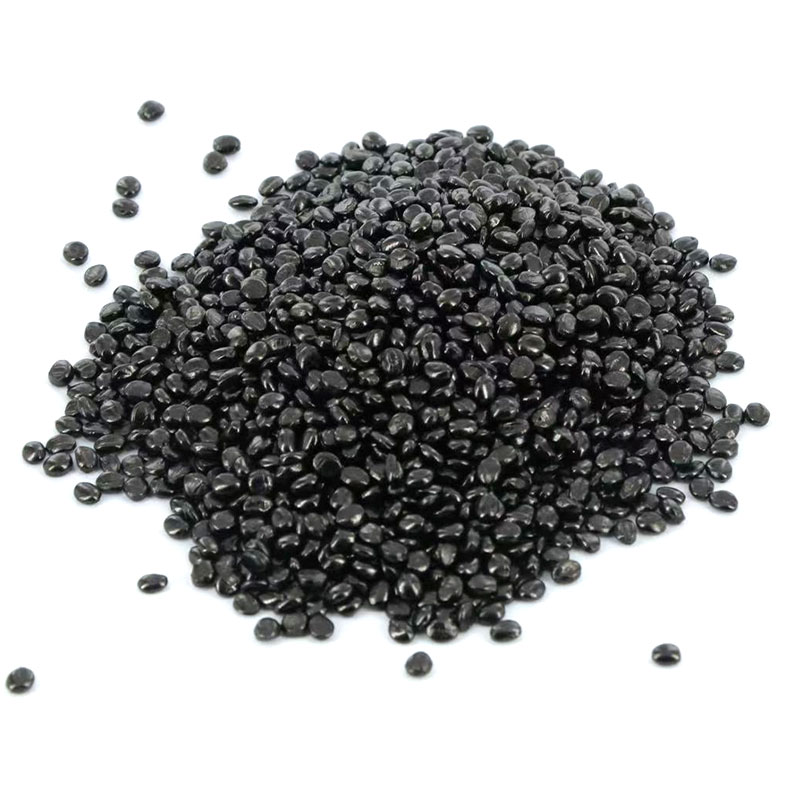 Injection Molding Reinforced Black Masterbatch for PP ApplicationsThis PE-based masterbatch with 40% carbon black and calcium carbonate filler enhances stiffness and color uniformity in PP injection-molded appliance parts, with a recommended dosage of 1-3%.View Product →
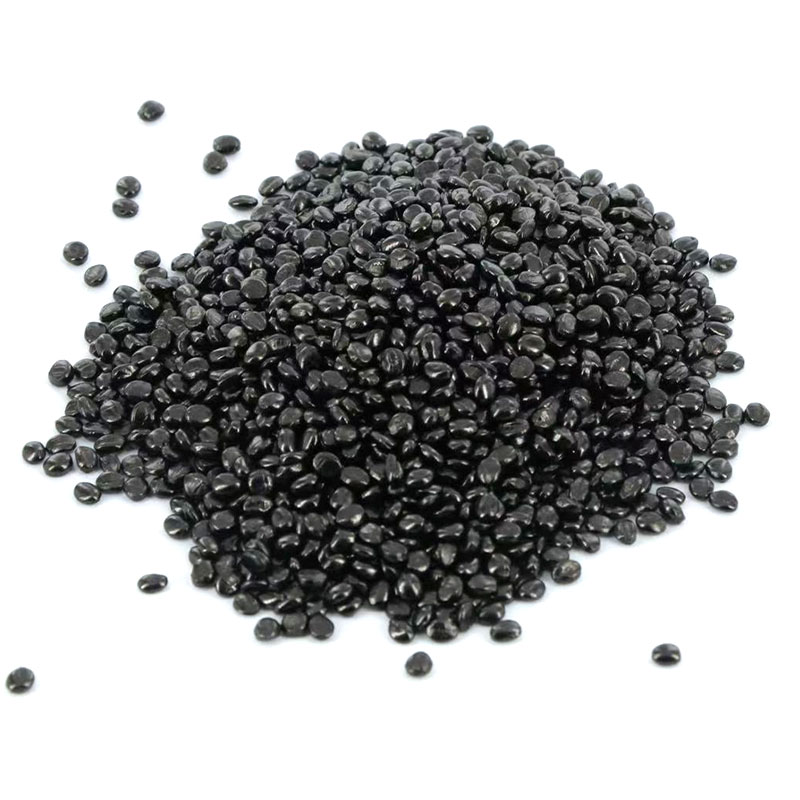 Structure-Enhanced All-PP Black Masterbatch for Durable Appliance CasingsDesigned for PP compounding and injection molding, this filler-free masterbatch boosts impact and abrasion resistance while avoiding phase separation, ideal for demanding structural housings.View Product →
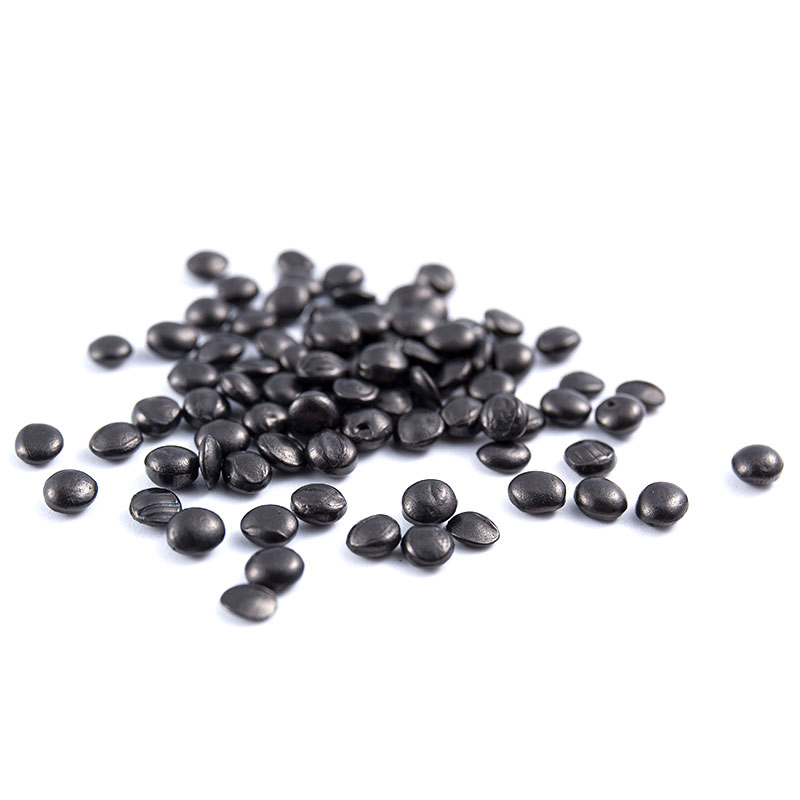 High-Temperature Resistant Black Masterbatch for Engineering PlasticsWith 47% carbon black, this PE-based masterbatch delivers high strength, thermal stability, and a cool blue-black tint across PA, PC, ABS, and PBT, suitable for 200–280°C processing.View Product →
Different appliance housings place different demands on the black masterbatch. A vacuum cleaner base needs stiffness and impact resistance. A refrigerator control panel needs high gloss and a deep black appearance. A motor cover needs heat resistance. The following product categories cover the main application profiles.
Injection Molding Grade Reinforced Black Masterbatch
This type is formulated for casing parts that carry structural loads or have long thin-wall sections. It provides good melt flow, high pigment load and maintains the stiffness of the base polymer. It suits washing machine panels, dishwasher door frames and other parts where warpage control is critical. The carrier is selected to match ABS, HIPS or PP, depending on the final application.
Structure-Enhanced Black Masterbatch
For housings that need better dimensional stability, a structure-enhanced masterbatch uses a carrier and optional filler system that helps reduce sink marks and shrinkage differences in thick sections. It is often specified for large appliance side panels, top decks and structural supports where the part must stay flat after cooling. The enhanced structure also helps slow warpage in semi-crystalline resins such as PP and PA.
High-Temperature Resistant and High-Strength Black Masterbatch
When the casing is close to a motor, heating element or exhaust vent, the black masterbatch must withstand continuous heat without surface discoloration. These high-temperature grades use thermally stable carbon black and a carrier with a high decomposition temperature. Typical applications include oven control housings, microwave oven air guides, motor end covers and heat-resistant back panels. They also keep their impact strength after long-term aging.
Common Buying Mistakes and Practical Advice
Suppliers of appliance casing black masterbatch are evaluated on price, formulation capability and delivery stability. But many molders still make the same avoidable mistakes during the selection process. The list below highlights the most important points to check before committing to a supplier.
- Choosing by price per kilogram instead of cost per part. A cheaper masterbatch may require a higher addition level, give lower impact retention or cause more rejects, so the final cost is higher.
- Ignoring the carrier resin. Always verify that the carrier is compatible with the casing polymer. A universal carrier often means compromise.
- Forgetting to check moisture and volatiles. High volatile content in a black masterbatch creates splay and vent deposits that stop production for cleaning.
- Not reviewing the regulatory test reports. For appliance exports, RoHS, REACH and other declarations must be available and current.
- Switching suppliers without a full-scale trial. A masterbatch that works in a small test mold can behave differently in a production mold with a different runner system and cycle time.
- Neglecting the supplier’s color stability data. Ask how many batches were tested and what the maximum ΔE was.
For a deeper comparison of masterbatch types and carrier options, read our carbon black masterbatch guide. When you are ready to evaluate suppliers, the How to Choose Black Masterbatch Manufacturers article explains the audit questions and test criteria that matter.
Frequently Asked Questions
What let-down ratio should I use for appliance casing black masterbatch?
For most appliance casing applications, 2–4% by weight is the correct range. Start at 3% and adjust based on wall thickness, mold surface finish, and the natural color of the base resin. If the casing needs high hiding power over a recycled or off-white base resin, use the upper end of the range, but do not exceed 5% unless the supplier has verified the mechanical performance at that level.
Can the same black masterbatch be used for ABS and PP casings?
Not typically. ABS and PP are chemically different, and a single carrier cannot match both. ABS requires a carrier based on ABS, SAN or another compatible styrenic resin. PP requires a PP-based carrier. Using an ABS masterbatch in PP will produce poor dispersion, surface streaks and reduced impact strength. If you mold both materials in the same factory, keep separate masterbatch grades for each polymer family.
Why does my casing show white specks after molding?
White specks usually come from an incompatible carrier, unmelted polymer particles or cross-contamination with another masterbatch. Review the carrier resin used in the masterbatch. If the carrier has a higher melting temperature than the casing resin, it will not melt completely and will appear as white or frosty points. This is especially common when a commodity PE-based masterbatch is used in ABS or PC/ABS.
How can I confirm the heat resistance of a black masterbatch?
Run a controlled aging test. Mold a test plaque with the same conditions used in production, then place it in an air circulating oven at the expected service temperature for 500 hours or a shorter accelerated period. Measure the color change and gloss before and after aging. A good appliance casing black masterbatch will show a small, gradual shift that is invisible in normal use. The supplier should also provide data from thermal analysis such as TGA or DSC.
Does black masterbatch affect the flame retardant behavior of an appliance casing?
It can. Carbon black itself is not a flame retardant, but it can influence the melt dripping behavior and thermal conductivity of the compound. Some flame retardant systems are sensitive to additives such as lubricants or certain carrier resins. If the casing must meet UL 94 V-0 or V-1, verify the masterbatch in the final flame retardant compound. Do not assume that a masterbatch used in a standard ABS casing will be acceptable in a flame retardant grade.
Is a high carbon black content always better?
No. High carbon black content reduces the masterbatch addition level and can lower logistics cost, but it also makes dispersion more difficult. Excessive pigment loading can cause the pellets to be dusty, difficult to feed or prone to agglomeration. The optimum carbon black content is between 30% and 50%, depending on the polymer, the carbon black grade and the production process. A well-dispersed 40% masterbatch is better than a poorly dispersed 50% product.
What to Do Next Before Starting Full Production
The practical path is simple: send a sample of the actual casing resin to the masterbatch manufacturer, provide a drawing of the part and state the performance targets, such as heat resistance, gloss, impact requirement and regulatory compliance. Ask the manufacturer to prepare a trial batch and run test plaques under conditions that reproduce your production process. Then compare the test parts against a reference sample under consistent lighting and measurement conditions.
A well-selected appliance casing black masterbatch should reduce rejects, keep color stable through long production runs and protect the mechanical quality of the housing. The time invested in carrier selection, dosing tests and supplier qualification pays back immediately in fewer interruptions and lower total part cost.