

 Español

At 3% letdown on a 45 micron garbage bag film line running 240 kg/h, a converter counted eleven black specks per square meter on the day shift and fourteen overnight. The incoming inspection gate was fifteen. The film shipped, the order closed, and the same argument restarted the following Monday. The converter suspected the resin. The resin supplier suspected the black masterbatch. The masterbatch supplier asked for the screw profile, the melt temperature and the dosing calibration before answering anything at all.
That loop is the plastics industry's masterbatch problem statement in miniature. It is not one problem. It is a set of measurable gaps between what a purchase specification says, what a process can actually deliver, and what a customer's inspection gate will accept. When those three things are written down loosely, blame circulates for months and nothing gets fixed.
Here is the conclusion first. The recurring problem statements around masterbatch are: dispersion that is never complete, carrier resin that does not match the matrix polymer, carbon black loading that trades mechanical performance for hiding power, color drift that crosses Delta E tolerances between lots, regulatory limits that keep moving across food contact, toys and automotive interiors, and black plastics that near-infrared sorters cannot see. Each one can be expressed as a test, a number and a tolerance. That version of the problem statement is the only version that gets solved.
The rest of this page takes each statement in turn, shows where it surfaces on a production line, and describes what a processor or buyer can measure instead of debating.
The Six Problem Statements the Plastics Industry Argues About
Before the detail, here is the whole landscape on one screen. Each card below frames the issue as a question a technical team can answer with data rather than opinion, plus the instrument or test that produces the answer.
01
Dispersion
How much undispersed carbon black survives the screen pack and appears as specks, gels or a rising pressure curve? Measured by filter pressure value testing, speck and gel counts per unit area, and the screen pack pressure record across a full run.
02
Carrier compatibility
Does the carrier resin wet and disperse in the matrix polymer without depressing impact strength or elongation? Measured by notched impact, tensile at break and a dispersion rating taken from the same molded plaque.
03
Loading economics
At what carbon black content does hiding power stop improving while cost, density and mechanical loss keep climbing? Measured by contrast ratio at a fixed film thickness, letdown ratio and cost per thousand finished parts.
04
Color consistency
How far can a batch drift before the customer notices on the shelf or in the assembly bay? Measured by Delta E at two illuminants, plus gloss and surface texture control on a matched plaque.
05
Compliance
Which restriction applies to which application, and what evidence does the buyer require before releasing a lot? Measured by migration testing, PAH and heavy metal screening, odor and VOC testing, and a documented substance list per grade.
06
End-of-life sortability
Can the black article be detected by a near-infrared sorter after collection? Measured by NIR response testing, pigment chemistry and any recyclability claim tied to packaging regulation.
Notice that none of these statements can be answered by a supplier's brochure alone. They are joint problems between the masterbatch producer, the converter and the brand owner, and each one needs a reference sample, a test method and a named owner before it can be closed.
Problem Statement 1: Dispersion Is Never Perfect, It Is Only Measurable
Carbon black arrives as primary particles in the 10 to 100 nanometre range, fused into aggregates of roughly 50 to 300 nanometres, and those aggregates cluster into agglomerates that can be tens of microns across. The masterbatch production process wets and separates the agglomerates; the converter's extruder finishes the job. Whatever survives both stages shows up as a speck, a gel, a weak point in the film or a slow rise in screen pack pressure.
So the honest problem statement is not "dispersion must be perfect". It is: "dispersion must be complete enough that the screen pack pressure stays flat for the duration of a production run and the visible speck count stays below the customer's gate". That sentence can be tested. "Good quality" cannot.
Five variables control the outcome: the structure and porosity of the carbon black grade, the melt viscosity of the carrier, the wetting and dispersing additive package, the shear history inside the extruder, and moisture. Moisture deserves special attention because carbon black is hygroscopic and a wet feedstock produces steam pockets that look exactly like poorly dispersed pigment, which sends teams hunting for the wrong root cause for weeks. Carbon black masterbatch is normally specified at 0.5% moisture or below.
| Method | What it detects | Typical specification language | Limitation |
|---|---|---|---|
| Filter pressure value, tested to ISO 23900-5 or EN 13900-5 | Agglomerates large enough to blind a defined screen | Maximum pressure rise at a stated throughput | Shows the sum of defects, not their size distribution |
| Speck and gel count on film or a molded plaque | Defects visible at the surface | Maximum specks above a set size per square meter at a stated thickness | Depends on operator eyes or scanner calibration |
| Long-run pressure rise on the production extruder | Gradual blinding from soft agglomerates | Flat pressure curve across an eight hour run | Slow, and it consumes production time |
| Microscopy or image analysis on microtome sections | Agglomerate size distribution inside the part | No agglomerates above a stated micron size | Laboratory only, small sample, not a routine check |
| Melt flow index shift against a reference | Carrier and matrix interaction, thermal degradation | Melt flow index within plus or minus 10% of reference | Indirect indicator, easy to misread |
The practical takeaway: agree on two of these methods, one for incoming inspection and one for dispute resolution, and write both into the purchase order. A supplier who resists naming a method is telling you something about their process control.
Problem Statement 2: Carrier Compatibility Versus Property Retention
A black masterbatch is mostly carrier resin. Typical products carry 20% to 50% carbon black, with the balance made up of a carrier polymer, dispersants and stabilisers. That carrier does not disappear when the pellets melt. It becomes part of the finished article, and if it is not compatible with the matrix polymer, it forms a separate phase that damages impact strength, elongates flow lines and can even plate out on tooling.
The classic mismatch is a polyethylene-carrier black masterbatch dosed into polyamide, ABS or polycarbonate. On a film line the consequences are mild. In an engineering part, the same letdown can cost 20% to 30% of notched impact strength before anyone notices, because the part still looks correct. Visual inspection passes, functional testing later fails, and the failure gets blamed on the moulding shop.
The problem statement therefore reads: state the matrix polymer, state the processing temperature window, and require the carrier to be either identical to the matrix, chemically compatible with it, or absent altogether.
Notched impact retention after 3% letdown in glass-filled PA6, reference unfilled value = 100
Indicative values from comparative trials. Absolute numbers vary with carbon black content, glass loading and moulding conditions, but the ranking between carrier types is consistent.
Carrier-free masterbatch is one answer to the compatibility problem, because there is no foreign polymer to dilute the matrix. The trade-off is real: carrier-free grades usually run at higher carbon black concentration, they demand accurate gravimetric dosing, and they need enough mixing energy in the screw to wet the pigment. On a machine with a short, low-shear screw, a carrier-free grade can actually disperse worse than a well-matched carrier grade. Match the product to the machine, not just to the resin.
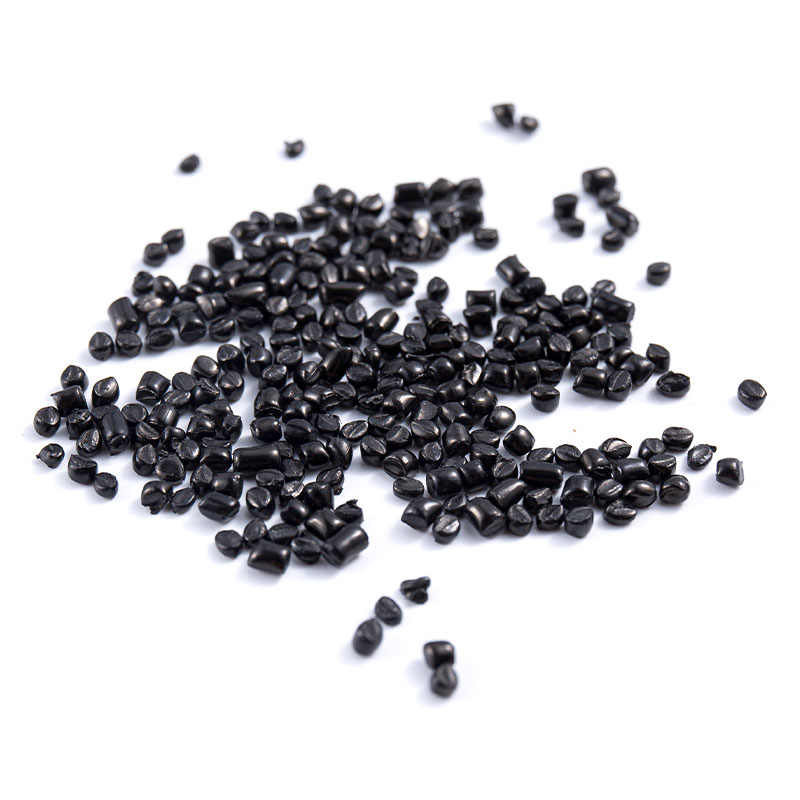 High Concentration Carrier-Free Universal Black Masterbatch Y02VCarrier-free universal black masterbatch for mixed schedules; eliminates carrier mismatch in engineering resins like PA, PC, PBT, PPS.View Product →
One workable route for mixed production schedules is a high-concentration carrier-free universal grade, dosed gravimetrically at low percentages, which removes the carrier mismatch question entirely for engineering resins such as PA, PC, PBT and PPS.
Problem Statement 3: Loading Economics, Where More Carbon Black Is Not More Black
Hiding power follows a saturation curve. Moving a film from 1% to 2% carbon black content delivers a large jump in opacity. Moving from 3% to 4% delivers almost nothing visible, but the cost line keeps rising, part density increases because carbon black has a specific gravity near 1.8, and elongation at break falls. At the same time, higher pigment loading makes dispersion harder, not easier, so speck risk rises exactly where quality matters most.
Film opacity and elongation retention against carbon black content in the finished film
Blue bars show contrast ratio as a percentage. The gain between 3% and 4% is under one percentage point, while pigment cost, density and dispersion difficulty all continue to rise.
The same chart has a second half that converters rarely plot. Elongation retention at those four loadings typically runs around 100, 96, 88 and 74 when the first figure is indexed to the unpigmented film. In other words, the last percentage point of opacity is being paid for with roughly a quarter of the film's ductility. For a garbage bag that gets dragged across a kerb, that is not a theoretical loss.
The problem statement here is a design instruction rather than a fault: define the minimum carbon black content that meets the opacity requirement, at the thinnest wall or film gauge the product will ever run, and specify that minimum in the purchase order. Ask suppliers for the hiding power curve of their grade, not just its nominal carbon black percentage. Two masterbatches labelled 40% can behave completely differently because of carbon black structure, carrier viscosity and dispersant quality.
Problem Statement 4: Batch-to-Batch Color Consistency and Delta E Discipline
Black is the least forgiving color to control and the easiest to argue about. Because reflectance is low, a small change in lightness is more visible to the eye than the same numerical change in a mid-tone color. A Delta E of 0.5 that would pass unnoticed on a beige part can be obvious on a matte black appliance housing, particularly under retail lighting.
Two practical issues drive most disputes. First, Delta E is not one number. Delta E 1976 and Delta E 2000 produce different values for the same pair of samples, so a specification that says "Delta E under 1.0" without naming the formula is an open invitation to disagreement. Second, lightness shift is the dominant variable in black. Controlling Delta L tightly usually matters more than controlling the a and b channels.
Third, a change of carbon black grade changes undertone. A finer primary particle size tends to produce a bluer, jetter black, while a coarser, higher structure grade reads browner or greyer at the same Delta E. When a supplier swaps carbon black lots for cost or availability reasons without telling the customer, the color target shifts, the customer's reference plaque no longer matches, and everybody loses a week.
| Application | Typical tolerance target | Measurement conditions | Notes |
|---|---|---|---|
| General industrial mouldings | Delta E 2000 within 1.5 to 2.0 | D65, 10 degree observer, matched surface texture | Visual assessment still decides borderline disputes |
| Visible automotive interior parts | Delta E 2000 within 1.0, Delta L within plus or minus 0.3 | D65 and a second illuminant, grain-matched plaque | Odor and fogging certified separately |
| Consumer packaging film | Delta L within plus or minus 0.4 at a fixed contrast ratio | D65, film at the production gauge | Opacity is specified alongside color |
| Toys and consumer goods | Delta E 2000 within 1.0 against an approved master | D65, polished plaque | Combined with PAH and heavy metal screening |
| Food contact tableware | Delta E 2000 within 1.5 | D65, production surface finish | Migration data must correspond to the same grade |
A useful habit is to keep a retained sample from every incoming lot, store it in the dark, and re-read it against the reference plaque whenever a customer complaint arrives. Retrospective measurement settles most color arguments in an afternoon, but only if the sample exists.
Problem Statement 5: Compliance Lines Keep Moving
Ten years ago a black masterbatch datasheet was largely a technical document. Today the compliance section is often longer than the technical section, and it is the part that stops shipments at customs or at a brand owner's gate.
Food contact is the strictest common case. In the European Union, framework Regulation 10/2011 governs plastic food contact materials, with overall migration limits and specific migration limits applied to every substance that may transfer. In the United States, colorants for polymers fall under Title 21 of the Code of Federal Regulations, and carbon black used in food contact applications must be supported by the appropriate listing. In China, the GB 4806 series sets the requirements for food contact plastics. A supplier who can only offer a general statement such as "food grade available" is not answering the question; what a buyer needs is the material declaration, the migration test report and the lot traceability that connects them to the delivered drums.
Consumer goods bring a different restriction set. Polycyclic aromatic hydrocarbons are the headline concern for carbon black, because the feedstock and the production route both influence residue levels. The strictest categories under the GS mark PAH requirements set limits in the 0.2 mg/kg range for individual substances such as benzo[a]pyrene, and toy safety standards add heavy metal migration requirements on top.
Automotive interiors add odor and emission requirements. VDA 270 odor ratings and VDA 278 thermal desorption results are usually specified by the vehicle manufacturer, and a low-volatile masterbatch is not optional in a closed cabin. This is where carrier selection and additive choice feed back into compliance: a low-cost lubricant package may meet the color target and fail the fogging test.
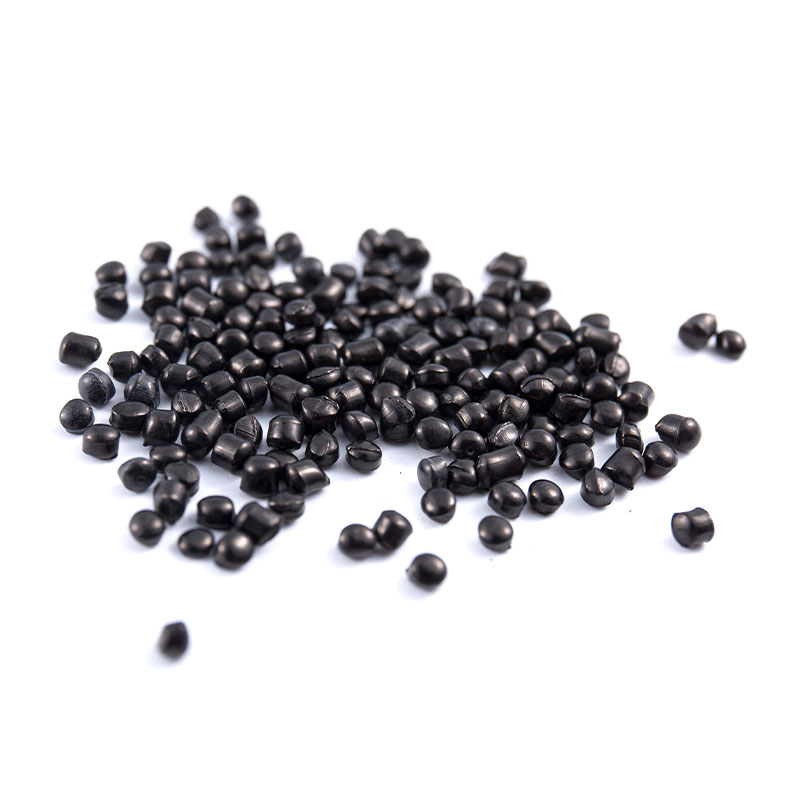 High Light-Shielding Black Masterbatch for Food Packaging AM4018Food-contact PE black masterbatch for films and lunch boxes; strong light blocking, uniform dispersion, and a documented substance list reduce rejection risk.View Product →
For food packaging film and bags, a high light-shielding food contact grade built on a documented substance list removes the most common cause of rejected lots, which is a mismatch between the grade that was tested and the grade that was shipped.
Problem Statement 6: Black Plastics and End-of-Life Sortability
The newest problem statement in the industry has nothing to do with the extruder. Near-infrared sorting equipment used in packaging recovery operates in roughly the 800 to 2500 nanometre band, and carbon black absorbs broadly across that range. The result is that a black polyethylene bottle can be chemically identical to a natural one and still be invisible to the sorter, so it is diverted to residue and burned or landfilled.
Regulation has caught up with the technical fact. The EU Packaging and Packaging Waste Regulation, in force since 2025, phases in recyclability requirements that bite from 2030, and several brand owners have already moved black packaging onto their restricted list for markets with advanced sorting infrastructure. Other regions are watching the same playbook.
The technical answers fall into three groups:
- NIR-detectable black masterbatch, which replaces part of the carbon black with infrared-reflective pigments so the article produces a readable spectral signature. Hiding power and cost are the two trade-offs, and both are negotiable with the right pigment balance.
- Reduced carbon black content combined with a particle size distribution designed for maximum opacity per unit of pigment, which keeps the signature partially readable while lowering cost.
- Mono-material design, where the article is built from one polymer family with no dark barrier layers or black adhesives that would confuse the sorter even if the outer surface reads correctly.
For a converter, the problem statement is a future purchasing consideration rather than a today problem, but the lead time is short. A packaging producer that qualifies an NIR-detectable grade now has a commercial advantage in conversations with brand owners who are already writing recyclability into their supply agreements.
Symptom-to-Root-Cause Map for Common Masterbatch Complaints
Most factory floor arguments collapse once the symptom, the probable cause, the data needed and the owner of the fix are written in the same row. This is the table worth printing and pinning near the dosing station.
| Symptom | Most likely root cause | Data to collect | Owner of the fix |
|---|---|---|---|
| Black specks and gels in film | Undispersed agglomerates, moisture, insufficient shear, oversized screen pack | Pressure curve, filter pressure value, moisture content, melt temperature profile | Masterbatch supplier with the film producer |
| Streaks or flow lines in mouldings | Cold slug, poor distributive mixing, mould temperature gradient | Short-shot study, shot weight record, melt and mould temperatures | Moulding shop |
| Color drift between production days | Carbon black lot change, dosing drift, melt flow index shift | Delta E record against the retained reference, gravimetric dosing log | Supplier and converter quality team |
| Loss of impact strength after letdown | Carrier and matrix mismatch, excess pigment loading, over-drying | Impact test on letdown plaques, carrier identification, loading calculation | Supplier and converter, jointly |
| Surface haze or blooming | Over-lubrication, incompatible dispersant, migration to the surface | Gloss reading, additive screening, mould deposit inspection | Masterbatch supplier |
| Odor or fogging failure in interior trim | Volatile carrier fraction, low molecular weight residues | VDA 270 and VDA 278 results on the finished part | Masterbatch supplier |
| Pressure rise after three to four hours of running | Soft agglomerates slowly blinding the screen pack | Long-run pressure log with timestamps, filter test result | Both parties review together |
| Weight variation in the finished part | Volumetric dosing assumption, inconsistent pellet bulk density | Gravimetric dosing verification, bulk density certificate | Converter equipment calibration |
What to Write Into a Black Masterbatch Specification
The single highest-value action in this whole discussion is to stop buying on a one-line description. A workable specification for a black masterbatch includes the following items, and every one of them is measurable.
- Matrix polymer and every polymer family the grade must serve, including the secondary components of any blend.
- Carrier resin, named explicitly, together with a statement of what happens if the carrier is mismatched.
- Carbon black type and nominal content, with the hiding power curve provided as a chart rather than a single number.
- Dispersion acceptance, expressed through a named test method and a maximum value, plus the screen size used.
- Moisture limit, typically 0.5% or below, with the test method stated.
- Color target with the reference plaque, the illuminant, the observer angle, the Delta E formula and the surface texture condition.
- Mechanical property retention, at minimum notched impact and elongation at break, measured on a letdown plaque of the actual matrix.
- Melt flow index of the masterbatch and the permissible shift in the finished compound.
- Filtration grade, pellet size range, bulk density and the packaging format used for shipment.
- Regulatory documentation: material declaration, migration test reports where applicable, PAH and heavy metal screening, plus any odor and emission testing for automotive use.
- Lot traceability from the delivered drum back to the carbon black batch, with a certificate of analysis per lot rather than per shipment.
- Retained sample commitment, so that disputes can be re-measured months later.
Converters who want a deeper reference on pigment selection and carrier behaviour before writing that document can work through this carbon black masterbatch guide covering types and carrier selection, which explains how carbon black structure, primary particle size and carrier viscosity interact inside the extruder.
How E-LUCK Frames These Problem Statements in Manufacturing
E-LUCK, the export brand of Guangdong Yijuyuan Plastic Technology, is a black masterbatch manufacturer rather than a general trader, and the product matrix is organised around exactly the problem statements described above. Grades are grouped first by processing route, then by application, then by carrier resin, which is the same sequence a converter uses when diagnosing a fault.
On the processing side, the range covers blown film, injection and extrusion, pipe and profile, sheet, wire and cable, and blow moulding. Within film alone, agricultural film, courier bag, shopping and garbage bag, and stretch film grades are separated, because a grade tuned for a 12 micron stretch film is not the same product as one tuned for a 100 micron agricultural film that must survive two seasons of ultraviolet exposure. On the injection and extrusion side, home appliance parts, appliance casings, high gloss mouldings and toy grades each carry their own dispersion and surface requirements, which is why a blown film black masterbatch range is specified separately from a moulding grade even when the nominal carbon black percentage looks similar.
On the carrier side, the company maintains dedicated families for AS, PC, PA, PBT, PET, PPA, PPS, PS, TPU, PCTG and POE, plus carrier-free products and a custom development category. That structure exists because the second problem statement, carrier compatibility, cannot be solved with a single universal product without accepting a performance loss somewhere in the plant.
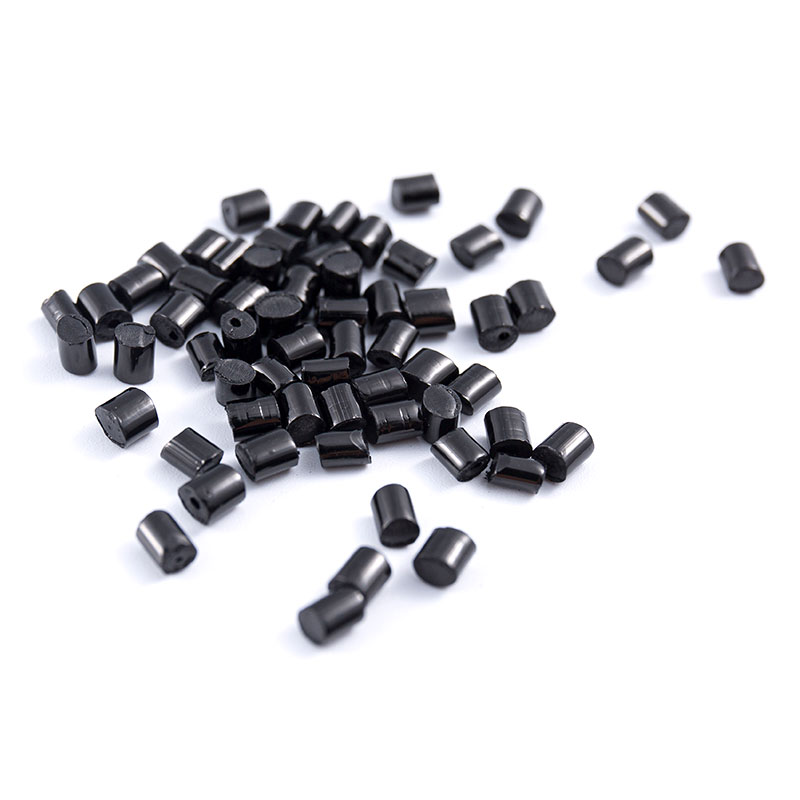 Low Volatile Environmentally Friendly Interior Black MasterbatchAS(SAN)-carrier black masterbatch for automotive and home interiors; low VOC, low migration, and stable blue-black tone for ABS/PC parts requiring OEM compliance.View Product →
For automotive interiors, the relevant consideration is combined compliance: a low-volatile, low-odor grade must hold its color through the moulding cycle and still pass the emission tests the vehicle manufacturer specifies. The company's published news includes the completion of IATF 16949 automotive quality management system certification, which is the documentation layer that sits behind that kind of requirement.
Practically, the fastest route from a complaint to a closed action item is to send the matrix polymer, the current letdown ratio, the processing temperatures, a sample of the defective part and the target specification to the masterbatch producer. A supplier who can only respond with a quotation is not solving a problem statement. A supplier who responds with a test plan, a proposed carrier change and a timeline is doing the work this page describes.
Frequently Asked Questions
What is the problem statement of the plastics industry regarding masterbatch in one sentence?
Masterbatch is sold as a concentrate that is expected to solve coloring and functional needs in one dosing step, but its performance depends on the matrix polymer, the processing machine and the end-use restriction, so the industry's real problem statement is that a single concentrate cannot be specified, tested or guaranteed without those three pieces of context being fixed first.
Why does dispersion matter more for black than for many other colors?
Carbon black has very fine primary particles and a strong tendency to agglomerate, and any undispersed cluster reads as a hard black speck against a black background where a light color would hide it. Black also tends to be used at higher pigment loading than pastel colors, which makes wetting harder and increases the risk of screen pack blinding over a long run.
Can a polyethylene carrier black masterbatch be used in polyamide or polycarbonate?
It can be dosed, and it will often look acceptable, but the polyethylene becomes a separate phase that reduces impact strength and can cause surface defects. For engineering resins, use a carrier matched to the matrix, or move to a carrier-free grade with accurate gravimetric dosing and sufficient mixing energy in the screw.
What letdown ratio should a film producer target?
Most film producers run between 2% and 5% of a 30% to 50% carbon black masterbatch, depending on film gauge and the opacity requirement. Work backwards from the contrast ratio the product needs at its thinnest gauge, then verify elongation retention at that loading, because the mechanical cost of the last percentage point of opacity is usually higher than the pigment savings are worth.
How should color tolerance be written so that it can be enforced?
Name the reference plaque, the illuminant, the observer angle, the surface texture, the Delta E formula and the numeric limit, and state which channel dominates. In black, controlling Delta L more tightly than the a and b channels reflects what the human eye actually notices, and it prevents arguments later about which number should have been used.
Which documents should accompany a food contact black masterbatch?
At minimum: a full material declaration for the grade, migration test reports from an accredited laboratory covering the intended use conditions, a substance list matching the relevant regional framework, and lot level certificates of analysis that allow the delivered material to be traced back to those tests. A general statement that a product is food grade is not sufficient evidence for a brand owner's compliance file.
Does using black masterbatch prevent a plastic article from being recycled?
Not by itself. The obstacle is detection. Conventional carbon black absorbs near-infrared light, so automated sorters cannot identify the polymer, and the article is diverted to residue. NIR-detectable masterbatch formulations and reduced pigment loading give the sorter a readable signature, and mono-material designs make that signature easier to read.
What does a converter need to send for a fast root-cause answer?
Five things: the matrix polymer and any additives already in the compound, the current letdown ratio and how it is dosed, the full processing temperature profile, a physical sample of the defective article or film, and the target specification including the test method used at incoming inspection. With those five items, most dispersion and compatibility questions can be diagnosed without a site visit.
The next time a speck count or a color reading starts a debate on the shop floor, resist the urge to reopen the general quality conversation. Pick the one problem statement that matches the symptom, name the test that will settle it, and agree in writing on the number that counts as a pass. Dispersion, carrier match, loading, color, compliance and sortability are all finite questions. They only become endless when they are left unwritten.
Start with the specification checklist, take one grade at a time, and build the retained sample archive as you go. That archive, more than any certificate, is what turns a recurring complaint into a single afternoon of measurement.