

 Español

Three pallets of black courier bags came back to the converter last quarter: the shade looked washed-out grey at the edges of the web, and fine specks were visible across the surface under shop lighting. The line had been dosing loose carbon black powder directly into the blender, and every batch fought the same battle — weighing accuracy, dispersion, die cleanliness. A masterbatch exists to end exactly that kind of firefighting.
The direct answer to the question in the title: masterbatch is a concentrated mixture of pigments and additives — commonly 20% to 60% active material — pre-dispersed in a carrier resin and delivered as free-flowing pellets. A processor blends a small dose, usually 1% to 5%, into natural polymer at the machine, and heat and shear distribute the color or function evenly through the melt. It is the standard route by which most plastic products get their black, their UV protection, or their antistatic behavior.
This guide explains what goes into a masterbatch, how it behaves on a production line, where specifications diverge by application, and what to check before placing an order — written from the perspective of a manufacturer that produces black masterbatch for films, pipes, moldings and engineering plastics.
What Is Masterbatch in Plastics?
Masterbatch — abbreviated MB and often called a concentrate — is a solid additive for plastics in which pigments and/or additives are dispersed at high concentration inside a carrier material. The carrier is a resin or wax selected for compatibility with the base polymer, so that when the two melt together in an extruder or molding machine, the pigment releases uniformly into the surrounding melt. Active content typically sits between 20% and 60%; the balance is carrier and wetting chemistry.
The name describes the method. The master recipe — pigment, carrier, dispersant — is compounded once, under high shear, where dispersion conditions can be controlled and verified in a laboratory. Converters then let that master down into every production run at a small, fixed dose. Instead of asking a film line to break down stubborn carbon black agglomerates with limited residence time, the processor buys a pellet in which that work has already been done and simply dilutes it.
Every masterbatch is built from the same four building blocks, in proportions that shift with the target application:
Concentration is a design decision, not a constant. A film-grade black masterbatch commonly carries 40–50% carbon black so thin gauges reach full hiding at modest dosage; general-purpose grades often sit at 25–35% to keep the price per kilogram attractive for thick-wall parts where a higher let-down is acceptable. When quotations arrive, normalize them by active pigment content: a cheap pellet at 25% can cost more per finished kilogram than a premium pellet at 50%.
Why Masterbatch Exists: The Problem It Solves
Carbon black is among the most difficult pigments in the industry to disperse. Its primary particles measure roughly 15–90 nanometers, and they bond into agglomerates that a conventional single-screw extruder, with its short residence time and limited shear, cannot fully break apart. Feeding loose powder straight into the machine therefore produces three predictable failures:
- Specks and a grey undertone. Undispersed agglomerates survive to the die and appear as dark dots, surface roughness, or a washed-out shade instead of a deep black.
- Die build-up. Poorly wetted carbon black accumulates on the die lip, causing die lines and forcing frequent shutdowns for cleaning.
- Dosing chaos. Carbon black powder bridges, clumps and clings to equipment; feeder accuracy collapses and the shade drifts from shift to shift. Powder handling also raises housekeeping and cross-contamination issues for converters running multiple colors on the same line.
A masterbatch moves the dispersion problem upstream to equipment designed for it. Inside a co-rotating twin-screw extruder, the pigment is wetted by carrier and dispersant, sheared at high screw speed, and locked into a stable pelletized form. What reaches the converter's blender is free-flowing, dust-free and dispersed to a verified standard; the line only has to dilute, a task gravimetric feeders handle with ease.
There is a second economic argument. Masterbatch lets a converter hold natural resin in stock and add color at the machine, so one resin inventory serves many products and shades. Fully pre-colored compounds remove that flexibility and usually demand larger minimum quantities per shade — a comparison quantified in a dedicated section below.
The Three Families of Masterbatch
Suppliers group their portfolios into three families, and knowing which family a quotation belongs to is the first filter in any sourcing exercise, because dosage windows, prices per kilogram and failure modes differ sharply between them.
| Family | What it delivers | Typical let-down | Common uses |
|---|---|---|---|
| Color masterbatch | Pigment for color, opacity and jetness; black, white and chromatic shades | 1–5% | Films, bags, housings, pipe, automotive trim |
| Additive masterbatch | UV stabilization, antioxidants, antistatic, slip, flame retardancy | 0.5–3% | Outdoor products, packaging, electronics, cables |
| Filler masterbatch | Calcium carbonate or talc for cost control and stiffness | 5–20% | Raffia, ropes, nonwovens, rigid household items |
The families also merge. A black masterbatch for agricultural film may combine pigment with a UV stabilization package; a pipe grade may pair carbon black with antioxidants that protect long-term strength. When briefing a supplier, describe the end product and its exposure conditions rather than only the color — that is what decides the recipe.
Inside a Black Masterbatch: Carbon Black and Carrier Resin
Two components dominate the performance of a black masterbatch: the carbon black grade and the carrier. Everything else fine-tunes.
Carbon black: the pigment that defines the grade
Grade selection controls jetness (how deep the black reads), undertone (blue, neutral or brown), hiding power, UV absorption and cost. Fine furnace blacks with primary particles around 15–25 nm produce the deepest, blue-leaning black that buyers expect on glossy appliance housings and automotive trim. Coarser grades above roughly 40 nm disperse more easily, extrude at lower pressure and cost less — the pragmatic choice for garbage bags, drainage pipe and other products where depth of shade has a ceiling. Quality laboratories describe jetness with L* values measured on pressed plaques: a high-jetness grade lands in the mid-teens, while a general-purpose grade floats several points higher.
Carbon black also does functional work. Well dispersed at 2% or more in polyethylene, it screens the large majority of damaging UV radiation — the reason black is the default color for water pipes, mulch film, cable jackets and outdoor furniture.
The carrier decides compatibility
The carrier makes up 30–70% of the pellet and must satisfy three conditions: process at the same temperatures as the base resin, flow compatibly with it, and stay invisible in the finished part. Polyolefin films run on PE or EVA carriers; styrenics on PS- or ABS-compatible carriers; engineering compounds on PA, PC, PBT or PPS carriers matched to the polymer. Melt-flow matching matters more than most buyers expect — as a working rule, keep the carrier's melt index within about ±30% of the base resin so the two materials travel through the screw together without flow marks or surface haze. Carriers are frequently chosen with a melt flow slightly above the base resin, so the pigment releases quickly once the melt forms.
Where one plant runs many polymers in the same week — a compounder alternating PP, ABS and filled PA — carrier-free concentrates remove the compatibility question entirely, carrying very high carbon black loadings with no carrier resin to interfere with the modified polymer.
How Masterbatch Works on the Line: Let-Down Ratios in Practice
The let-down ratio — the share of masterbatch dosed into natural resin — is where formulation meets daily production. The arithmetic is deliberately simple:
Most black films carry 0.8–2% total carbon black; PE pressure pipes specify 2–2.5%; deep-black injection moldings typically reach their shade at 1–2% pigment content. If a supplier quotes a 25% grade for the same film, the let-down must double to 4% — which doubles the carrier entering the melt and the volume of masterbatch purchased per ton of product.
Inside the machine, the masterbatch follows the same path as the resin:
- A gravimetric feeder meters pellets by weight, holding dosage far steadier than volumetric systems.
- Pellets dry-blend with natural resin, or feed through a side port on the extruder.
- Heat and shear re-melt the carrier and release the pre-dispersed pigment into the melt.
- The screen pack filters out remaining agglomerates; a low, stable pressure rise signals clean dispersion.
- Melt reaches the die as a homogeneous, uniform black.
Two practical warnings from the plant floor. Dosing below roughly 1% magnifies every feeder error and the shade starts to drift; dosing far above the required ratio wastes money and floods the melt with carrier that can soften properties. Segregation is also real — long transport distances between feeder and throat let heavy pellets separate from the blend, so keep feed paths short and direct.
How Black Masterbatch Is Made
Black masterbatch production is a compounding exercise in dispersion. The classic manufacturing route runs through five stations:
- Weighing and pre-blending. Carbon black, carrier pellets, wax and additives are dosed by weight into a high-speed mixer, where the wax begins pre-wetting the pigment surface.
- Twin-screw compounding. A co-rotating twin-screw extruder with a high-shear screw configuration wets, breaks down and distributes the pigment. Carbon black is often fed through a separate port or pre-dispersed as a paste to keep the process clean.
- Pelletizing. Strands drop through a water bath and are cut to length, or the melt is pelletized underwater; pellets are then sieved and passed over magnets to remove metal traces.
- Homogenization. Production batches are blended in large silos so the first kilogram and the last kilogram of an order match.
- Laboratory release. Melt flow rate, carbon black content (by ash or thermogravimetric analysis), moisture, heat stability and a dispersion rating from pressed plaques or a filtration pressure-rise test are checked before the batch ships.
Homogenization capacity deserves a buyer's attention. Suppliers who blend small batches struggle to hold one shade across a large order; suppliers with large homogenization silos ship consistency. Ask directly about batch size and homogenization practice — the answer predicts your shade stability better than any datasheet claim.
Cleanliness discipline inside the plant shows up later as fewer specks on your film: dedicated pigment handling, sealed transfers, sieving and metal separation are visible signs that a producer takes dispersion quality seriously.
Application Requirements: Where Specifications Diverge
The same pellet family behaves very differently once it leaves the laboratory. Specifications that pass on a thick injection molding can fail on 30-micron film. These are the requirement patterns by application, based on the grades in daily production for each market.
Blown film, courier bags and stretch film
Film is the least forgiving environment for dispersion: thin gauges expose every surviving agglomerate as a speck, and a gel at the die becomes a visible line running the length of the roll. Film grades therefore prioritize dispersion and filtration behavior — low pressure rise, no die build-up — with carbon black contents of 40–50% so thin layers reach full hiding at modest dosage. Courier and shopping bag grades add toughness and surface finish; stretch film grades demand high purity; agricultural film grades bundle UV stabilization, because mulch film spends a full season in direct sun.
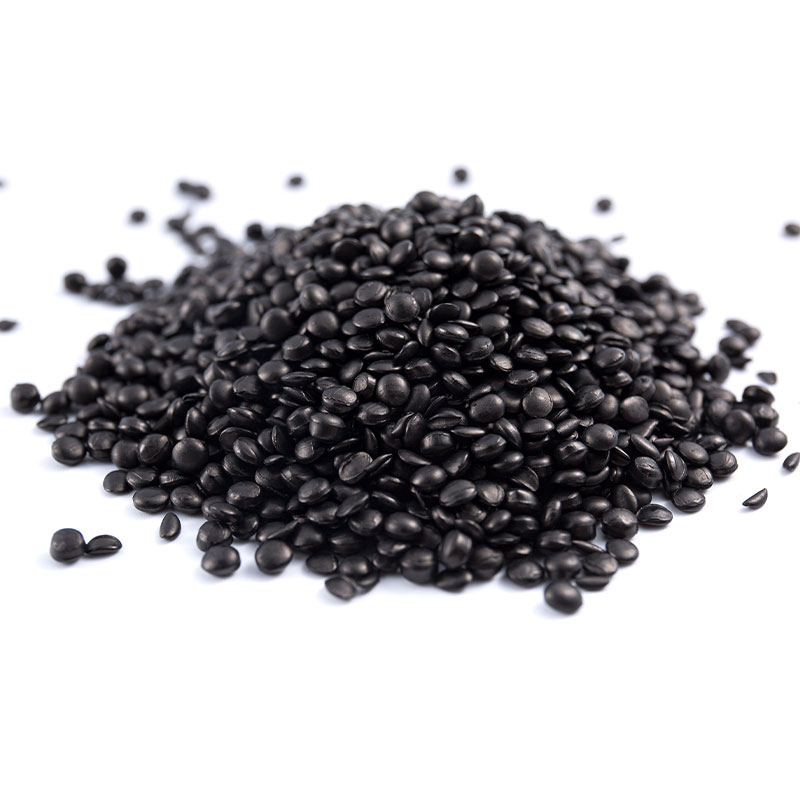 High Hiding Black Masterbatch for Film Applications (EN4066)A PE-based concentrate with about 46% carbon black and low ash, engineered for clean dispersion and filtration behavior. It suits film extrusion where thin gauges expose agglomerates, delivering full hiding at modest dosage.View Product →
Pipes for water supply and drainage
PE pressure pipes carry 2–2.5% carbon black as their built-in UV shield, in line with long-standing practice for buried and exposed polyethylene pipe systems. The masterbatch must contribute clean dispersion — specks inside a pressurized pipe wall act as stress raisers — plus low moisture and documented weathering behavior. Drainage and sewer grades have more freedom on shade but still need long-term environmental stability.
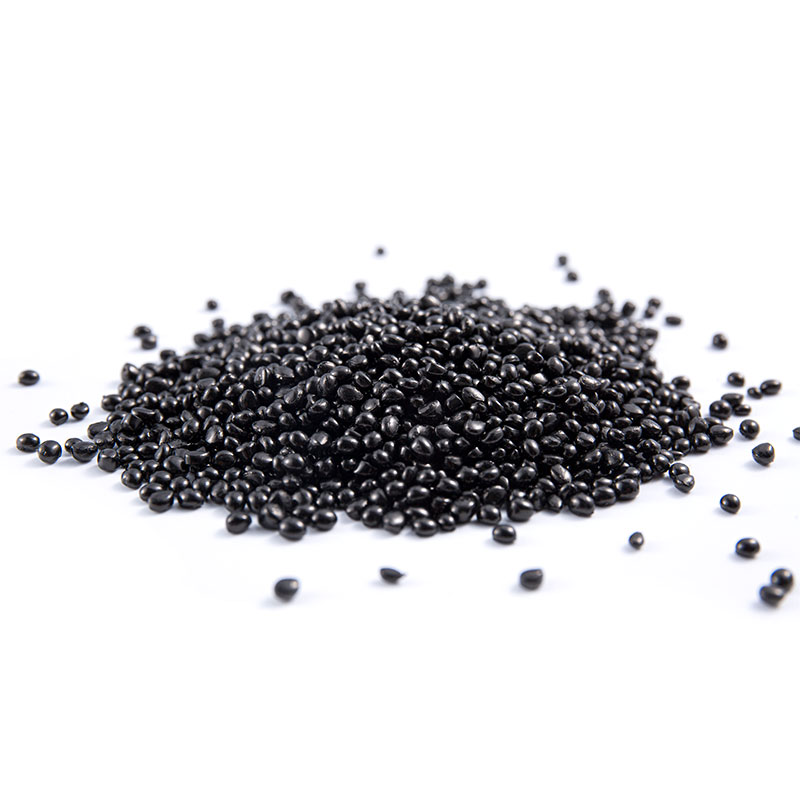 UV Protection Black Masterbatch for PE Pipes (H6045)This PE-carried grade contains roughly 45% carbon black for uniform coloring and enhanced UV resistance. It fits pressure pipe systems needing clean dispersion, low moisture, and documented long-term weathering stability.View Product →
Injection molding: appliances, toys and housings
Molding grades trade a measure of jetness for flow and surface quality: high gloss on appliance housings, impact resistance on toys, and heat stability that survives engineering-resin processing windows up to roughly 280 °C. Undertone becomes a design decision — a blue-undertone black reads as premium on a glossy housing, while a neutral black suits matte technical parts. Consistency across regrind ratios also matters, since molders routinely blend sprues and runners back into the feed.
Automotive interiors and exteriors
Automotive specifications read like a materials exam: low volatile emissions and fogging for the cabin, scratch and mar resistance on interior trim, uniform light shielding on visible parts, and weathering durability for exterior components. Interior grades therefore control the volatility profile of the carrier and the additive package as carefully as the pigment itself.
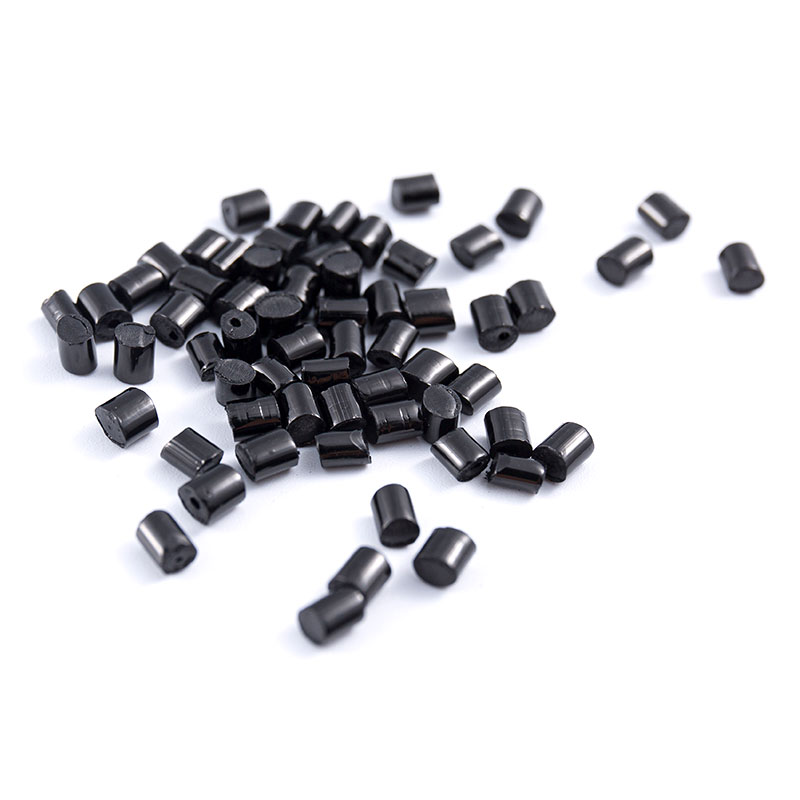 Low VOC Black Masterbatch for Automotive InteriorsFormulated on an AS (SAN) carrier with highly dispersible carbon black, this low-emission grade controls volatility and fogging for cabin parts while supporting glossy or matte finishes and documented compliance testing.View Product →
Food-contact packaging and tableware
Food-contact work is a compliance exercise before it is a color exercise. Colorants and additives must sit within the applicable frameworks — in practice, declarations against the EU food-contact plastics Regulation (EU) No 10/2011 and US FDA colorant listings such as 21 CFR 178.3297, with migration behavior as the deciding factor. Collect the declarations of compliance for each grade and keep them aligned with downstream certifications for tableware, packaging bags and fruit and vegetable turnover boxes. For a fuller treatment of the documentation trail, see this guide on how food-contact black masterbatch secures safety and compliance.
Engineering compounds and specialty carriers
Compounds based on PA, PC, PBT, PPS, PET, TPU, PCTG or POE process hot, shear-sensitive and often under tightly controlled conditions. Here the carrier question dominates: a mismatched carrier creates haze, embrittlement or degradation, while correctly matched or carrier-free concentrates disappear into the polymer. Heat-stable pigment packages that hold their shade at 280–300 °C are the baseline expectation for these markets.
Masterbatch vs. Compound vs. Liquid Color vs. Powder
Masterbatch is one of four routes to a black plastic part, and each route shifts cost and risk to a different place in the supply chain — which is why the same part can be sourced so differently from plant to plant.
| Route | Main advantage | Main trade-off | Typical best fit |
|---|---|---|---|
| Masterbatch | Proven dispersion; one resin inventory serves many shades; smaller order quantities | Requires dosing accuracy and mixing on the line | Converters running several products and shades |
| Pre-colored compound | Zero dosing; shade locked into the resin itself | Premium on every kilogram; large minimum quantities; less flexibility | Long runs of a single frozen specification |
| Liquid color | Very low dosage; no moisture pickup; fast shade changes | Pump maintenance; carrier and compatibility limits | High-volume extrusion with frequent changeovers |
| Dry pigment blend | Lowest upfront ingredient price | Dust, poor dispersion, shade drift, hygiene burden | Rarely suitable beyond rough outdoor items |
The arithmetic trips up many buyers. A kilogram of masterbatch costs more than a kilogram of resin, but only 1–5% of it enters the product, whereas a compound's premium applies to 100% of the resin. Plants running several products on one line almost always land on masterbatch for flexibility; long-run, single-specification products can justify compounds when their volumes match the minimum order.
Six Quality Problems and Where They Come From
Field complaints cluster into a handful of patterns, and most trace back to dispersion, moisture or carrier compatibility rather than to the pigment itself. Use this map the next time a defect appears:
| Symptom | Likely root cause | What to check first |
|---|---|---|
| Black specks on the surface | Incomplete pigment dispersion or contamination | Dispersion rating of the grade; screen pressure rise; feeder and blender cleanliness |
| Die build-up and die lines | Incompatible carrier or low-grade wax | Carrier compatibility with the base resin; melt temperature window |
| Shade drift between batches | Weak homogenization; carbon black content variation | Supplier batch size and homogenization practice; certificate of analysis per lot |
| Gels and fisheyes | Moisture pickup or degraded carrier | Moisture specification and certificate; storage conditions; drying practice |
| Washed-out grey tone | Low effective carbon black content or coarse grade | Total pigment content (dosage × concentration); grade undertone and jetness data |
| Early UV failure outdoors | Insufficient or poorly dispersed carbon black; missing UV package | Carbon black percentage in the part; weathering data; additive package |
A Practical Checklist Before You Order
Before any purchase order, run this checklist. It takes an hour and prevents most of the disputes described in the table above:
- Confirm the carrier resin and its melt index against your base polymer; target roughly ±30% melt-flow compatibility.
- Ask for the actual carbon black percentage and grade family — jetness and undertone data, not just the word "black".
- Request dispersion evidence: pressed-plaque ratings and, for film grades, filtration pressure-rise data on the exact product.
- Verify heat stability at your processing temperature, including behavior under your regrind policy.
- Check moisture limits and packaging: below 0.1% for polyolefin grades, tighter for PA and PET, with moisture-barrier liners.
- Collect compliance documents: RoHS and REACH declarations, food-contact declarations where the part touches food, automotive material requirements where relevant.
- Run a one- to two-hour line trial on your machine with your resin, checking shade, specks, pressure rise and mechanical properties.
- Compare cost per finished kilogram — normalize every quotation by dosage and pigment concentration before looking at price per tonne.
Frequently Asked Questions About Masterbatch
What is masterbatch in plastics, in one sentence?
A masterbatch is a concentrated blend of pigments and additives, dispersed in a compatible carrier resin and pelletized, which a processor lets down into natural polymer — typically at 1–5% — to color the product or give it properties such as UV resistance.
How much masterbatch should I add to my resin?
Multiply the dosage by the pigment concentration: 2% of a 45% grade delivers 0.9% carbon black in the product. Films usually run 0.8–2% total carbon black, pipes 2–2.5% and moldings 1–2%. Start from the supplier's recommendation and confirm on a trial.
Can one masterbatch color PE, PP, ABS and PC alike?
Universal carriers exist and work acceptably across polyolefins and styrenics for many products. Engineering resins are less forgiving: PA, PC, PBT and PPS demand matched carriers or carrier-free concentrates to avoid haze, embrittlement or degradation.
What carbon black content does a black masterbatch contain?
Standard pellet grades carry 20–50%, with high-concentration and carrier-free types reaching higher. Content is verified by ash or thermogravimetric analysis and should appear on the certificate of analysis for every batch.
Does masterbatch affect the mechanical properties of the product?
A well-formulated grade is designed to disappear into the product: matched carrier, fully dispersed pigment, compatible additives. Problems appear when the carrier is mismatched, the dosage is excessive or dispersion is poor — then impact strength and surface quality suffer first.
What is the shelf life of black masterbatch?
Manufacturers commonly quote 24 months in sealed, dry storage away from direct sunlight. Pellets do not expire suddenly, but moisture pickup in open bags — especially with engineering-grade carriers — causes gels and surface defects.
Why does my black product look grey instead of deep black?
Four usual suspects: total carbon black content too low (dosage × concentration), a coarse pigment grade, poor dispersion leaving light-scattering agglomerates, or variation in the natural resin's base color. Work through them in that order.
Is masterbatch suitable for food-contact packaging?
Yes, provided the grade is formulated for it. Ask for declarations of compliance against the frameworks that apply to your market — Regulation (EU) No 10/2011 in Europe and FDA colorant listings in the United States — and keep them on file with each batch.
Matching a Formulation to Your Line
Datasheets answer about half of the questions; the machine answers the rest. A productive briefing starts with six inputs: base resin and its melt index, processing temperature, product gauge or wall thickness, filtration setup, a physical shade reference — an actual part beats a color chip — and the compliance environment the product must satisfy. From those inputs a trial grade is compounded, tested for dispersion and heat stability in the laboratory, then validated on the customer's own line before serial supply.
E-LUCK builds its range around that workflow. As a manufacturer focused entirely on black masterbatch, the portfolio covers blown film grades for agricultural film, stretch film, courier bags and shopping or garbage bags; injection and blow molding grades for appliances, high-gloss parts and toys; water supply and sewer pipe grades; food-contact tableware and packaging grades; automotive interior and exterior grades; and sheet, profile and wire grades. Specialty lines match carriers to AS, PC, PA, PS, PPA, PPS, PET, PBT, TPU, PCTG and POE, alongside carrier-free and high-concentration grades for compounders.
Where a standard grade will not hit the specification, customized black masterbatch development takes over: the formulation is adjusted around your polymer, process window and target properties, then proven in trial batches before regular supply. If the current black is drifting between batches or the film is showing specks at the die, send the failing part with a short process description — a physical sample shortens the diagnosis by half.